
|
Gluten-free travel guide: Japan
An impossible journey in Japan ?
Published
on
Last
modified
on


Planning a gluten-free trip to Japan may seem like a challenge, but this detailed guide will provide you some valuable information that will help you in having the best journey. Discover restaurants, grocery stores, and tips to enjoy a safe and enjoyable culinary experience.
Gluten in Japan
This section details the reasons why it can be difficult to enjoy a trip to Japan when you require a gluten-free diet. The presence of gluten in most dishes, the lack of awareness about celiac disease, a laborious labelling and cultural differences explain those difficulties.
The presence of gluten in most dishes
Although Japanese cuisine predominantly relies on rice as a staple food, which is naturally gluten-free, gluten can still be found in various dishes due to its use as a thickening agent or in sauces, broth or even marinated meat.
Soy sauce, which is widely used in Japanese cuisine, often contains wheat, making it unsuitable for those with gluten sensitivity. In most cases, soy sauce is incorporated into the dish making impossible to eliminate the source of contamination without removing the entire content of your plate.
The breadcrumbs is another practice that will impact your experience. Contrary to what one might think, fried food is very popular either in stalls or in restaurants. Tempura are wetherr made with vegetables or meat and is a potential source for cross-contamination.
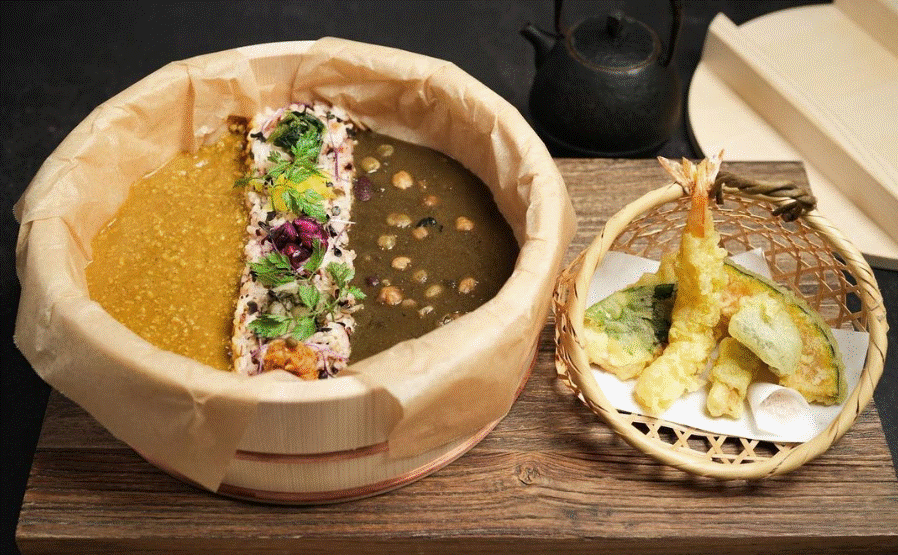
Japenese curry and tempura contain gluten unless othewise specified
(Photo: Curry Koisus)
The section the essential things when preparing your trip will detail this aspect by listing ingredients and dishes contaning unsuspected gluten.
The lack of awareness about celiac disease
Japan is part of those countries where restaurant staff and shopkeeper often have a limited knowledge about gluten and the ingredients that contain it.
However, it seems important to understand the context in which Japan fits in.
Japan reports about 0.2% of its population affected by celiac disease which is relatively low. In comparison, Western countries display around 1% of its population touched by the disease.
Researchers comes with several hypothesis to explain those figures.
Firstly, low level of person asking for medical diagnosis is reported and unlike Western countries, few scientific studies have been conducted leading to unreliable statistics. It is thought that the reported figure is below the real number of people affected by celiac disease.
Apart from the fact that the 0.2% communicated is under-estimating the reality, the authors still believe that Japenese lifestyle could explain a lower likelihood to develop the disease. In fact, some studies try to examine the impact of the diet during childhood on the onset of celiac disease. While studies draw contradictory conclusions, the question remains: do the contradictory findings arise because this parameter does not influence the onset of the disease, or is it due to the complexity of implementing such studies that leads to biases in the conclusions?
Finally genetic differences might partially explain the observed differences.
A separate article that will provide a more in-depth analysis of the studies will be published soon. So stay connected if you are interested in this topic.
You should now be best placed to understand why Japenese does not have the answer to »what contains gluten » and this is simply because they are not subjected to this question.
Knowing this, it is essencial that you do your own research before leaving. You will need to know among other things the products to avoid and culinary practices that can lead to cross-contamination. This will be further discussed in the trip preparation section.
Your understanding of the topic will be even more important knowing that wheat allergy is known in Japan. If you are not vigilant, your case could be associated to a « simple » elimination of the wheat by Japenese staff. This would be risky knowing that barley is certainly present in their dishes, dishes that you will need to avoid.
A tedious label reading exercice
The labelling is most the time like a lifeline to us, that piece of paper that clearly states the presence or absence of gluten. Overall, this will remain the same in Japan, I just want to draw your attention on 3 points.
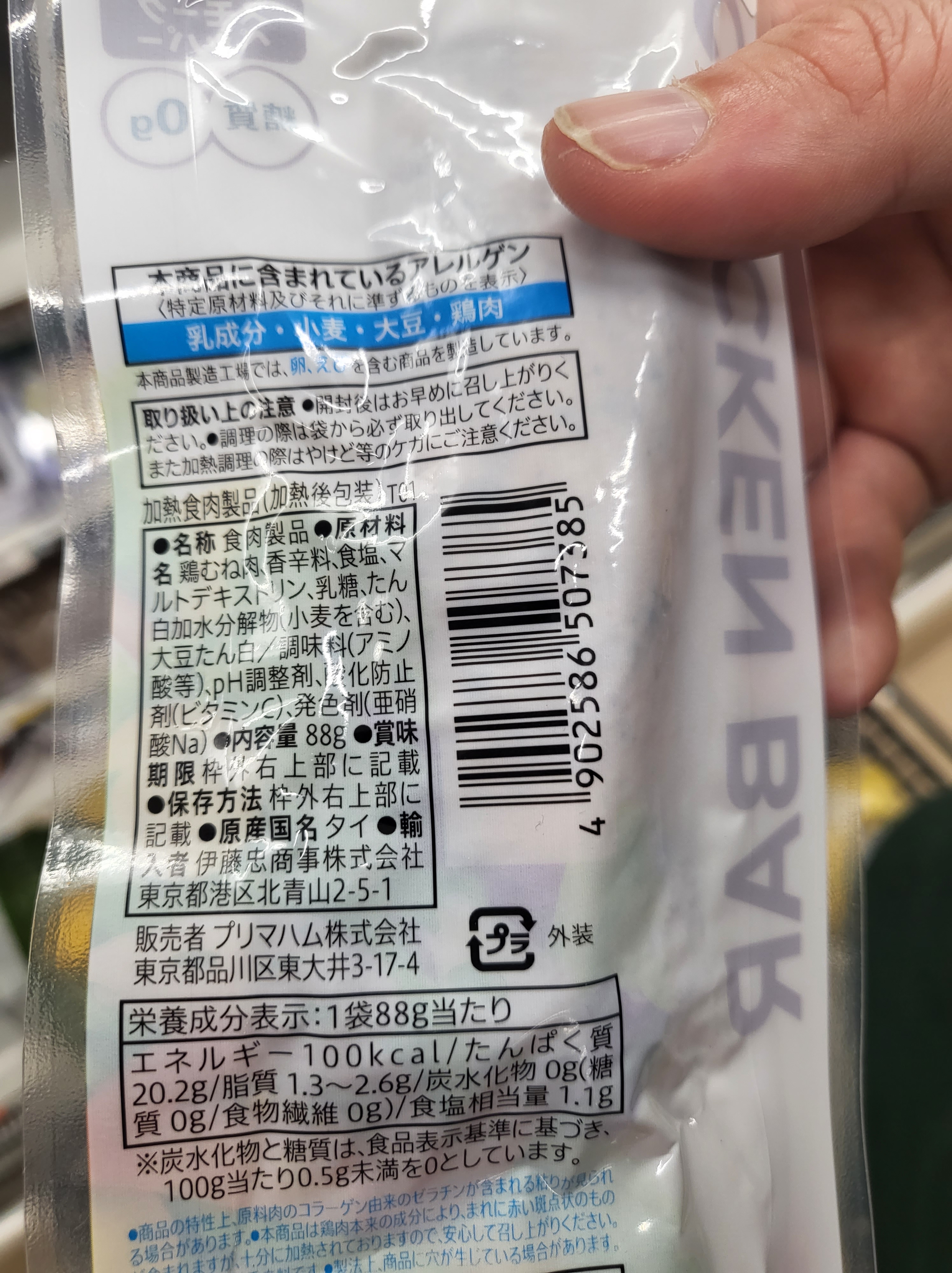
The first point regarding labeling is that in most of the case, everything will be written in Japenese and only in Japenese. You will see no trace of English. Hopefully for us, tools such as Google translate are now avaialble to help. Translation from a picture or voice recording translation are two life-saving features.
However, sometimes the translation provided can be confusing leading you to question its reliability: do all the ingredients appear right ? In case of doubt, don’t hesitate to ask someone, he will help you figure out the reality.
On the other hand, sometimes it’s not the translator that raises questions but rather the labels in itself. For example, I have come across Soba noodles in the supermarket. It was in a plastic bow in which regular soy sauce was separated from the noodles wit an individual packet. The translator clearly indicated the presence of wheat in the dish (which is reassuring), but I have never been able to understand if it came from the soy sauce only or also from the noodles. This lack of clarity seems to come from the labelling rather than the translation. From what I have read from different sources, manufacturers are becoming more aware of this and are trying to be more explicit. In this case, it would mean finding an inscription like: « wheat (contained in soy sauce) ».
Finally, allergen labeling is different from what can be found in most Western countries. The regulation only requires listing the 7 main allergens, in which wheat is a part, but not gluten. Barley or rye will be listed as ingredients, but they may not necessarily be included in the allergen list. This makes the task tedious for Japanese people and very complex for foreigners. It becomes a real game of « Where’s Waldo? » and even with a translator, you can waste a lot of time.

Cultural differences
You probably already know that Japanese culture is very different from ours, and that’s what will make your trip even more exotic. However, at times, it can also hinder your search for gluten-free options.
Systematically, I would ask if I could eat all or part of the menu. On several occasions, I was told that I couldn’t eat any item without being able to indicate where the source of contamination came from. I would leave feeling frustrated and wondering if it was to protect a trade secret or if it was to take no risks. By reading articles written by Japanese people, it seems that the latter option is indeed part of their culture and that in doubt, they potentially preferred not to take the risk of me getting sick by asking me to continue on my way. You may say that it is a positive attitude. To that, I would answer yes, without any doubt, but in a country where it is already difficult to eat gluten-free, it adds to the challenge. At certain times, I decided to take the risk of eating in these kinds of restaurants anyway, and I didn’t get sick. I don’t necessarily recommend it to you because each person decides the risk they want to take, but I think it is interesting to keep this aspect of their culture in mind.
As discussed earlier, celiac disease is largely unknown in Japan. However, the concept of gluten-free is not completely unfamiliar to them. It has been brought by lifestyle magazines mentioning this diet as healthy and followed by celebrities. Once you’re there, take the time to observe the gluten-free stores, and you will notice that many of them promote it by saying « It’s gluten-free, it’s good for your health. »
This leads the Japanese to think that your request is just a whim. However, it can be seen as extremely impolite to ask for a dish or even a menu to be adapted just out of desire. It is important to know that Japanese artisans are deeply committed to their craft and often spend their whole lives perfecting it to the extreme, not for money, but to provide the best service to their customers. Therefore, it is very important to explain the reason for your request and how much it is important for you. Personally, I went with a card that explained it clearly, and everyone I met was very kind and receptive (sometimes to the extreme, as mentioned above). So, I only experienced these situations through the readings I did before my departure.
Difficulties to speak in English
At the airport and in nearby train stations, everyone speaks English very well, which will allow you to join the country without any problems.
Outside of this context, Japanese people speaks little English or I should rather say are very shy about speaking a foreign language. If you ask them if they speak English, they will almost always answer « very little » even though you will be able to have a full conversation with them. The perfectionism and fear of making mistakes among Japanese people are not myths and are obvious in these kinds of situations.
Also I have read that Japanese people would primarily learn reading and writing in English, and the focus is less on speaking (on a side note the same educational pattern is used in many other countries such as France).
Furthermore, English is very different from Japanese, from sentence structure to pronunciation. We have met Japanese people who spoke perfect English but with a strong Japanese accent, which made understanding them more difficult.
Finally, I have read here and there that English proficiency is constantly improving, especially by starting the learning earlier on and placing more emphasis on oral skills. The organisation of the Olympics would also have been a good reason to learn the language. So, your experience will maybe be different from mine.
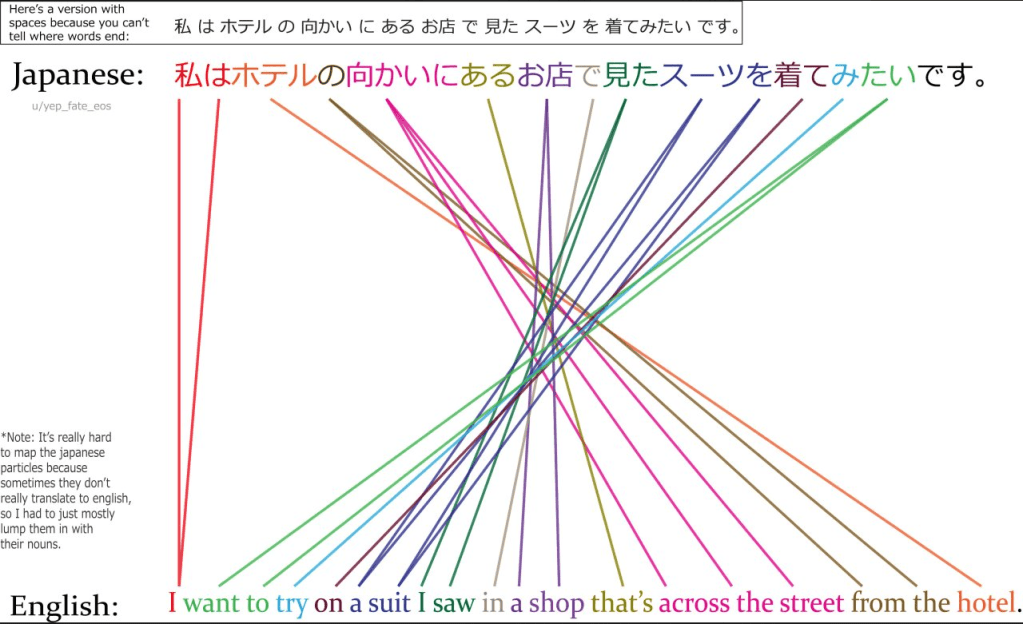
Illustration of the difference in sentence structure between Japanese and English
(source: https://awed-frog.tumblr.com/post/617561392469393408/whoa)
Also, despite this observation, the Japanese are very patient and they always took the time to communicate with us through gestures or with the help of an online translator. In the end we did not have any communication problems: another means was found to convey the message.
The essentials when preparing your trip
A good preparation for your trip will make your experience more enjoyable and comprehensive. This paragraph details the points I recommend you to consider before your trip.
Look for gluten-free options before you leave
This is something I did a lot when I started traveling, but I started neglecting it over time. I picked up this habit again to prepare for my trip to Japan, and I absolutely do not regret it. Preparing your culinary journey will allow you to fully enjoy your travel: it will prevent you from ending up hungry, sick, or frustrated because you couldn’t taste the local cuisine.
The hotels of a certain prestige generally offer gluten-free menus as they are regularly in contact with foreign people. Therefore they know what it involves.
Luxurious Japanese hotels can also adapt, and I was able to have my own experience in a ryokan that adjusted its menu to my dietary needs. I detail my experience below.
In international parks such as Disney and Universal Studio, restaurants have an allergen guide for each of their dishes. You should be able to eat safely without too much difficulty.
Outside of this specific context, it becomes more complicated. You will have to do your own research and sift through the information you find. Despite the fact that the disease is not well-known in Japan, it can be easy to get lost in your research.
So I tried to summarize all the information I could find (Google Maps reviews, Find me Gluten Free, Legal Nomads, establishment websites, Facebook groups…) on a map that I wanted to be a little different from the usual ones. It seemed important to me to include a number of filters so that you don’t have to click on each point one by one to find out if it meets your requirements. This way, you can find filters for the type of food offered, filter by opening day, or filter out establishments that only offer options versus full menus. and many more. The filters are cumulative, and I hope this tool will be useful during the preparation of your trip but also during your trip.
The map is available at the end of the article.
If you want to more address, I recommand you the following websites:
- The Facebook group Gluten-free in Japan! has by far been the most useful source of information for me. The group is very active and quickly answersto everyone’s inquiries. Many restaurants and businesses are already listed there and are regularly updated through the feedback from travelers.
- Find me gluten-free
- The website Legal nomads
- Google maps: I mainly use it to check the current practices of restaurants I have selected by looking at recent reviews. It also allows me to verify if the restaurant is still open! Between my restaurant search and my departure, one and a half months have passed and several of the restaurants on my list had closed in the meantime.
Finally, if you are short on time to plan your trip, do not hesitate to inquire about using the Gluten Free Tours Japan organization. I personally haven’t taken the time to study this solution, but several travelers have used it and come back with very positive reviews about it.
Prepare your allergy card
As mentioned above, it seems essential to have a card explaining precisely what your diet involves.
For my part, I used one shared in the Facebook group Gluten-Free in Japan! If you go to the file tab, you will find different allergy cards and you can select the one that suits you best. Most of them are commented by travelers who already tested it, so feel free to take a look.
For the most sensitive, it can be more reassuring to rely on « official » cards. Legal Nomads offers ones that have received very positive feedback.
Learn the pitfalls to avoid
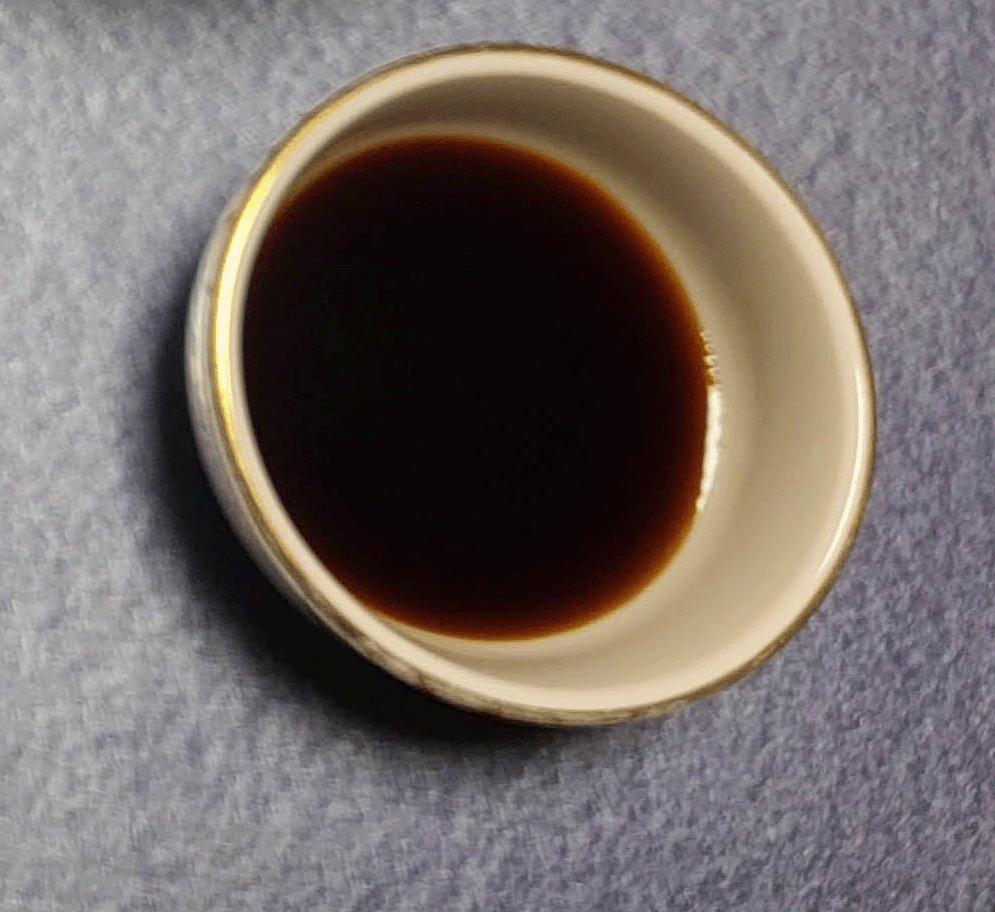
- Soy sauce: Although gluten is not always present, it is often the case. If you hear about shoyou, it should raise a red flag in your mind. Tamari sauce, on the other hand, represents the traditional method of production and is gluten-free. An entire article explaining the interest of wheat in soy sauce production and the differences between gluten-containing and gluten-free soy sauce will be coming soon.
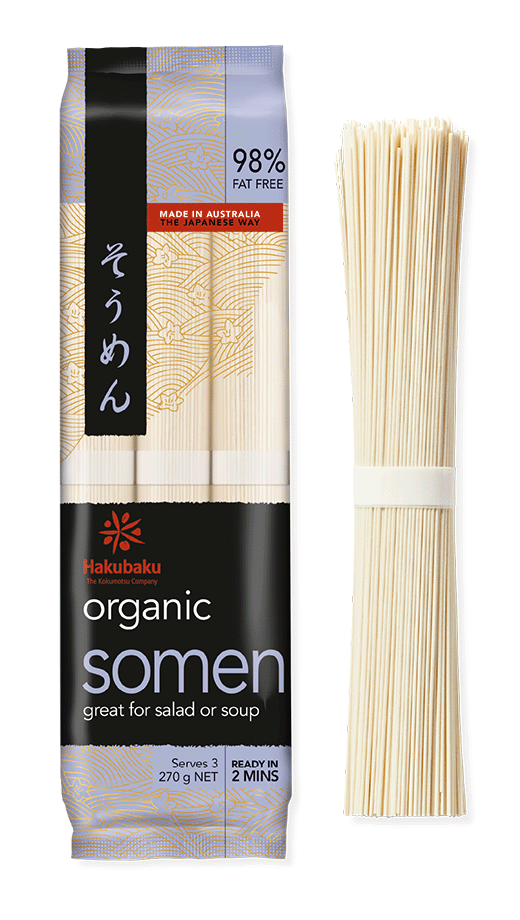
- Most noodles: You may hear here and there that noodles in Japan are safe because they are made from rice flour. The reality is quite different. Udon, which is one of the most commonly consumed noodles in Japan, is made from wheat; ramen noodles also contain gluten, as do sômen noodles despite their white color. Traditionally, soba noodles do not contain gluten and are made solely from buckwheat, but nowadays they are more and more cut with wheat. In conclusion, be cautious of noodle-based dishes and unless indicated otherwise, assume that they contain gluten.
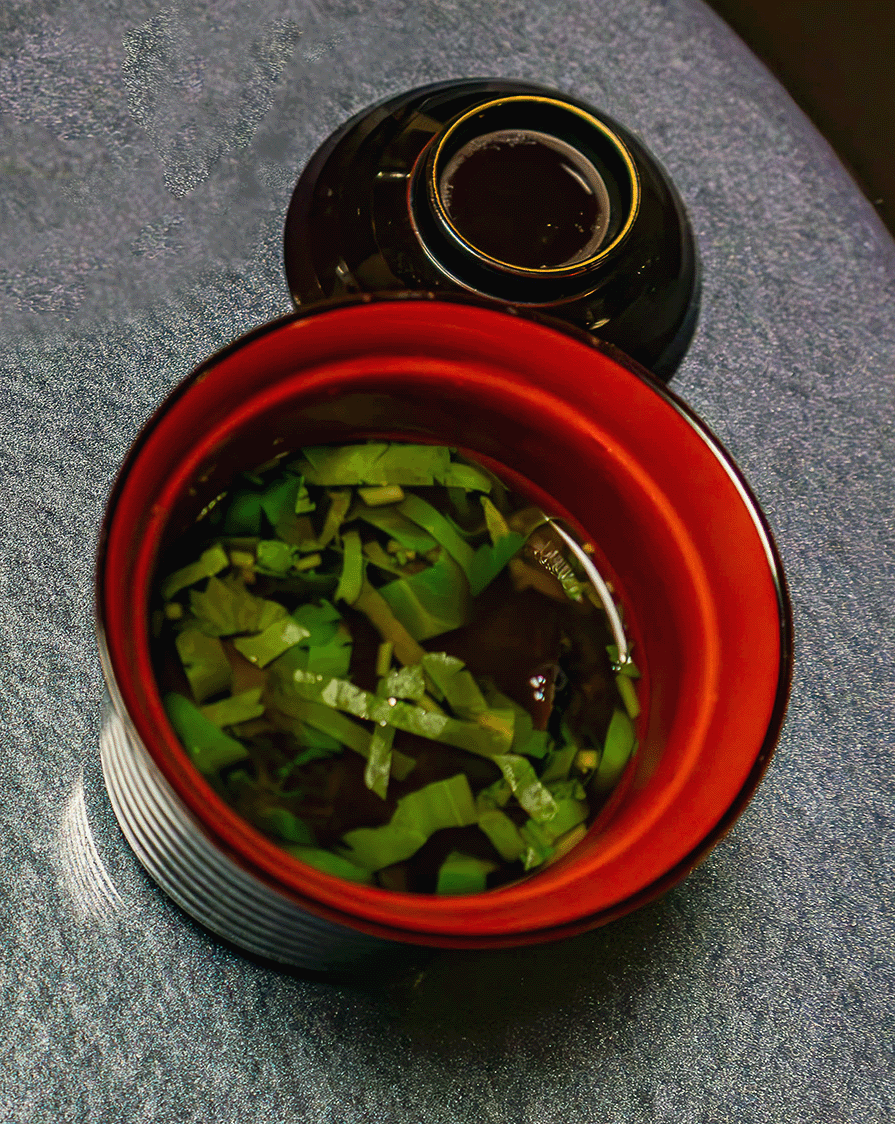
- Miso is a fermented paste. There are several manufacturing recipes. Mugi miso is made from barley and therefore contains gluten.
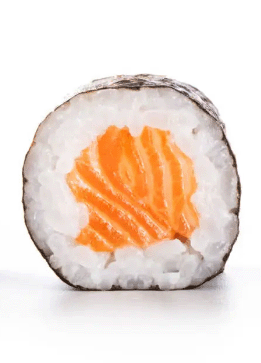
- Sushi: In this case, the source of gluten can come from various elements. It can come from the meat, which is sometimes marinated in sauces that contain gluten. The rice can also be prepared with malt vinegar instead of rice vinegar. Be cautious of sushi with surimi as well. This crab-flavored paste is often made with wheat starch and sometimes the restaurant staff will not be aware about it. This is why you need to be cautious when it comes to sushi.
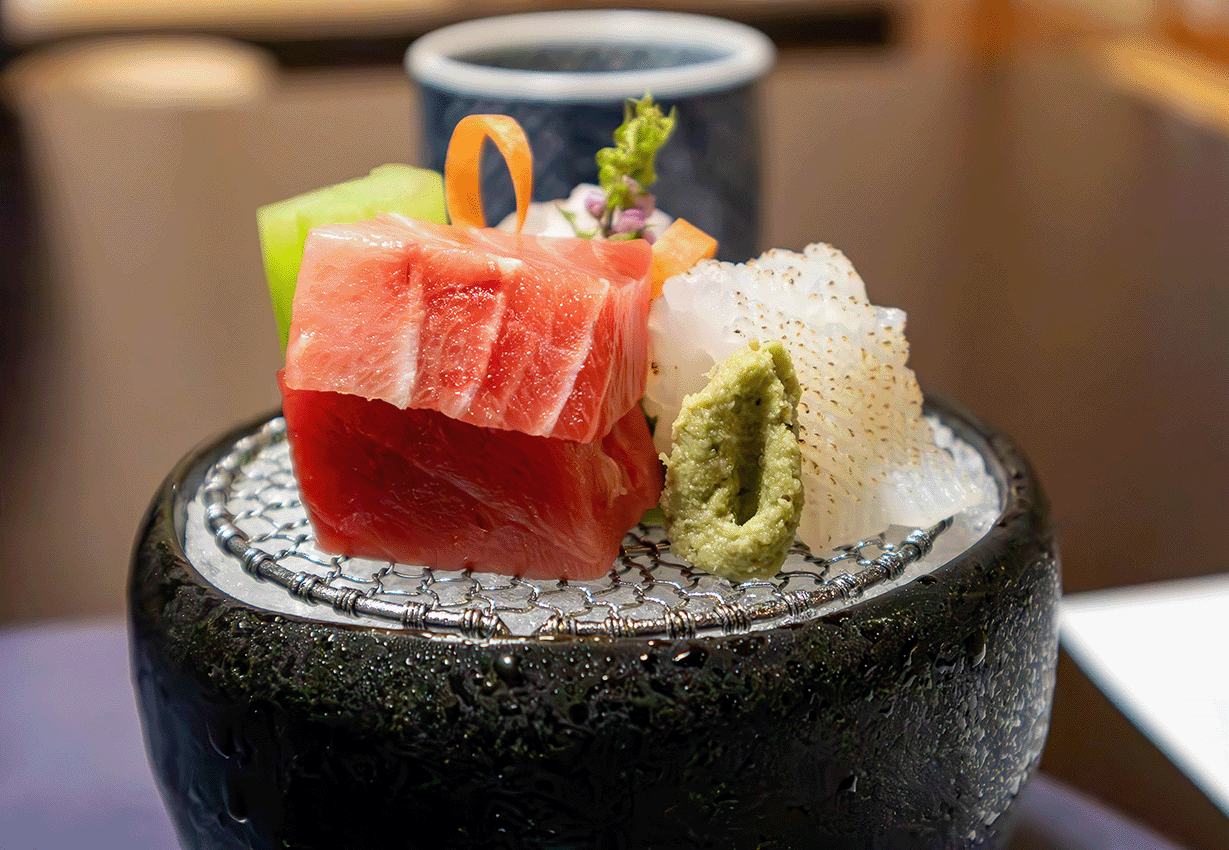
- Wasabi: Cheap wasabi sometimes contains gluten.
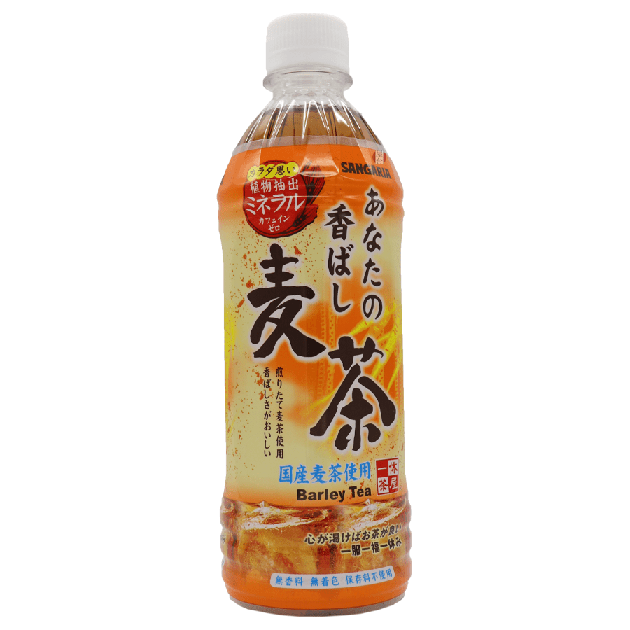
- Mugi-cha: This is a tea made from barley, very popular in Japan. Despite its name, it does not contain tea and consists simply of roasted barley grains infused in water. This means you also need to be vigilant about the « tea » that may be served to you. On the other hand, Genmai (roasted rice infusion) and Sobacha (roasted buckwheat) are beverages that can be consumed. There are many variations of mugi-cha, and you can find barley-infused drinks in beverage vending machines. Caution is advised.
- Japanese curries generally contain gluten due to the soy sauce or flour that may have been added to them, unlike Indian curries, which are usually gluten-free.
Learn some basic words
I had skipped this part a bit before leaving, but I had learned a few words like wheat, allergy, soy sauce. I was able to recognize them in some conversations, which reassured me, but it was never critical for me to know them (most of the time, I used Google Translate).
– Wheat : komugi (小麦)
– Barley : oomugi (大麦)
– Soy sauce : shouyu (醤油)
– Gluten : fushitsu (麩質)
– Gluten-free : Guruten Furîグルテンフリー
–I am allergic to … : … ni taishite arerugî ga arimasu. (… に対してアレルギーがあります。)
Download translator apps
Download applications that can help you translate an image (this will be valuable when you come across labels) as well as voice messages (so you don’t have to type everything). Google translate is a good option. Also, during my research for this article, I also found that Waygo was a good alternative for translating labels (I had not the opportunity to test it).
Take your soy sauce
C’est un conseil que vous retrouverez quasiment de partout. J’étais un peu dubitative mais je l’ai quand même fait. Aujourd’hui je pense qu’il n’y a pas de doute à avoir et embarquez un peu de sauce soja sans gluten.
Qu’il s’agisse de shabu-shabu, yakiniku et autres restaurants qui ne font pas mariner la viande au préalable, votre sauce soja aura toute sa place.
Book accomodations with a kitchen
I would say that this point is not absolutely necessary. You will always find something to eat in konbini (convenience stores). However, it can quickly become redundant as the choice remains limited. Having a kitchen in certain accommodations will allow you to diversify your meals without spending endless time in supermarkets translating all the labels or avoiding another discussion at a restaurant to explain your situation and hope that the message was well understood.
Bring some gluten-free food
It’s the question I ask myself every time: is it really necessary to bring gluten-free products? Am I being not overreacting? Usually, I decide at the last moment based on the space left in my bag.
Regarding Japan, I advise you to bring some products. It’s a bit like the kitchen: if you don’t do it, you won’t starve and you will always be able to get another onigiri, but having your own little snacks or nibbles will bring you some comfort, it will prevent you from getting hungry, and it will allow you to vary the flavors.
Then if you have a little space left, I recommend it: whether it’s energy bars, cookies, bread that you eat with local jams…everything is good to take.
Also, depending on the itinerary you have chosen, plan for more or less food. In big cities, it will be less critical than in more remote areas.
Where to eat ?
Finding safe places to eat gluten-free in Japan can be a challenge, but don’t worry! This section presents options for gluten-free eating by sharing great addresses or providing tips for finding products in local stores and grocery stores.
Restaurants
After having read the previous paragraphs, you may be wondering, « but what can we eat? »
The list of restaurants offering gluten-free options or dedicated to gluten-free has already been mentioned to prepare for your trip. You can find it on the interactive map available at the end of this article. If you want to find other good addresses, I recommand you to visit Find me gluten free, Gluten-Free in Japan!, the website of Legal nomads, which is regularly updated, or Google maps.
Now, let’s imagine that you are in Japan, it’s noon, and you haven’t made a reservation, and all the restaurants are full, or you have planned an itinerary without any gluten-free restaurants nearby. You still have the option of eating the food you could have brought. You can also go to konbini to find some food (this point will be detailed in the next paragraph). Finally, depending on your sensitivity and the establishments, you can venture into what I will call the gray area: there are associated risks, but if you ask all the right questions, they can quickly be alleviated.
- Yakitori stalls: Yakitori is a skewered meat dish. Some may be marinated in sauce (tare yakitori), which you won’t be able to eat. Shio yakitori is seasoned simply with salt. In this case, the main risk lies with the grill, which can be a source of cross-contamination. Some people report positive experiences, but it greatly depends on the staff, the cleanliness, and the utensils used. So, if you’re interested, make sure to inquire and choose accordingly.
- Yakiniku: Yakiniku means grilled meat, and going to these restaurants allows you to experience Japanese barbecue. Depending on the restaurant, there may be a central grill or individual grills on the table for you to cook your meat. The sauces are usually served separately. The problem here, just like with yakitori, is not the sauces but the grill itself. Inform the staff about your situation, and most of the time they will take extra care to clean the grill. Ask if they have a common or individual grill, as this will determine whether everyone needs to follow the same dietary restrictions. Finally, sometimes the meat comes on a leaf that is placed directly on the heat source, so your food won’t be on direct contact with the grill, which can be reassuring. Also, ask if they have tamari sauce, otherwise inquire if you can use your own.
- Shabu-shabu: This is a Japanese hot pot dish. A broth, slices of raw meat, and vegetables are served, and the sauces are used once the meat is cooked. Before diving into this adventure, ask for the broth to be prepared only with konbu (an edible seaweed) or even just with water if you have any doubts about the origin of the konbu. It’s better if dashi is not used, or inquire about its source (when pre-made dashi is used, it usually contains gluten). Lastly, ask if they have tamari sauce, or inquire if you can use your own.
- Sushi: This has already been discussed as a dish that can potentially contain gluten due to the rice, meat, and wasabi. Make sure to inquire about the restaurant’s practices to determine whether it is safe for you to eat there or not. The chain Kura Sushi is often mentioned as a safe option. I haven’t personally tried it, but I saw on their website a detailed list of allergens for each dish as well as people mentioning the presence of gluten-free soy sauce upon request.
- Soba: Most soba restaurants, even if not specifically advertised as gluten-free, should be accessible to you. Beforehand, ask if the noodles they use are 100% buckwheat. Clearly explain your situation so that they pay special attention to the utensils used. In most cases, the only available option will be cold soba without any pre-seasoning. Zaru soba and mori soba are two variations that can accommodate a gluten-free diet. The difference between the two is that zaru soba has seaweed placed on top of the noodles. These dishes are served with finely chopped scallions and salt for seasoning, sometimes with olive oil as well. You can also complement them with an omelet. Don’t forget to bring your gluten-free soy sauce to enhance the flavors.
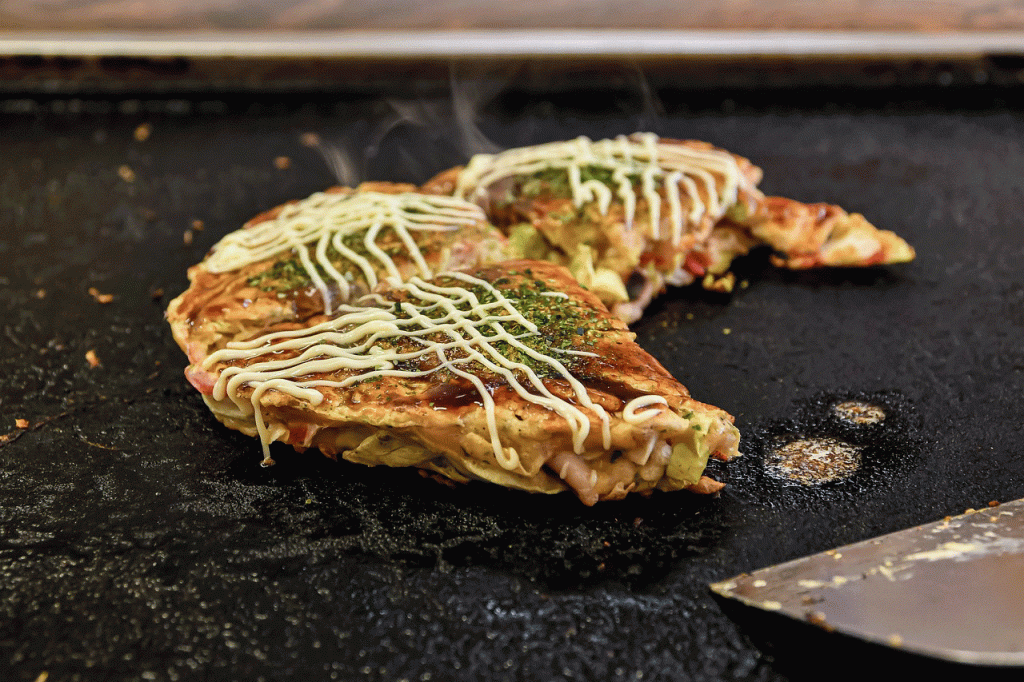
- Gluten-free okonomiyaki: Okonomiyaki is a dish made with cabbage and meat, coated with a batter that is a cross between an omelet and a pancake. The Hiroshima variation is prepared with a layer of noodles (udon or soba). It is then topped with sauce and mayonnaise. Despite the recipe being gluten-rich, many restaurants offer a gluten-free version. However, in most cases, the dish will be cooked on a shared teppanyaki grill. Many people have tried this and reported positive experience. Make sure to gather information and carefully observe the practices of the establishment before giving it a try.
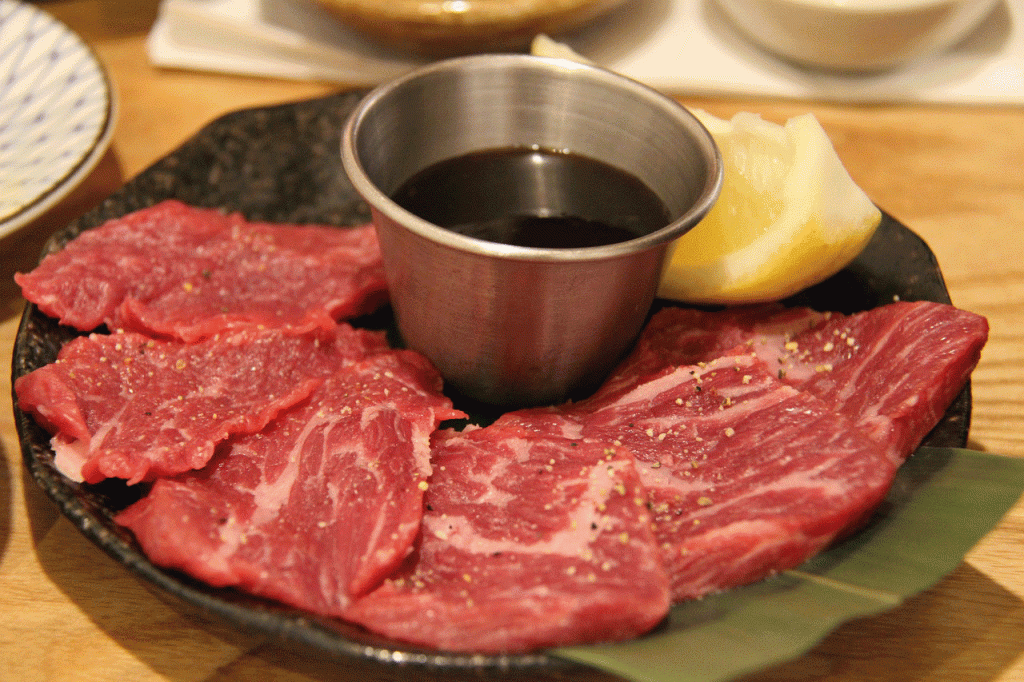
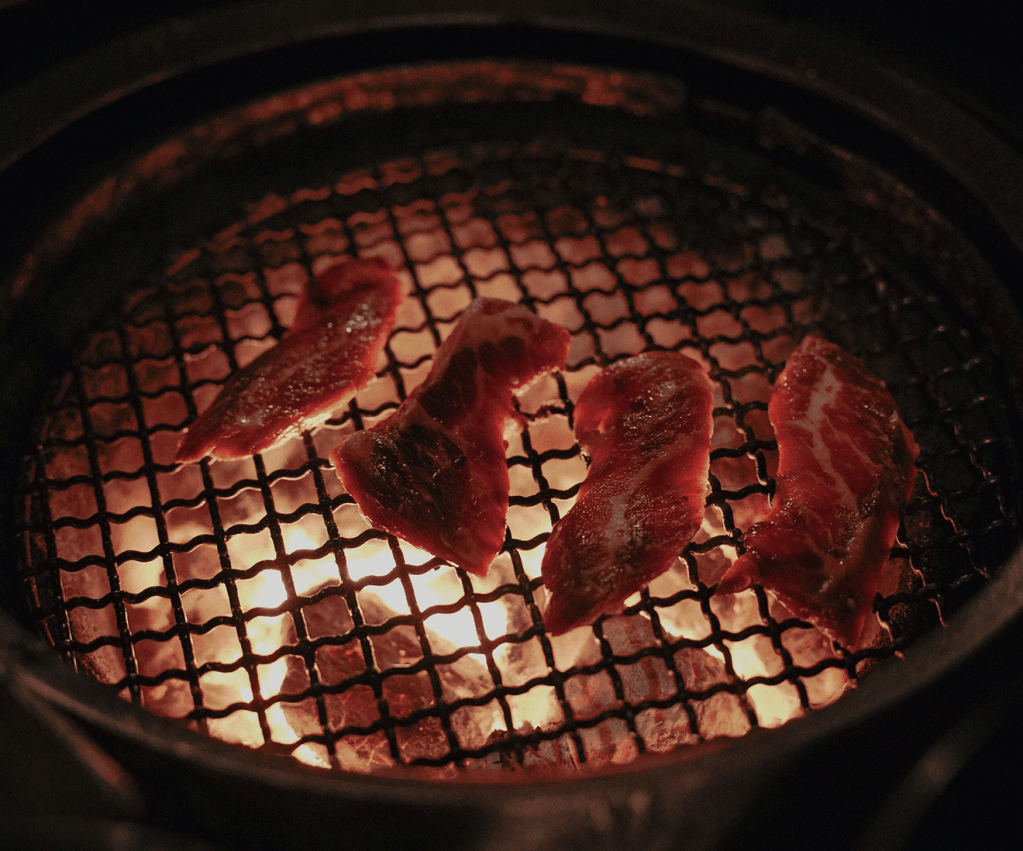
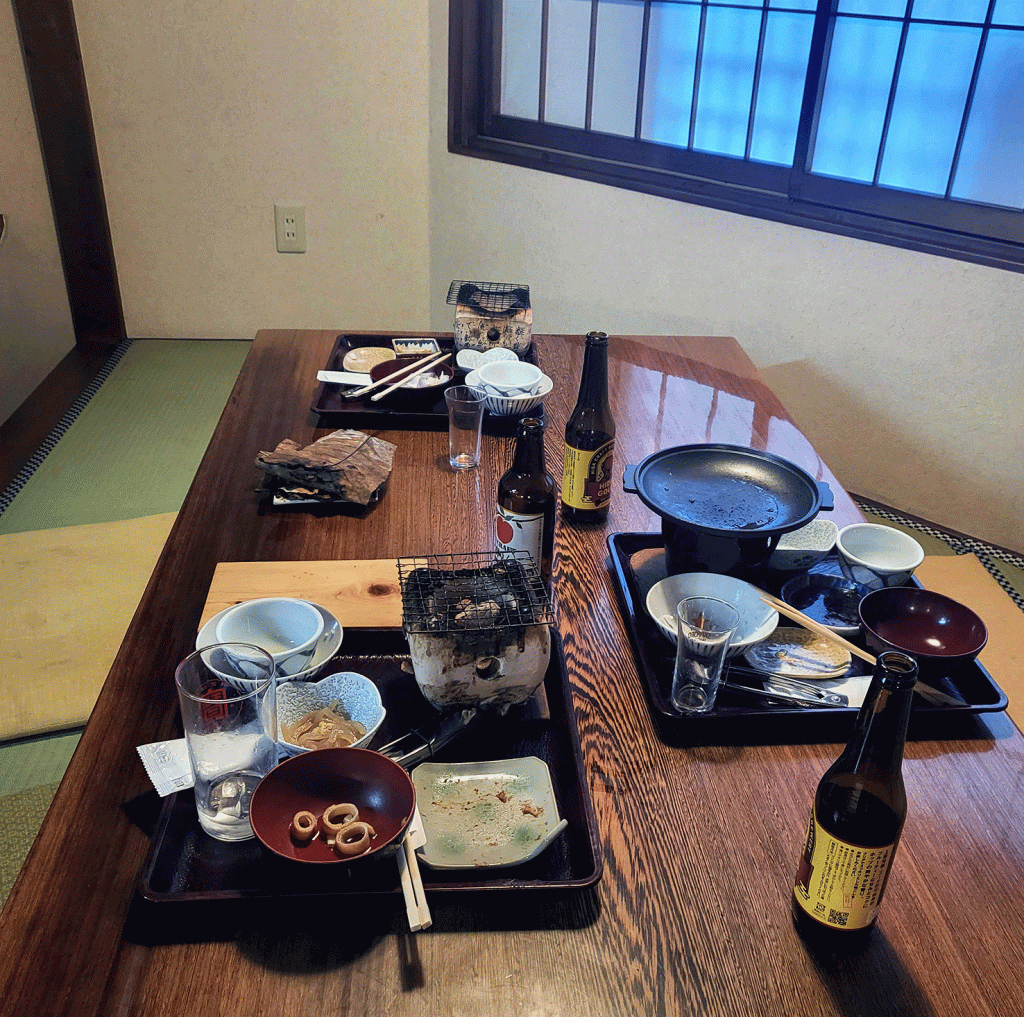
Yakiniku: The meat is served separately from the sauces. It can be cooked directly on the grill or on a leaf (the leaves are visible after cooking in the last photo). The meat can be cooked on charcoal or on a hot plate as seen in the last photo.
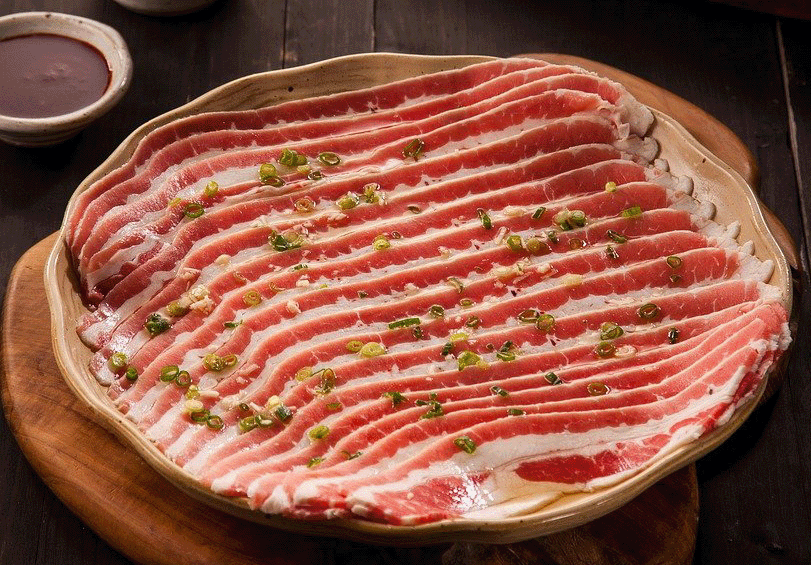
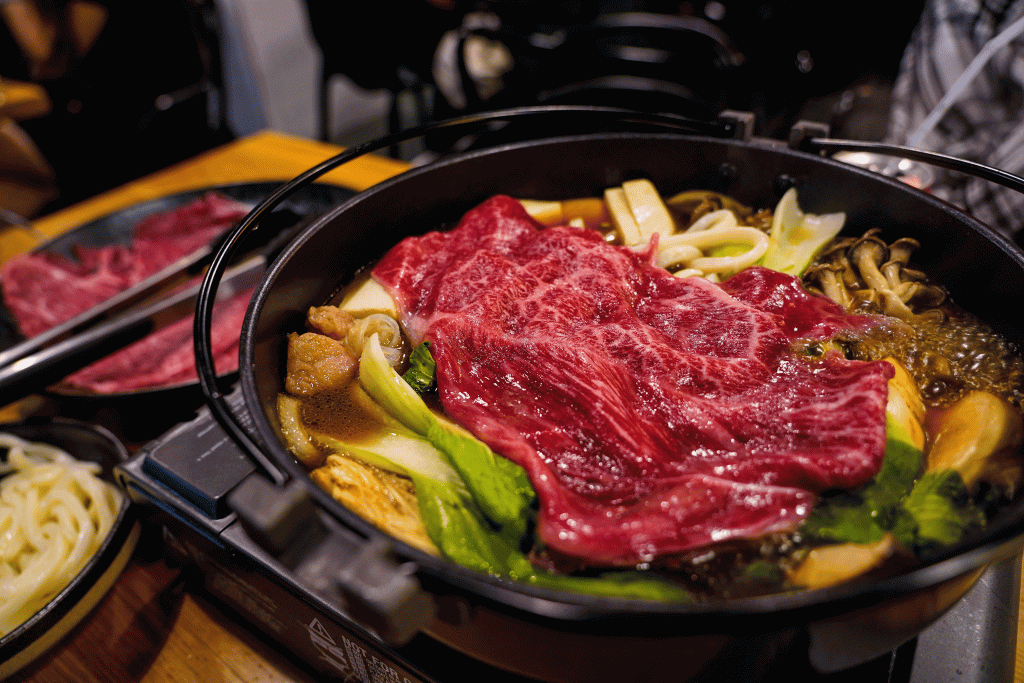
Shabu-shabu: The meat arrives without sauce and is cut into very thin slices. The entire dish (meat and vegetables) is cooked in boiling water at different timing (meat first, then the vegetables). Make sure that only a minimum amount of ingredients are added to your cooking water (konbu is usually fine, but be more cautious with dashi).
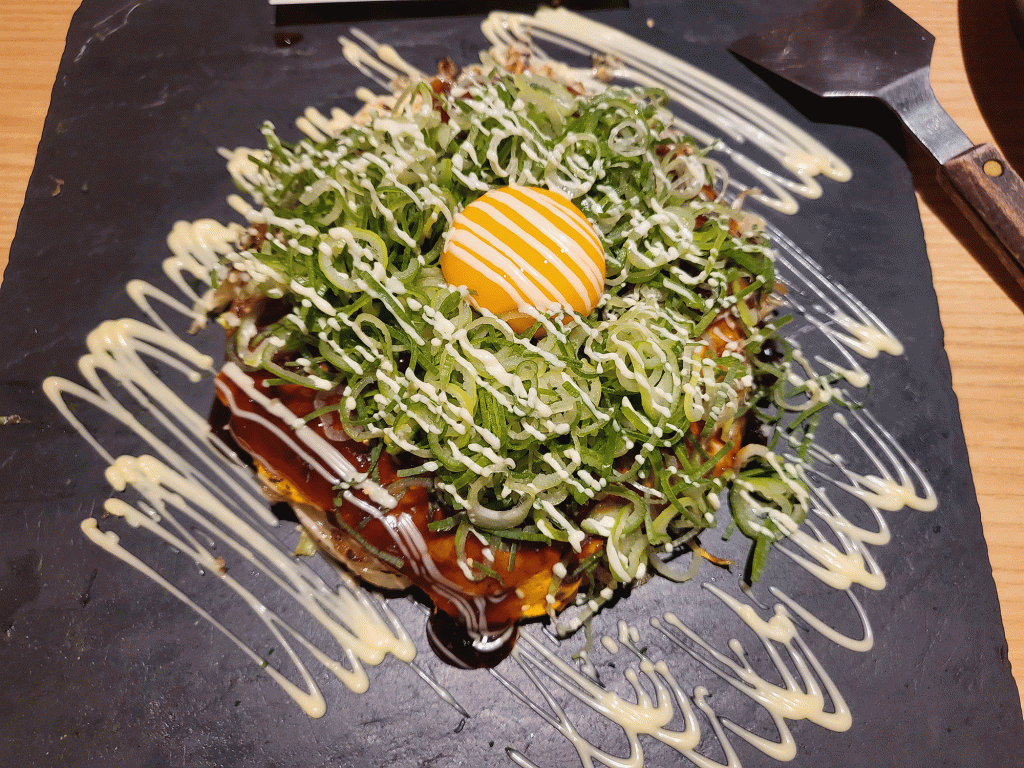
Stores and groceries
Konbini (7/11, Family mart or Lawson) will be your best friends during this trip. Despite the fact, they don’t offer certified gluten-free products and the fact they present a limited number of products that do not contain gluten, their big advantages are their opening hours (24/7) and their omnipresence (you’ll literally find them at every corner in the cities). Couldn’t make it to the restaurant you wanted? Feeling a little hungry? Hello, the nearest konbini.
Here is a non-exhaustive list of products you can find:
- Onigiri: still, make sure to check with your translator that the version you choose does not contain gluten.
- Hard-boiled eggs: be careful with those cooked in soy sauce, you will easily recognize them.
- Salads: some do not contain soy sauce.
- Cooked sweet potatoes.
- Drinks.
- Snacks such as yogurts or dried fruits.
You can always try the organic stores you will find on your way. I have tried several and every time I found gluten-free products such as pasta, biscuits and chocolate.
The following stores are chains that offer gluten-free products (prefer searching in Japanese to find all locations): Natural House (ナチュラルハウス), Bio-ral (ビオラル), Bio C Bon (ビオセボン), and Natural Lawson (ナチュラルローソン).
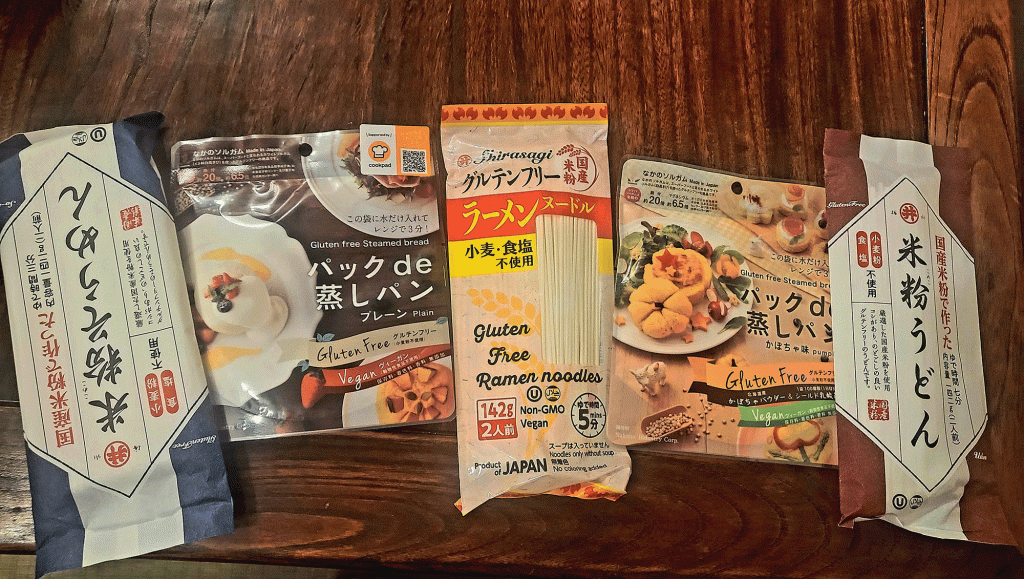
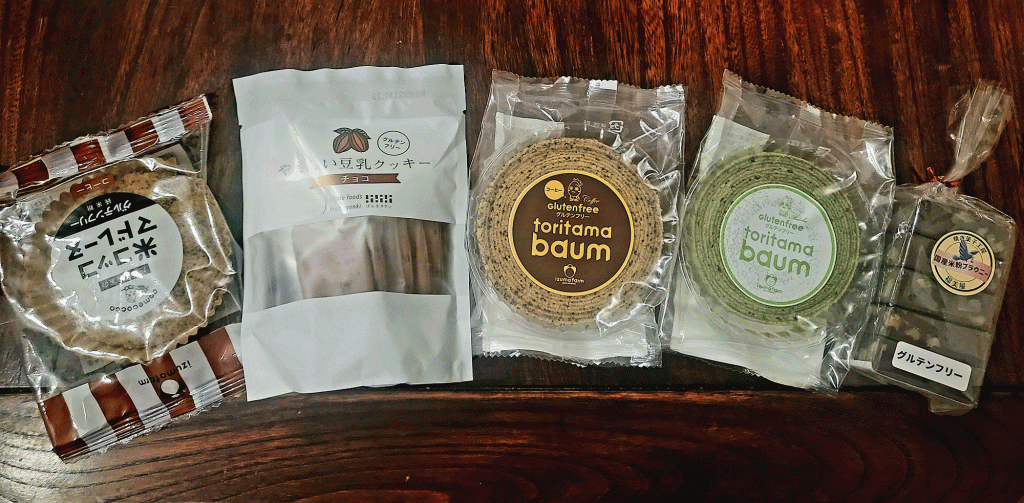
Gluten-free products bought at Bio-Ral in Shinjuku. It only represents a part of the gluten-free products available.
My experience
I present here some of the addresses that I have tested in Kyoto, Miyajima, Hakone, and Tokyo.
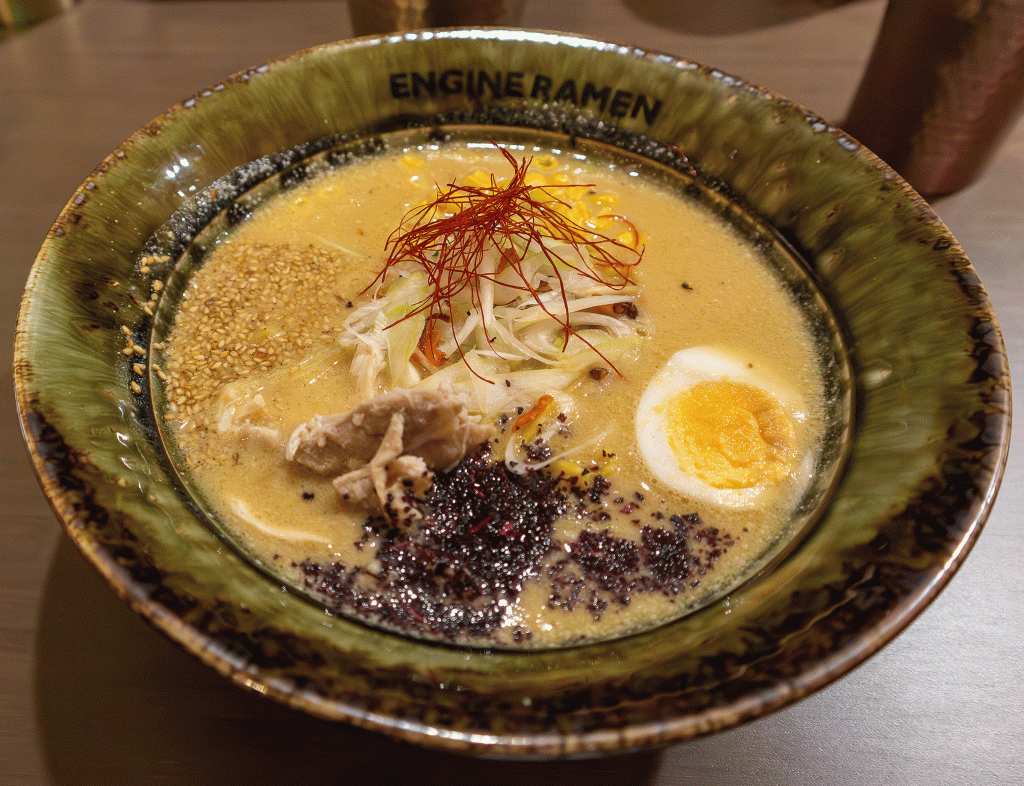
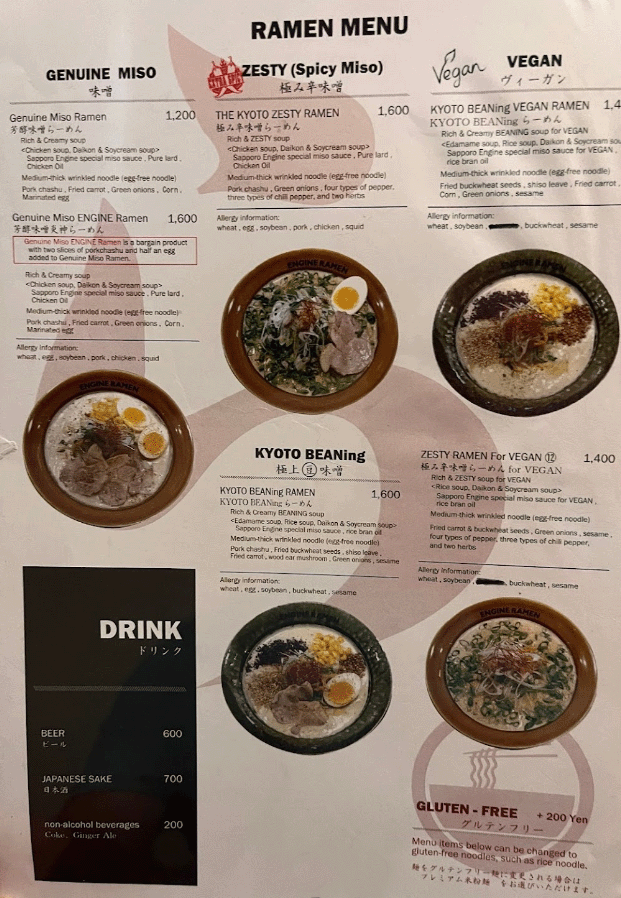
Engine Ramen – Kyoto – GF friendly – Full menu available – Speciality: Ramen
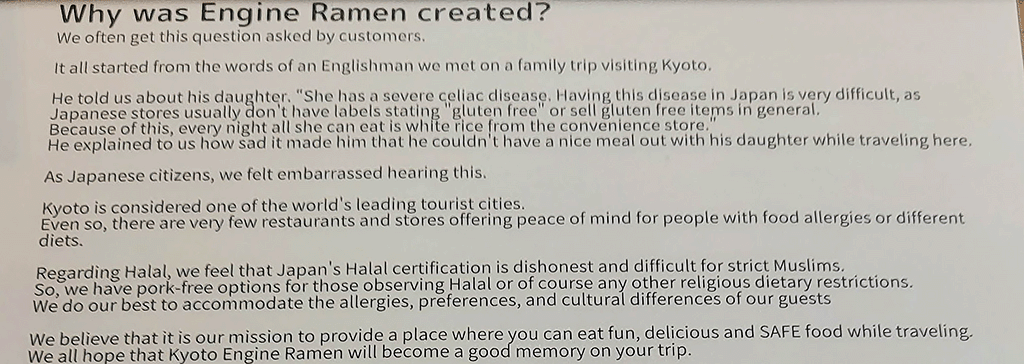
Engine Ramen is a restaurant located in Kyoto that offers gluten-free ramen. While the establishment is not exclusively dedicated to gluten-free options, the staff is very knowledgeable about celiac disease. All the ramen dishes on the menu can be adapted to gluten-free diet. I really appreciated everything about this restaurant, from the ambiance to the food.
I also highly recommend trying the sake offered by the restaurant, which is smooth and delicious.
Here, there is no long queue. Show up at the restaurant and if there is a wait, they will add you to the list and tell you at what time to come back. We went there twice and had to come back 45 minutes and 1 hour later. We walked around the adjacent streets and took the opportunity to do some shopping. For your information, Nishiki Market is just a few steps away from the restaurant, and we managed to find some stalls that were still open.
Follow this link to find its location on Google Maps https://maps.app.goo.gl/qtRHAzpn7JvwKKep8.
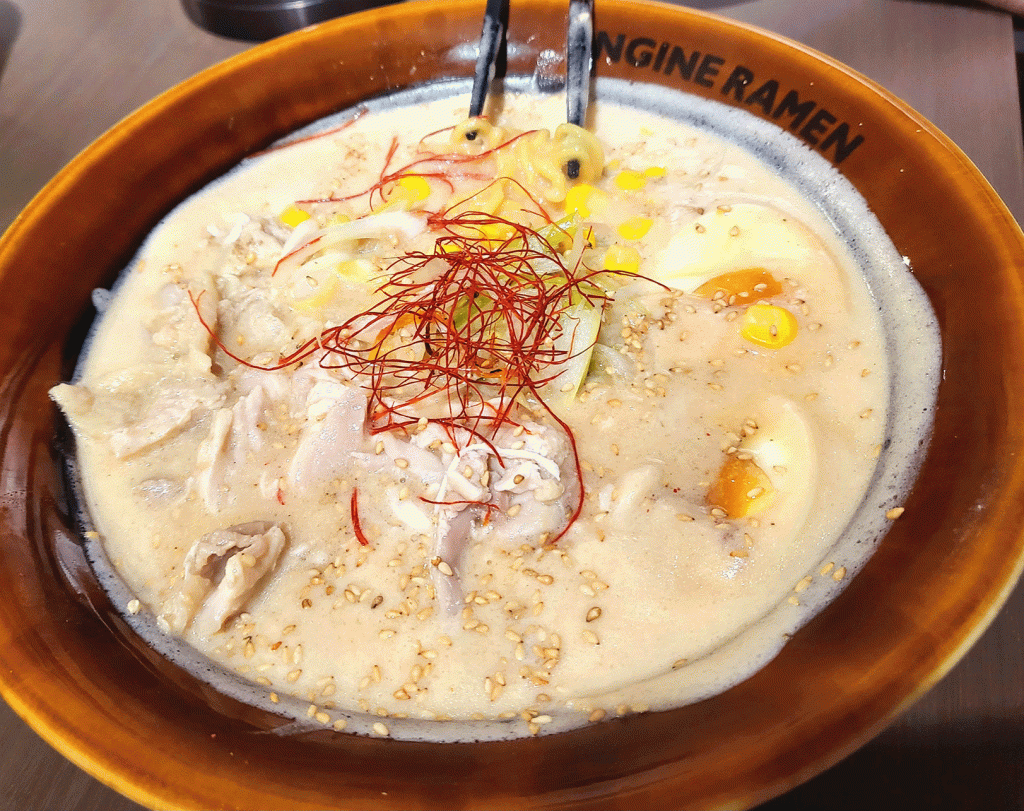
Gion soy milk ramen Uno yukiko – Kyoto – 100% GF – Full menu available – Speciality: Gyoza, ramen
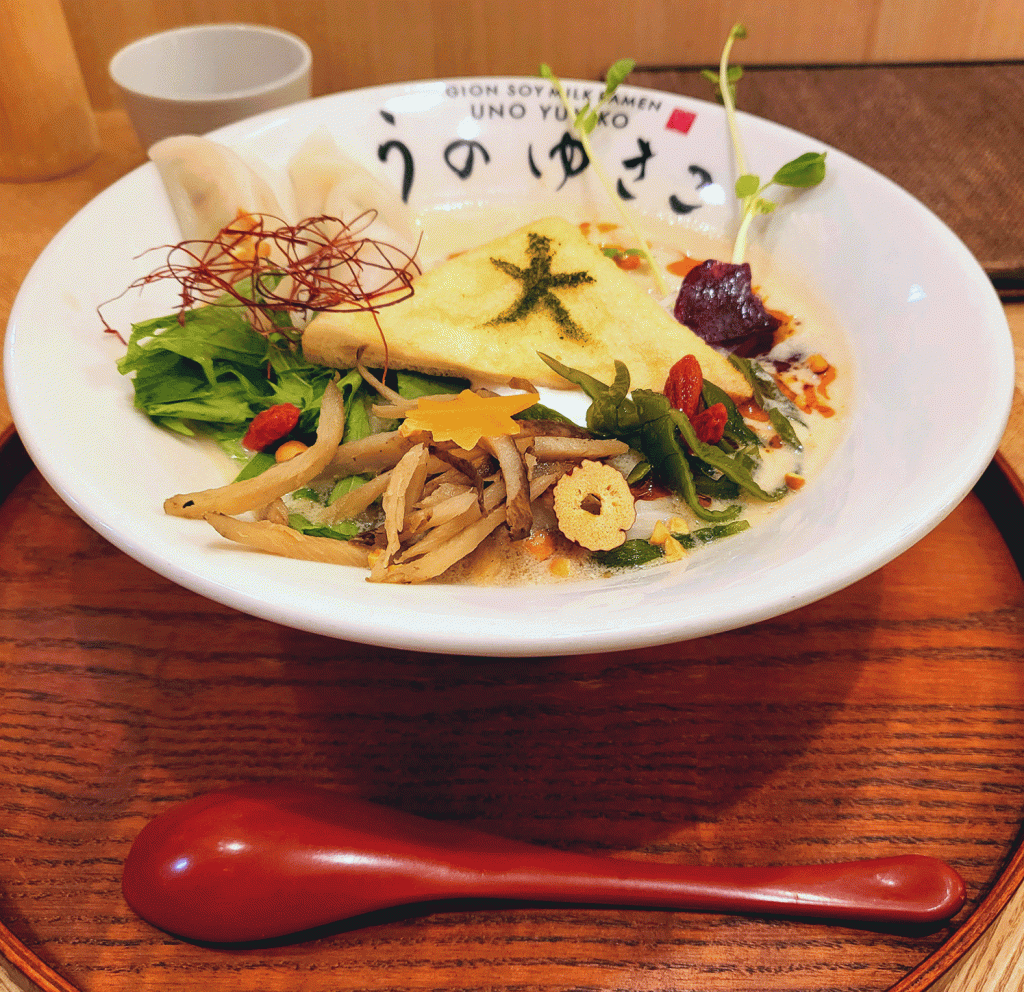
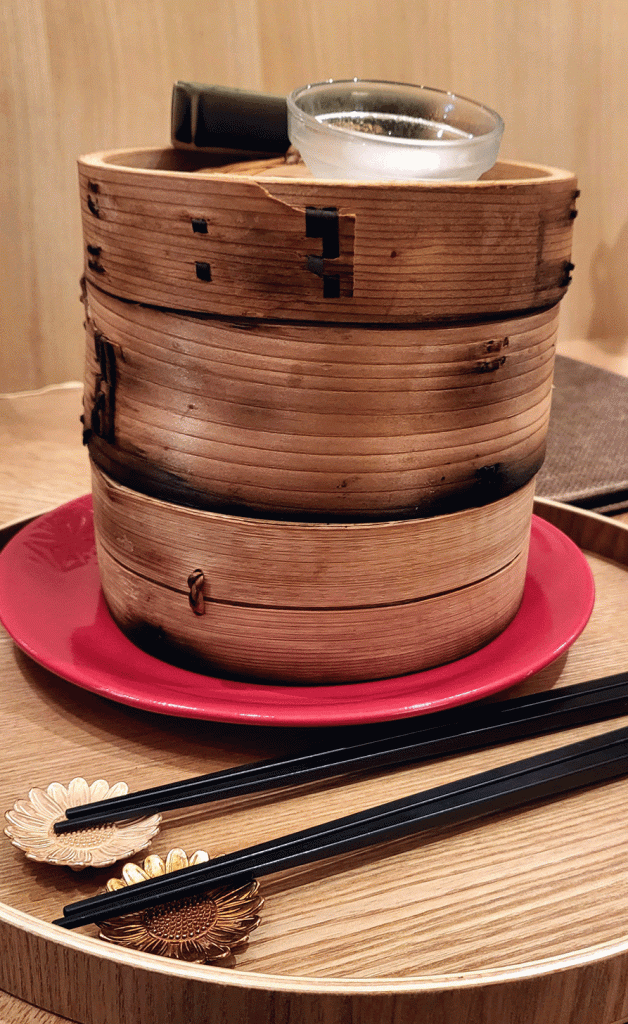
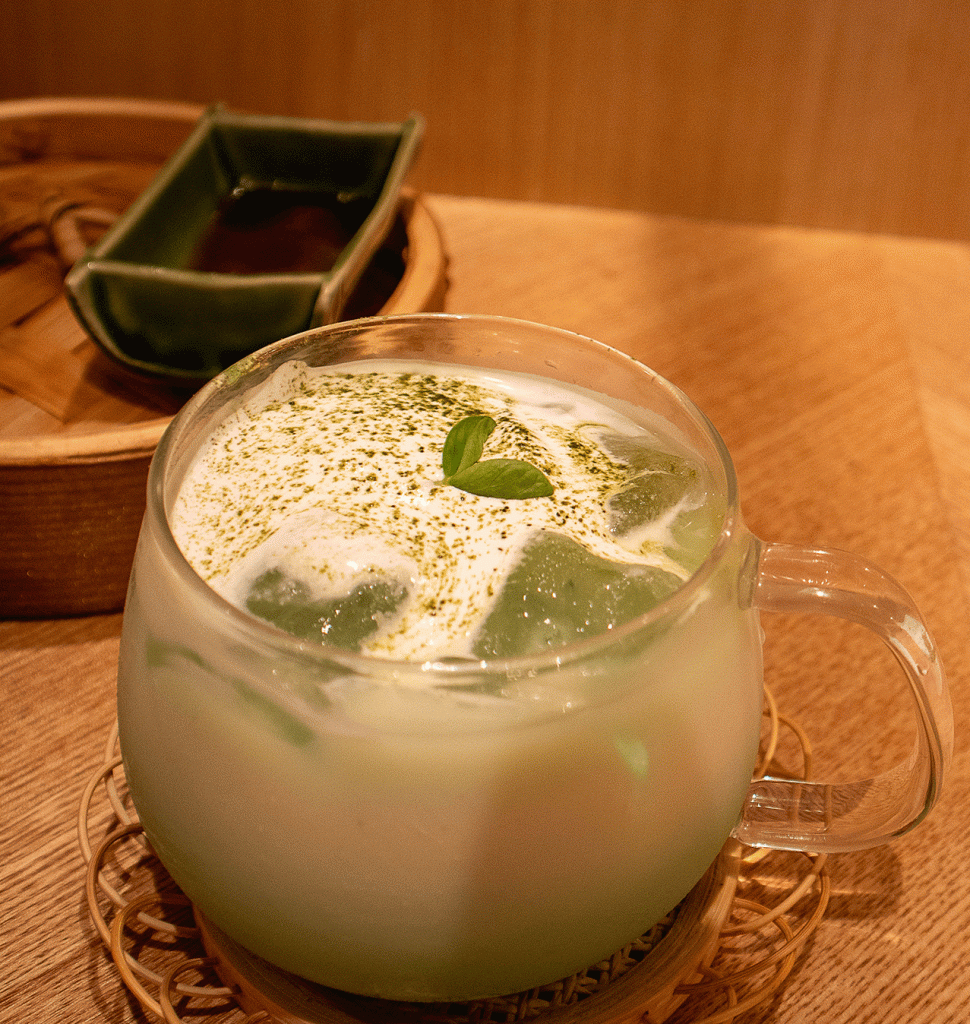
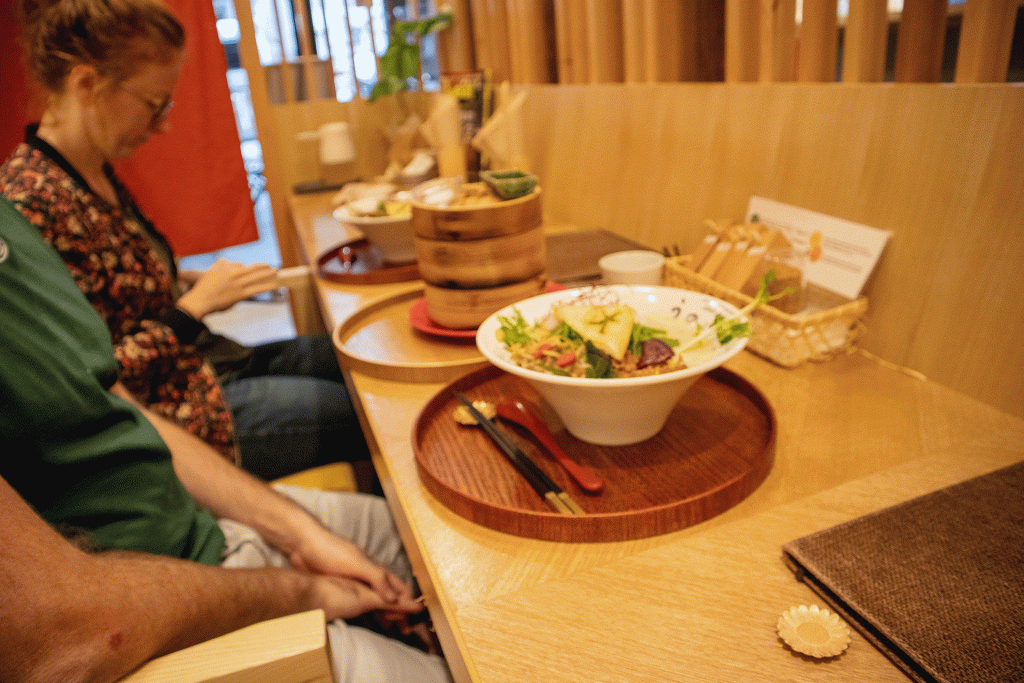
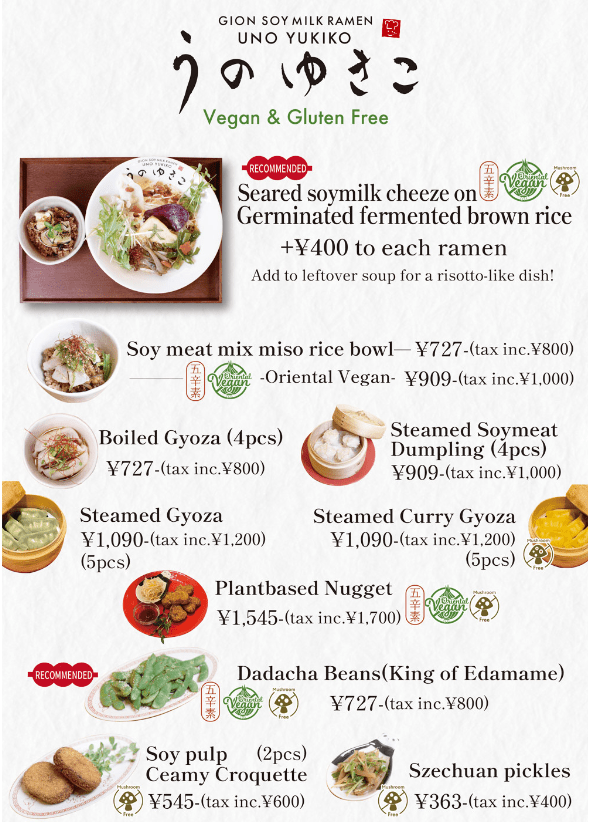
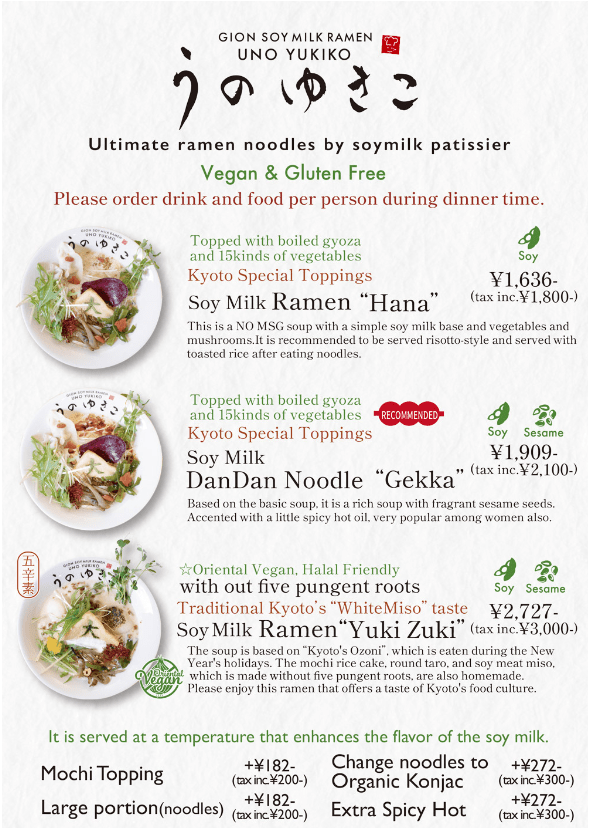
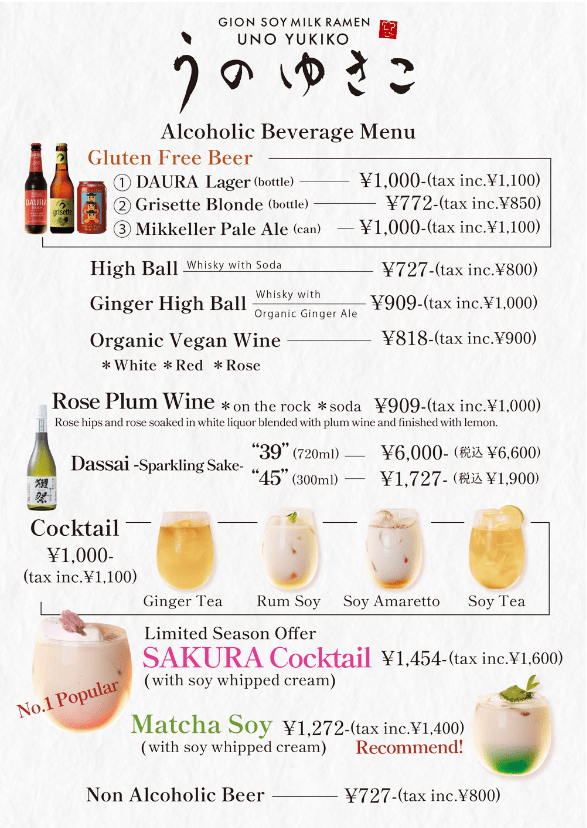
Gion Soy Milk Ramen – Uno Yukiko is a vegan and gluten-free restaurant located in Kyoto. They offer Japanese dishes such as gyoza and ramen. The atmosphere is very traditional, and the dishes are full of flavors.
Gluten-free snacks are available for purchase at the counter.
Follow this link to find its location on Google Maps
https://maps.app.goo.gl/dKVF9DXFsuXyywnH7
For more information, visit their website at
http://soymilkramen.com/.
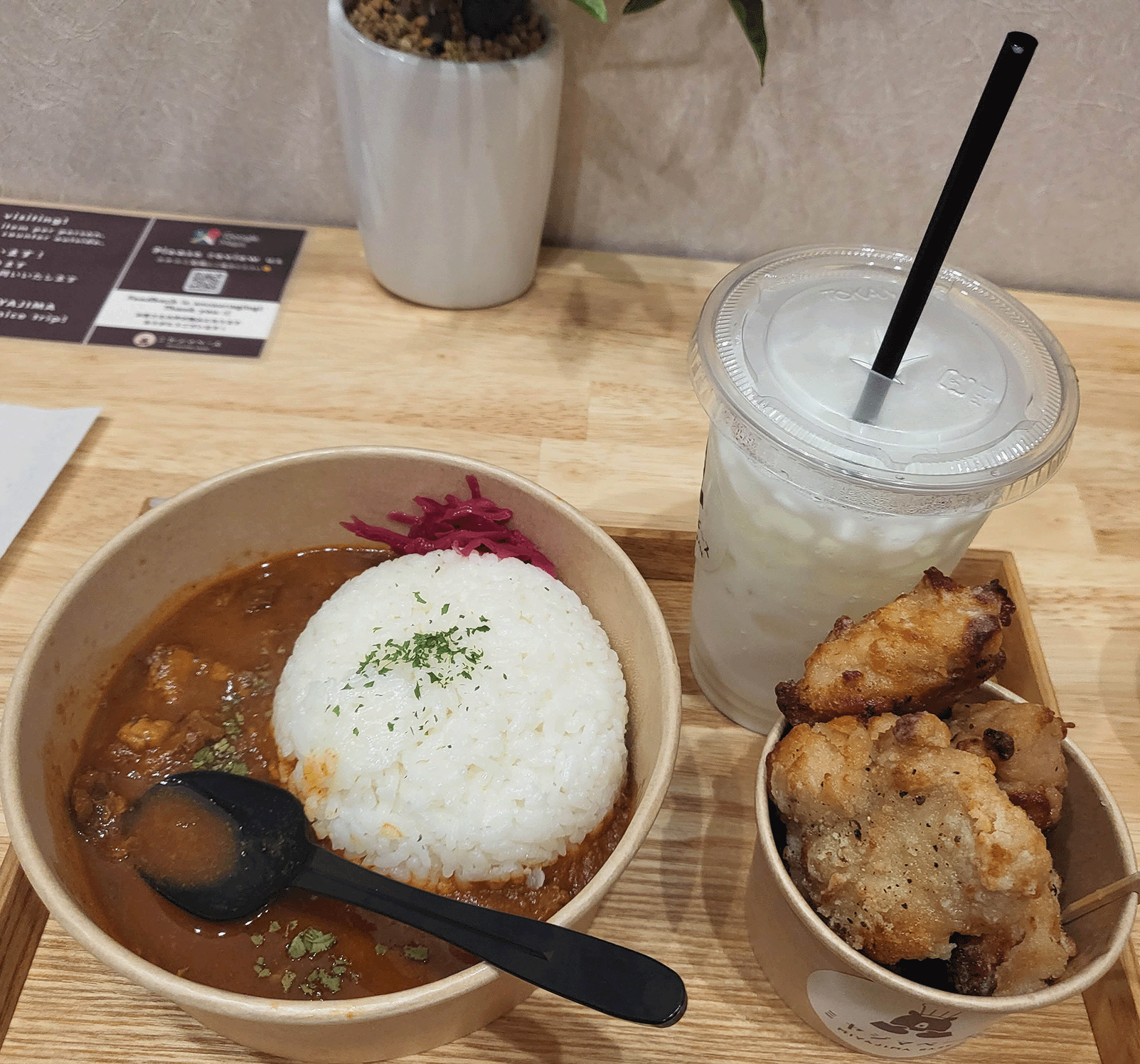
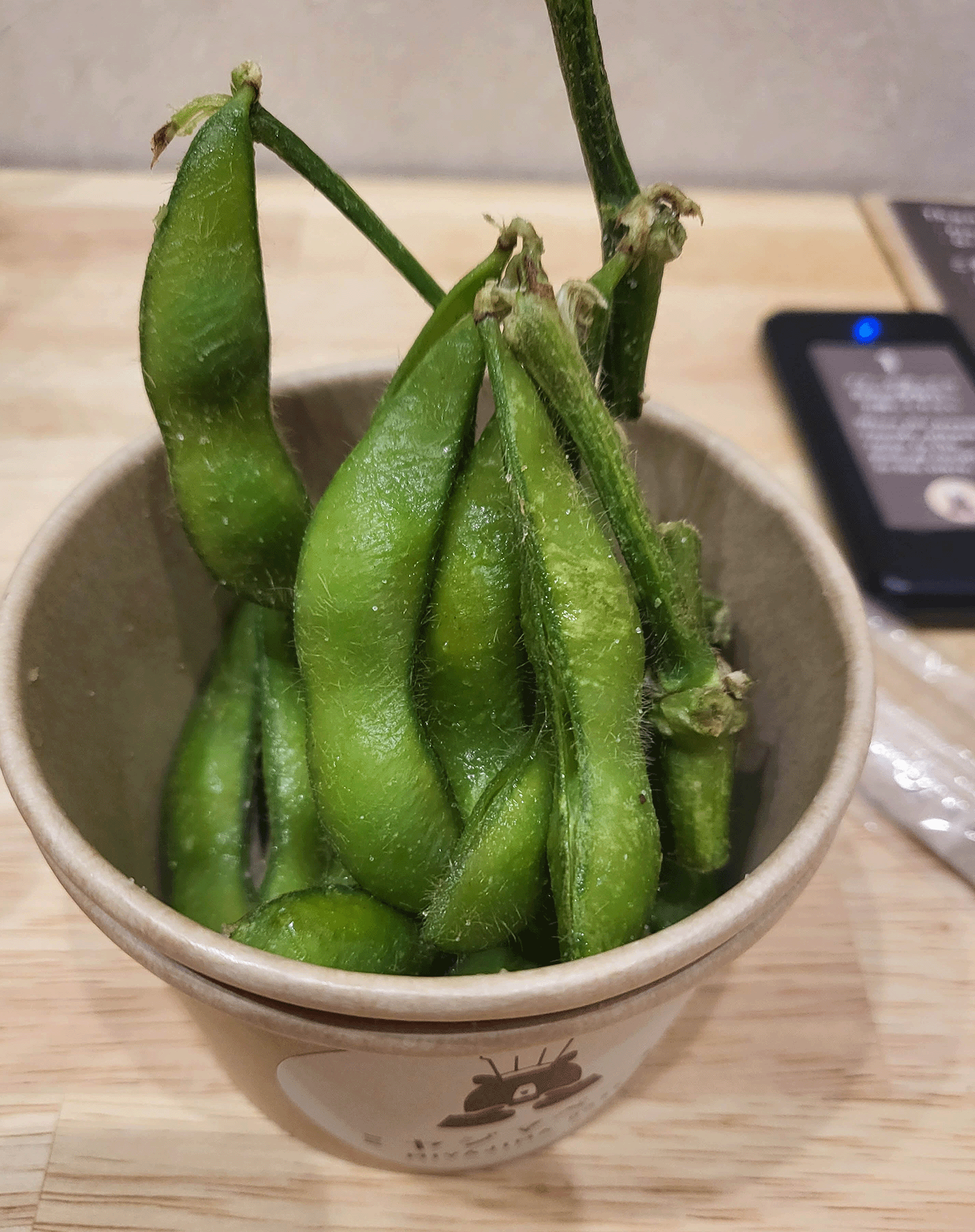
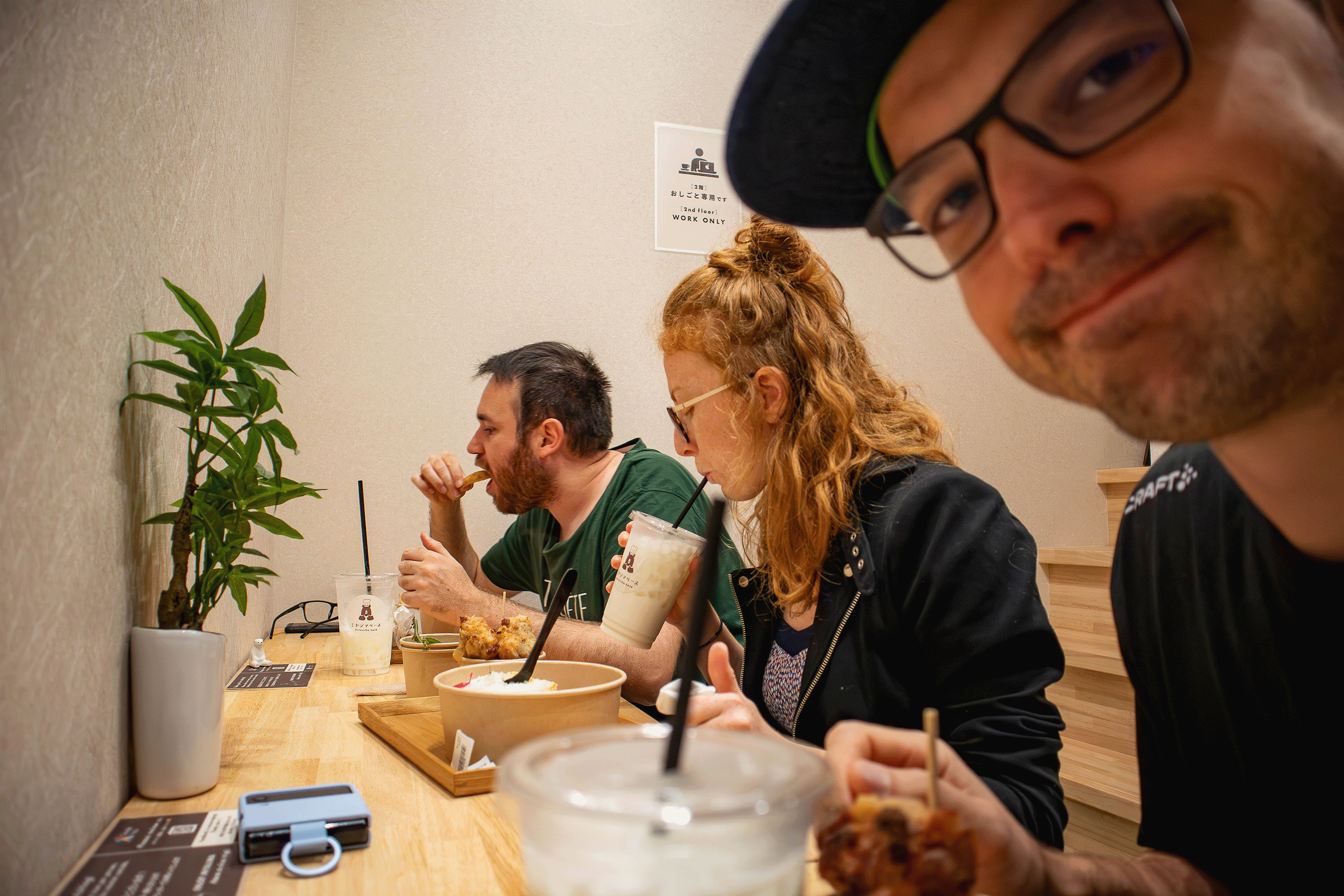
Miyajima base – Miyajima – 100% GF – Full menu available – Speciality : Karaage, curry
Miyajima base is a small restaurant located in Miyajima, an island near Hiroshima.
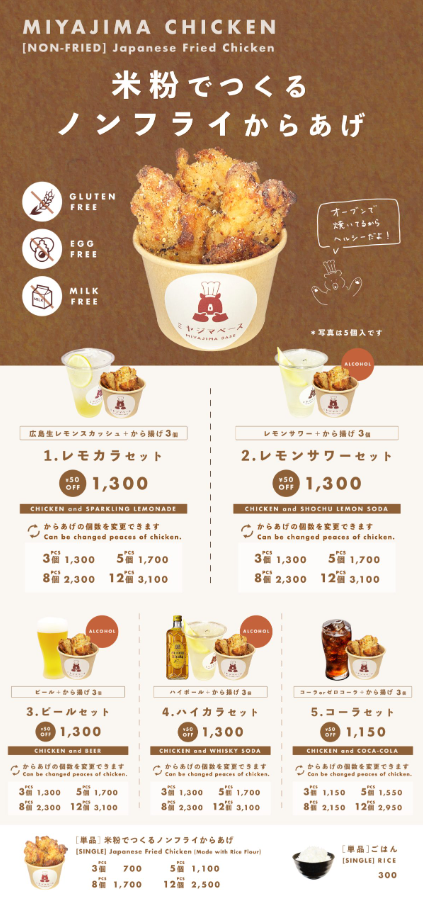
They are currently offering a delicious curry accompanied by chicken nuggets (karaage).
The atmosphere is once again very typical and enjoyable. You can also take your meal to-go.
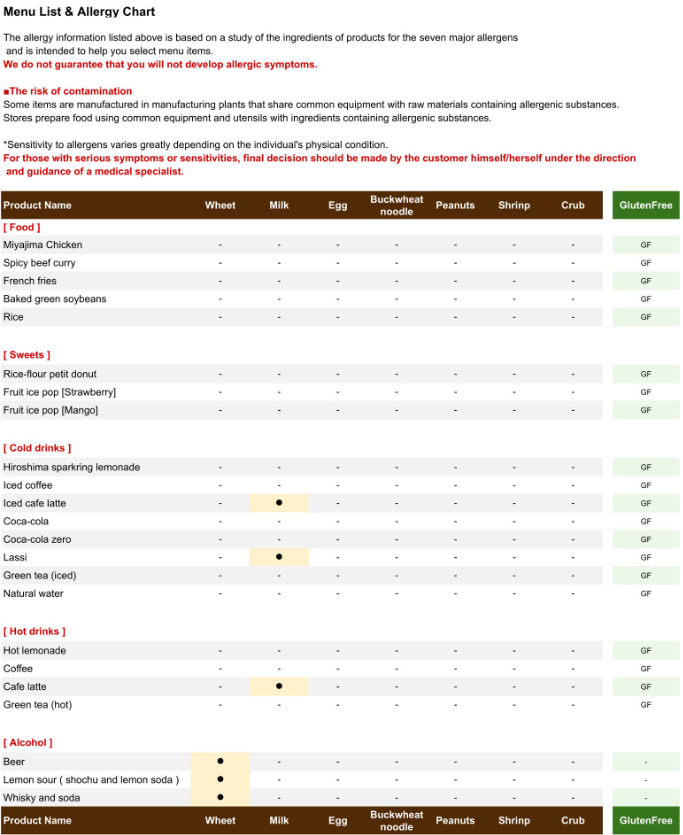
I marked them as 100% GF because all of their dishes are gluten-free, only a few gluten-containing beverages are available.
The ingredients are of high quality and I really enjoyed the experience.
Follow this link to find its location on Google Maps
https://maps.app.goo.gl/yo3Y58oaqofKNuQX8
For more information, visit their website at
https://miyajima-base.com/
Hananoyado Fukuya ryokan – Hakone – GF friendly – Full menu avaialble – Speciality : Kaiseki
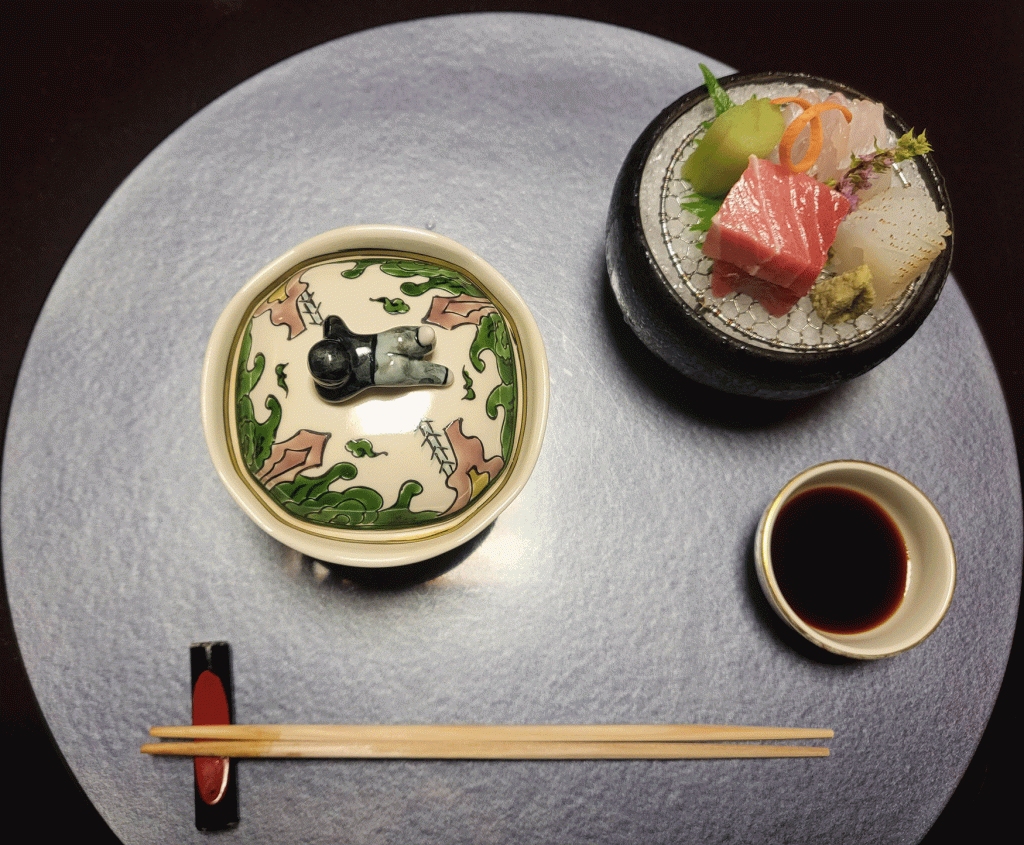
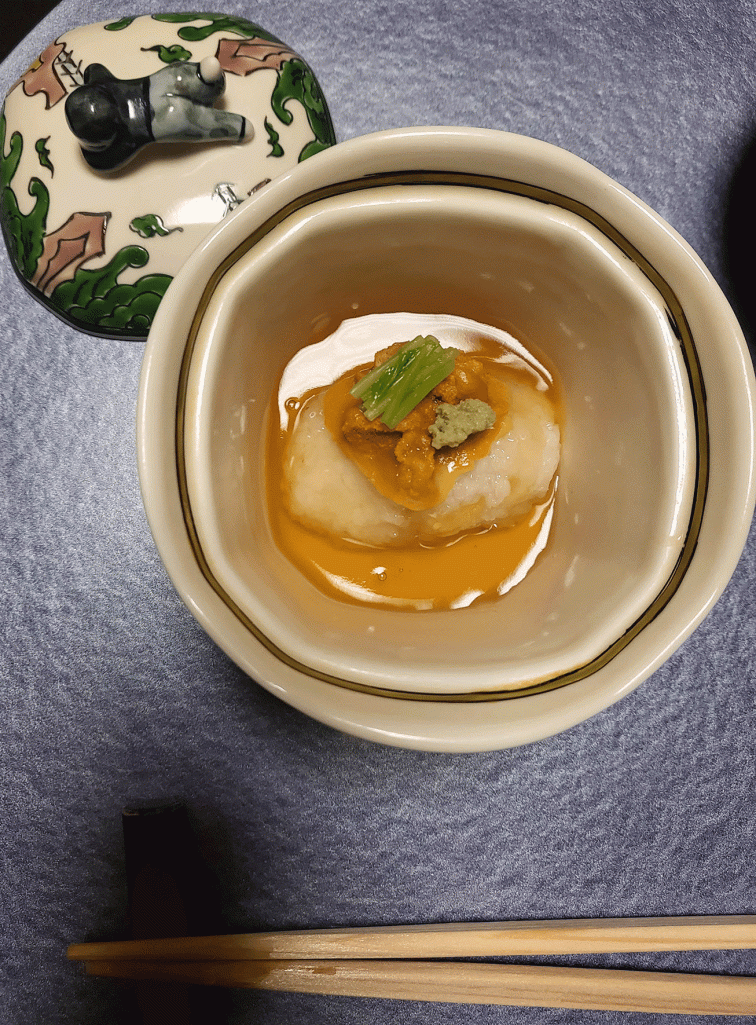
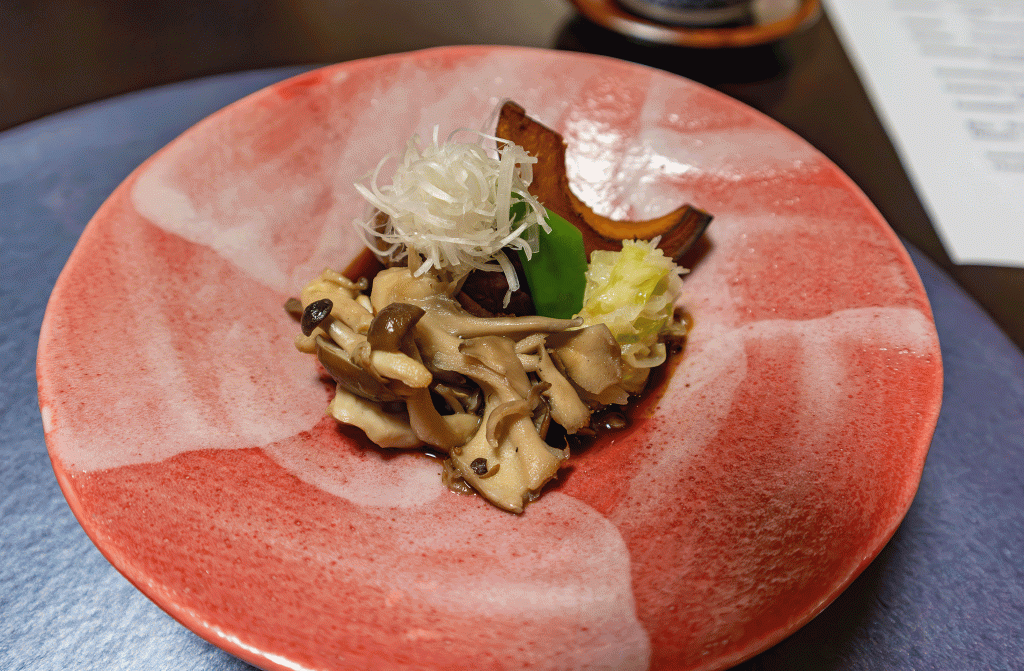
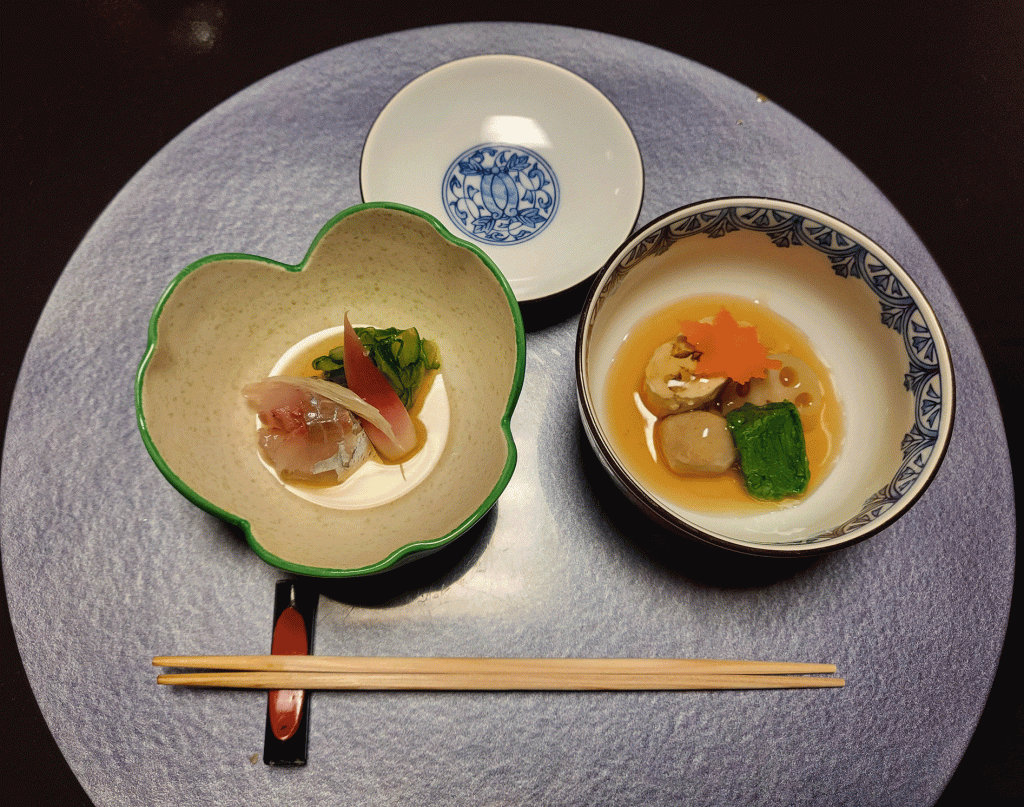
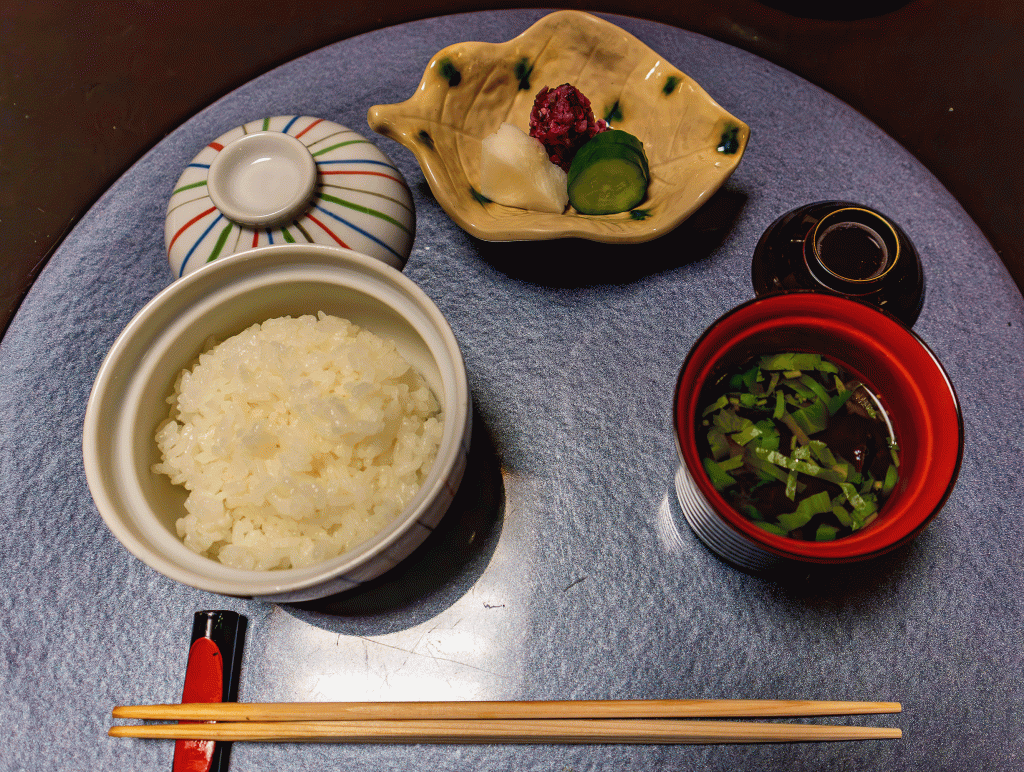
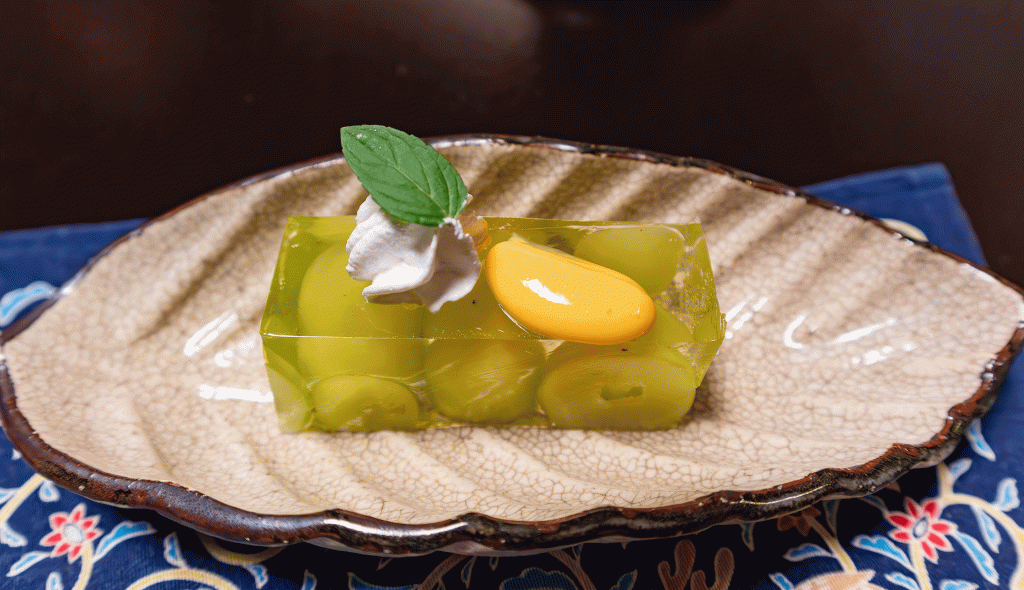
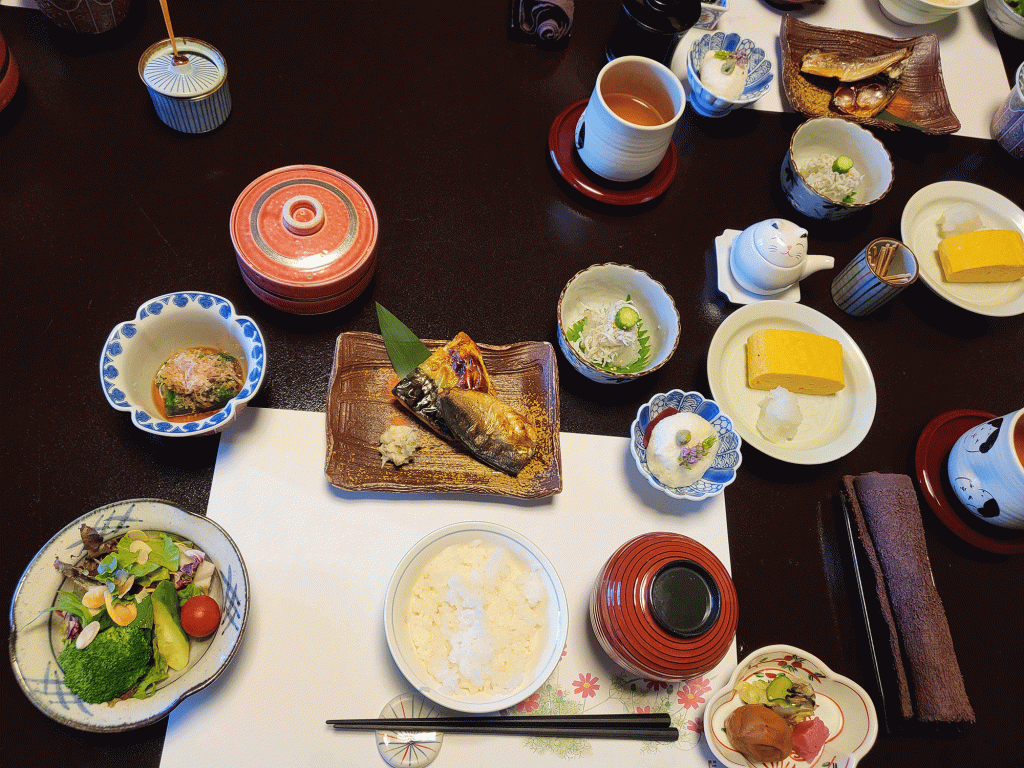
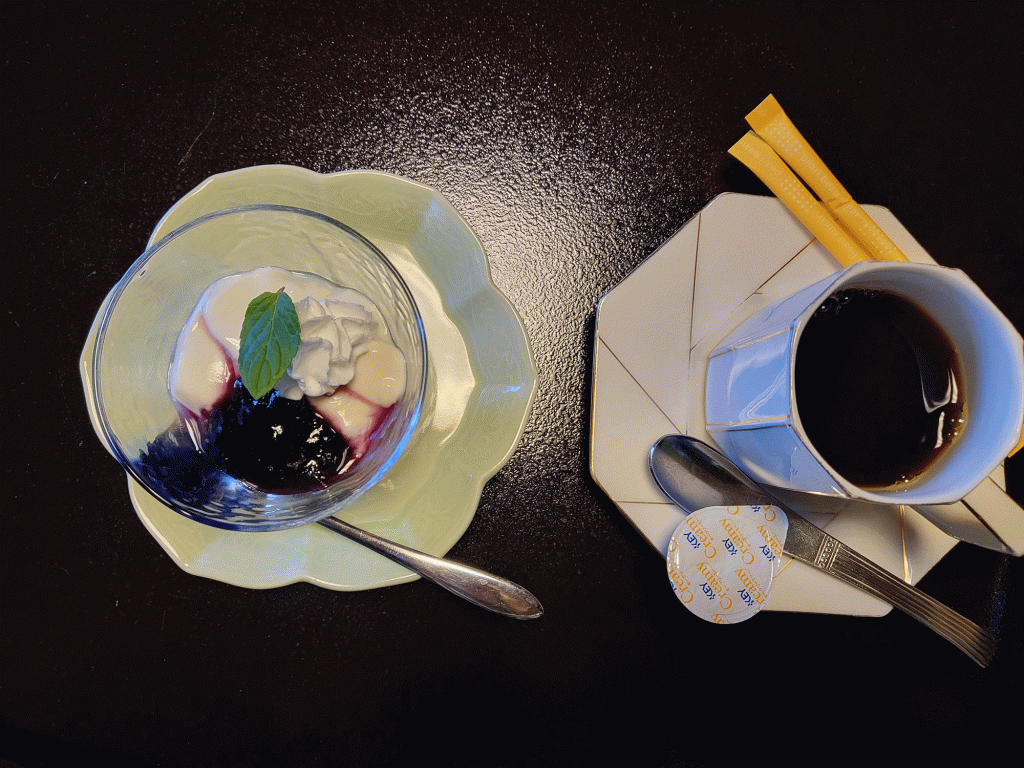
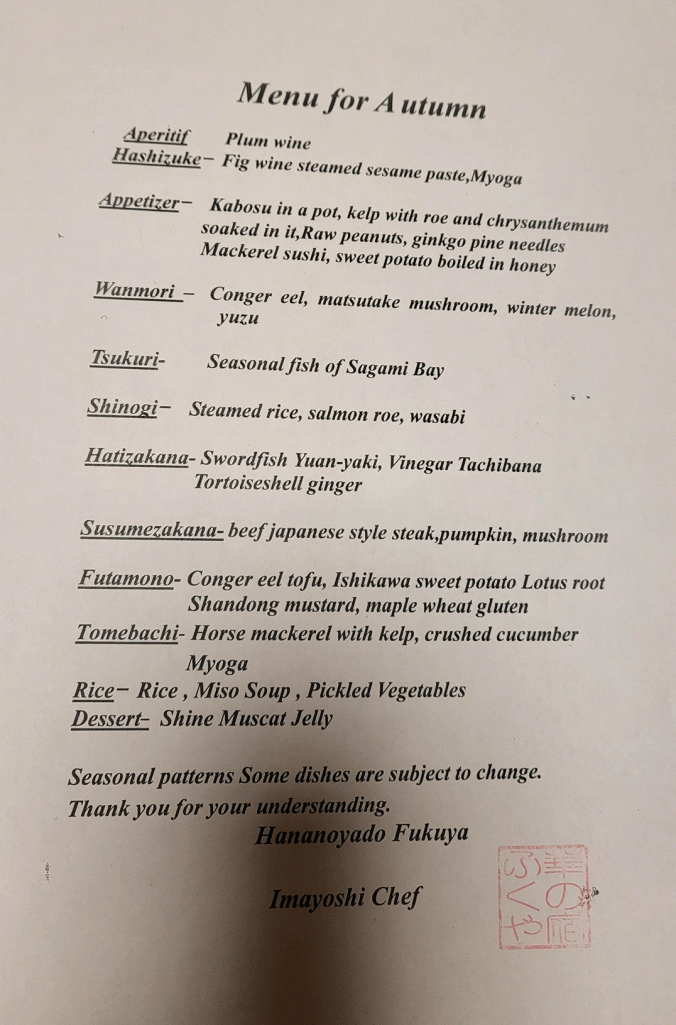
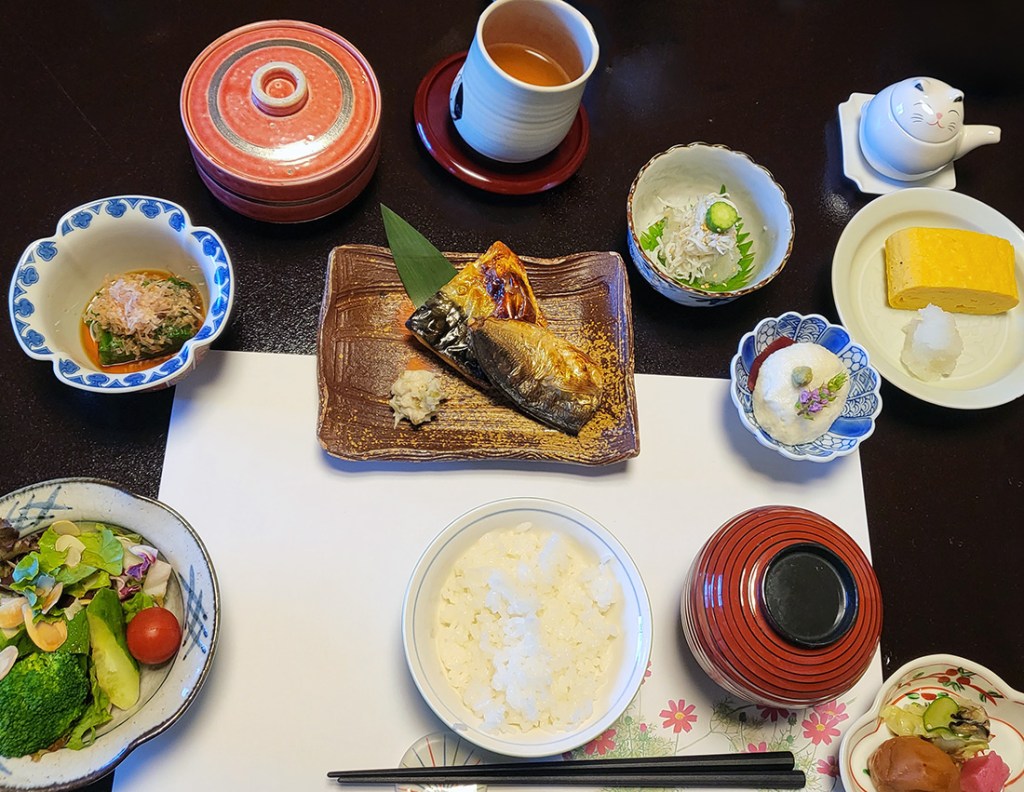
During our stay, we stayed during one night in a ryokan. This luxurious, traditional Japanese accommodation allows you to access onsens (private or public) and includes meals. In our case, dinner and breakfast were included. We chose a ryokan located in Hakone. We contacted them regarding my dietary restrictions, and they were able to adapt each dish to be gluten-free. They even brought me gluten-free soy sauce.
I sometimes had less ingredients, but the dishes remained delicious with those complex flavors that can only be found in Japan.
I’ll let you judge from the photos, but in my opinion, it’s definitely worth it and allows you to taste quality kaiseki cuisine.
However, be prepared: it’s generous! The dishes range from good to excellent, and none of them, in my opinion, were tasteless or bad as you might sometimes hear from kaiseki cuisine.
For more information, visit their website at
http://www.hakone-fukuya.com/
Gluten free T’s kitchen – Tokyo – 100% GF – Full menu available- Speciality : different japenese dishes
Gluten-free T’s kitchen is a restaurant located in Tokyo, more specifically in Roppongi. The restaurant is small, so I recommend booking in advance.
They offer a 100% gluten-free cuisine with a diverse menu. It should be the perfect opportunity for you to taste all the Japanese dishes you’ve been dreaming of.
They also sell gluten-free products such as noodles, snacks, and soy sauces.
The staff speaks English fluently, and when we visited, the team consisted solely of English-speaking individuals.
Please find below their location and their website
https://maps.app.goo.gl/oCVmA3oH7TNWxZhf8
https://glutenfree.co.jp/
NB: as quite often during this trip, I was slightly hungry when the dishes arrived and I forgot to take pictures… it gives you a small preview, Google maps and its users will take care of the rest.

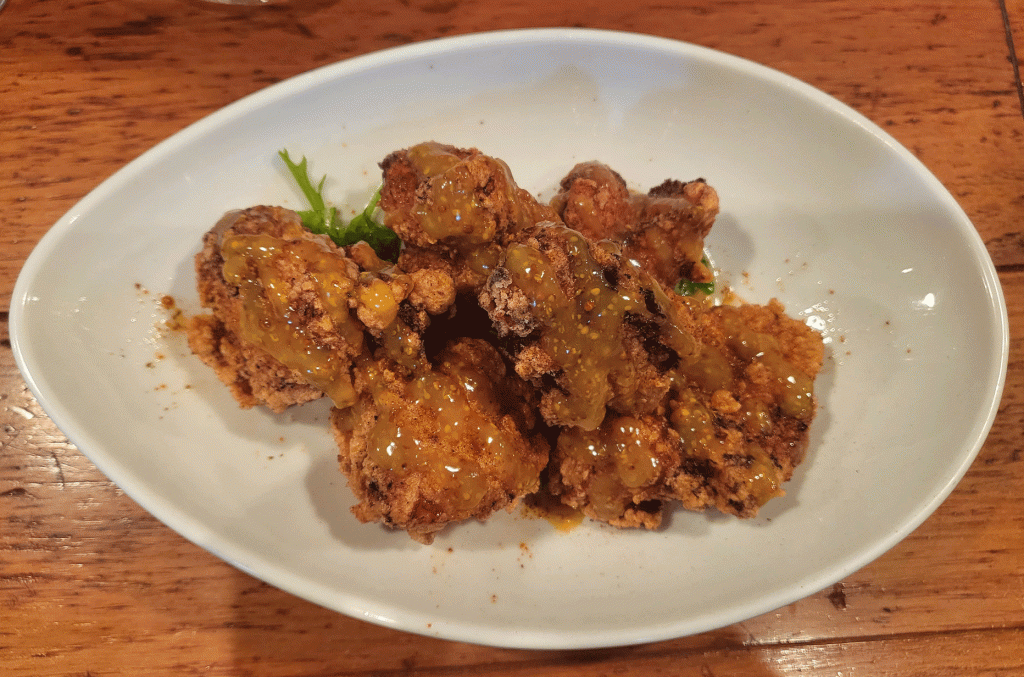
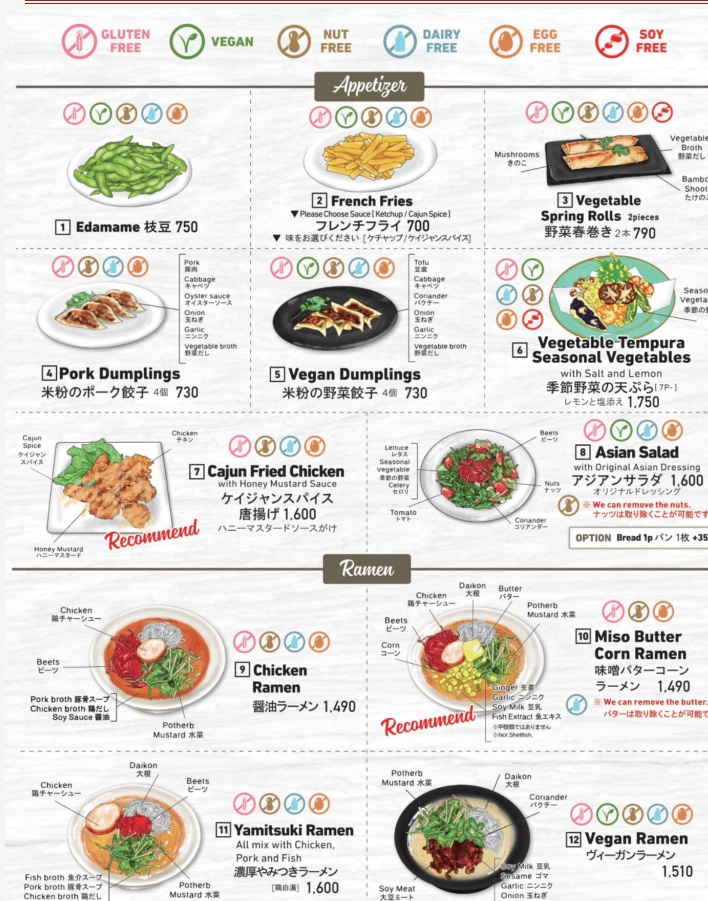
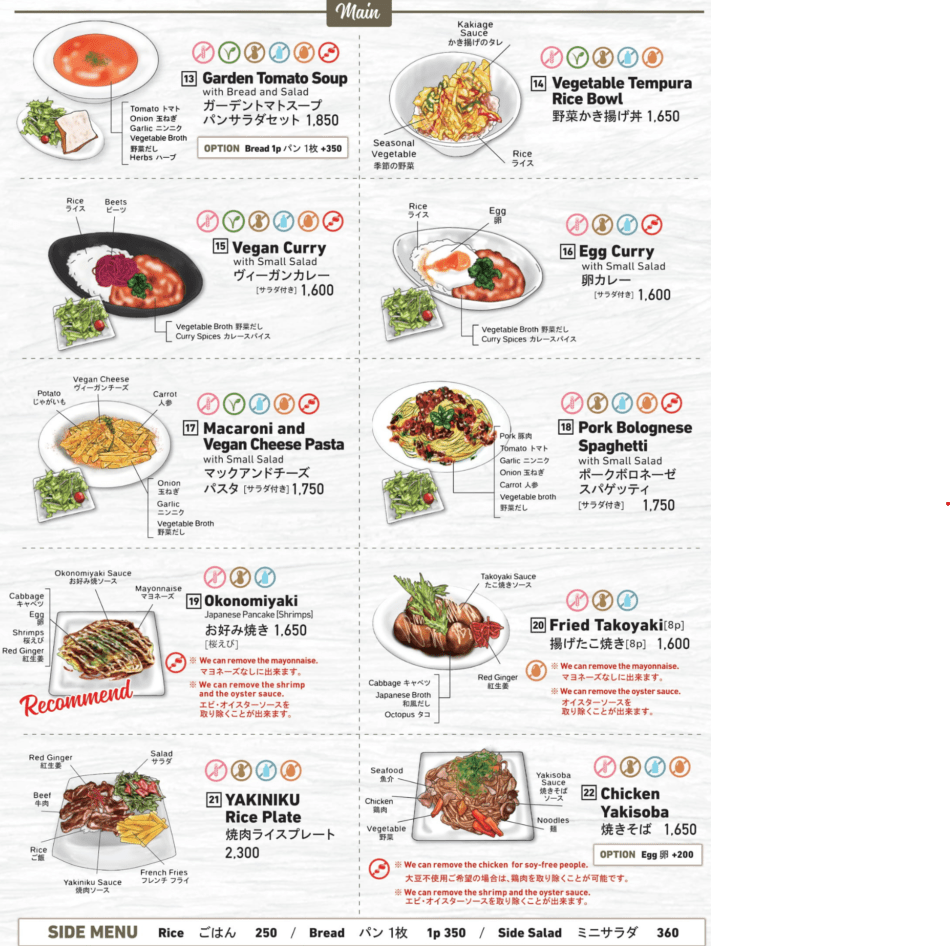
Teppan Baby – Tokyo – GF friendly – Speciality: Okonomiyaki
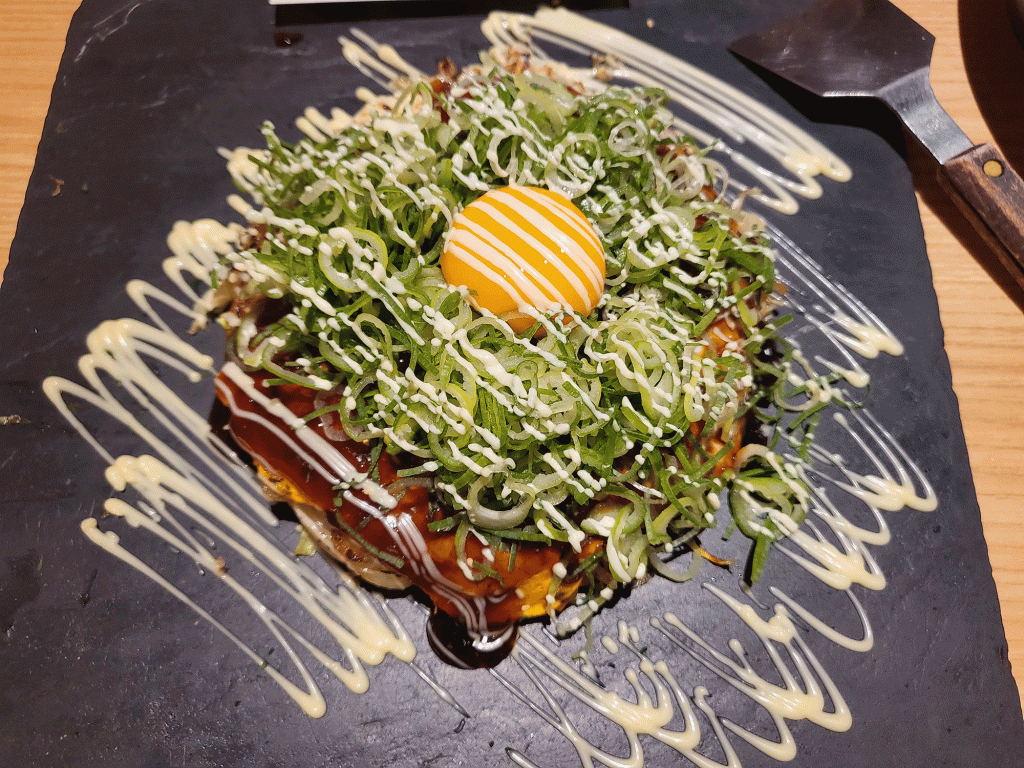
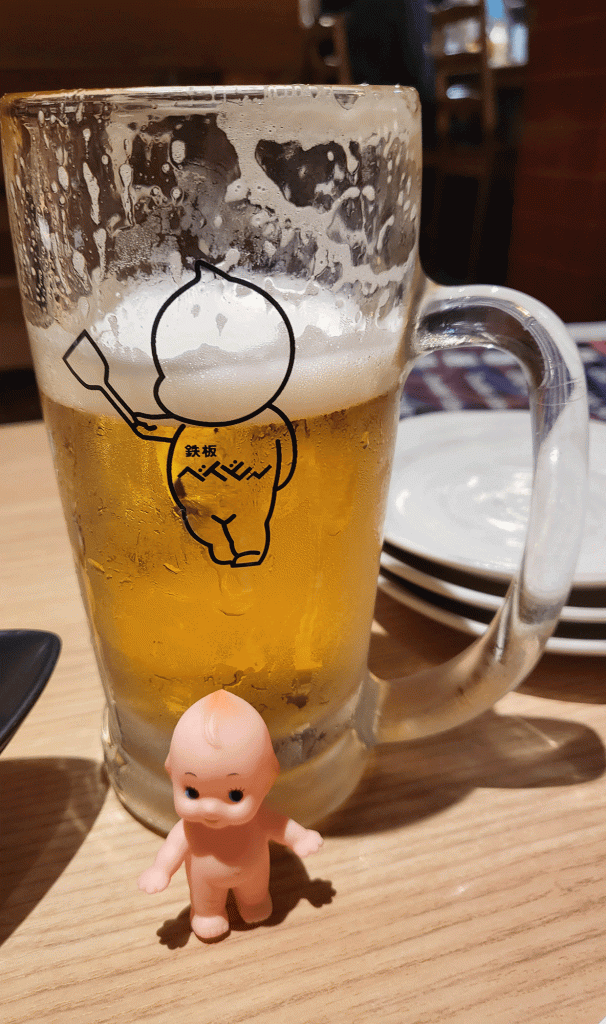
Teppan baby is a restaurant specialized in all dishes that require teppanyaki (hot plate). They are known for their excellent okonomiyakis for which they offer a gluten-free version. Be aware of cross-contamination, as everything is cooked in the same place. Personally, I did not get sick, so as other coeliacs (you can find their comments on Google maps of Find me gluten free).
They sell gluten-free okonomiyaki sauce. So if you want to avoid any risk of cross-contamination, why not get this sauce to make incredible homemade okonomiyaki.
The restaurant is located in the Shinjuku district and you should not be afraid of noise as the music is quite loud and the servers communicate the orders to the kitchen from the other end of the room.
Follow this link to find its location on Google Maps
https://maps.app.goo.gl/7Uqca4J3B2WXNdvx7
For more information
https://teppanbaby.com/
NB: The beer that appears in the photos is not gluten-free and it is just there to show the baby, the symbol of Teppan baby.
The best places to satisfy your sweet tooth – Kyoto, Miyajima, Tokyo
Finally, here is a list of various establishments offering sweet treats without gluten.
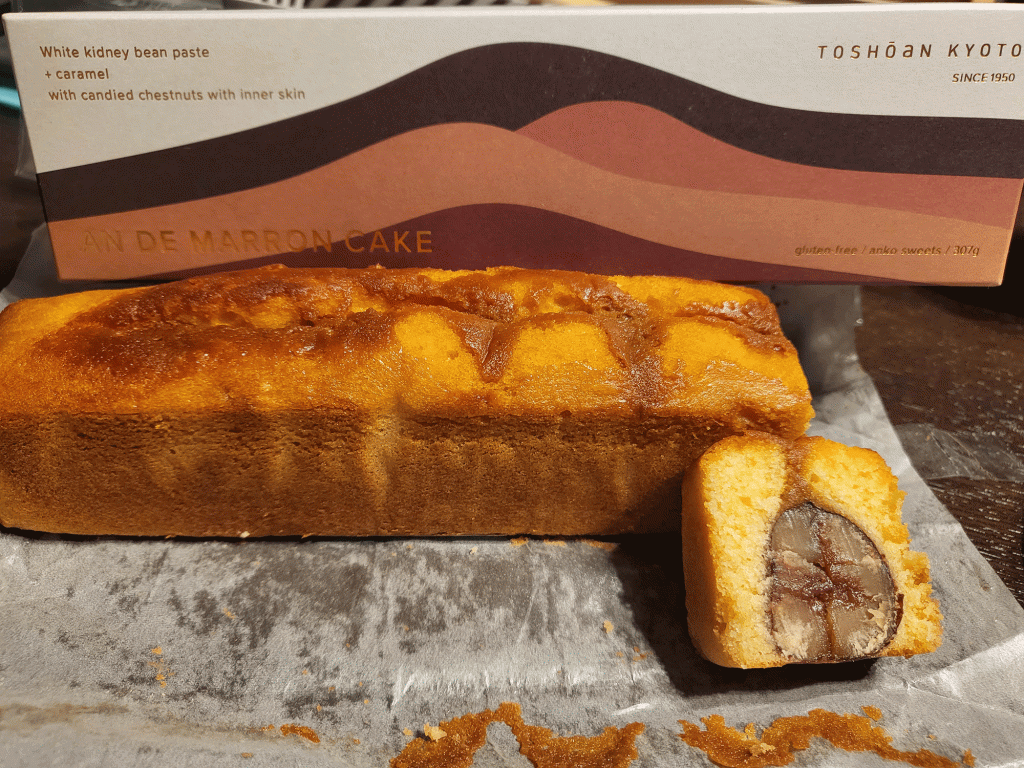
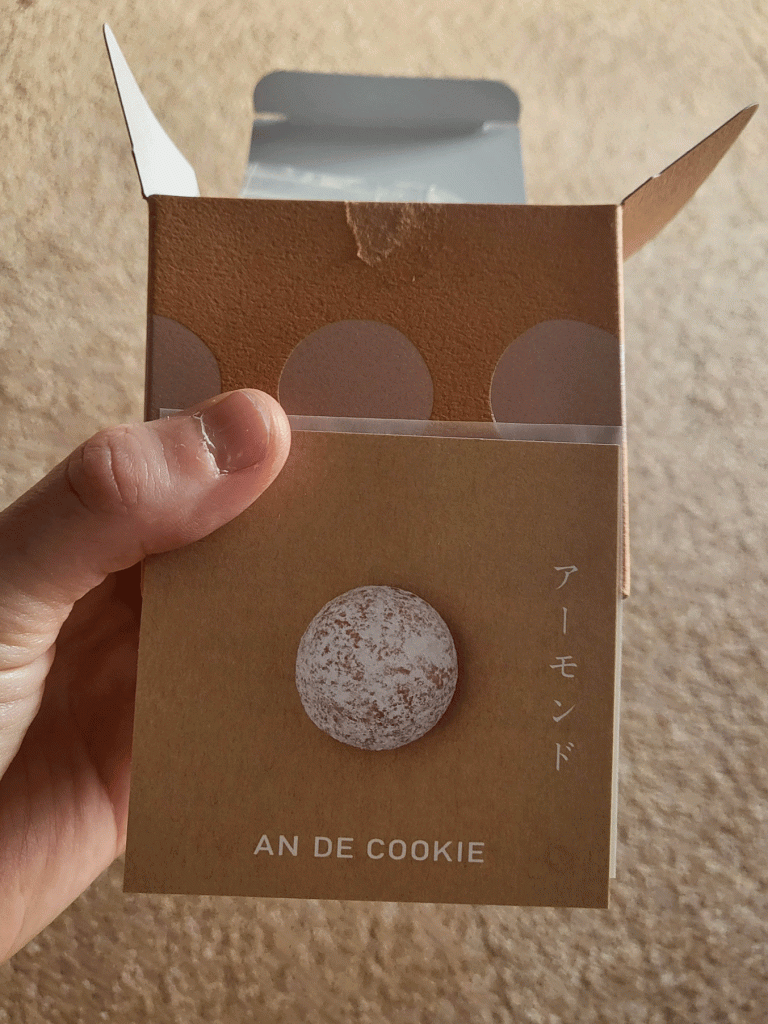
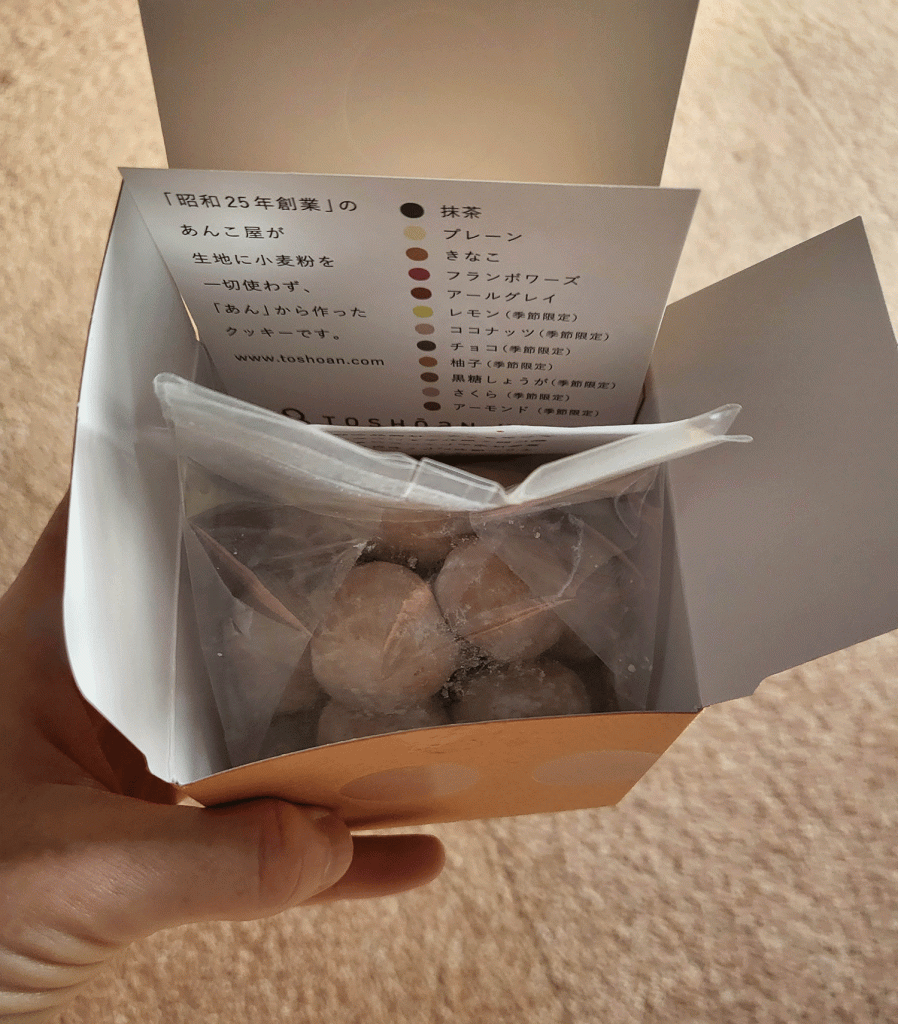
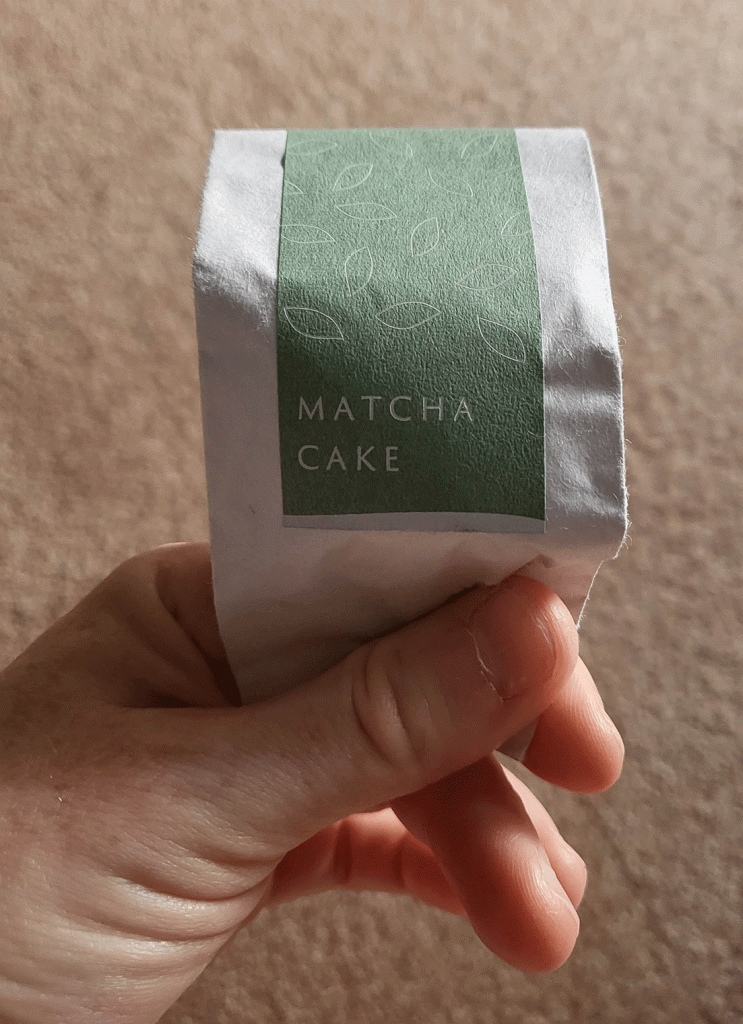
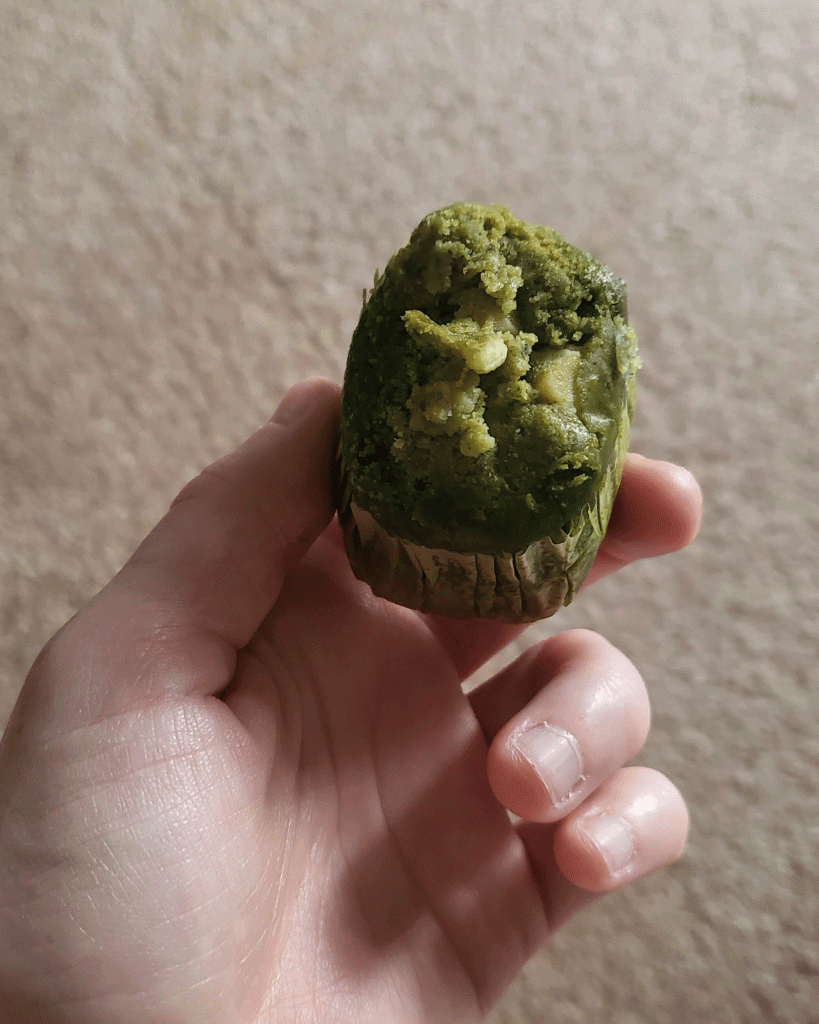
Toshoan is a 100% GF grocery store located in Kyoto. They offer numerous products that will immerse you in the flavors of Japan. https://maps.app.goo.gl/Bd4HWhqWQj45i5gw7
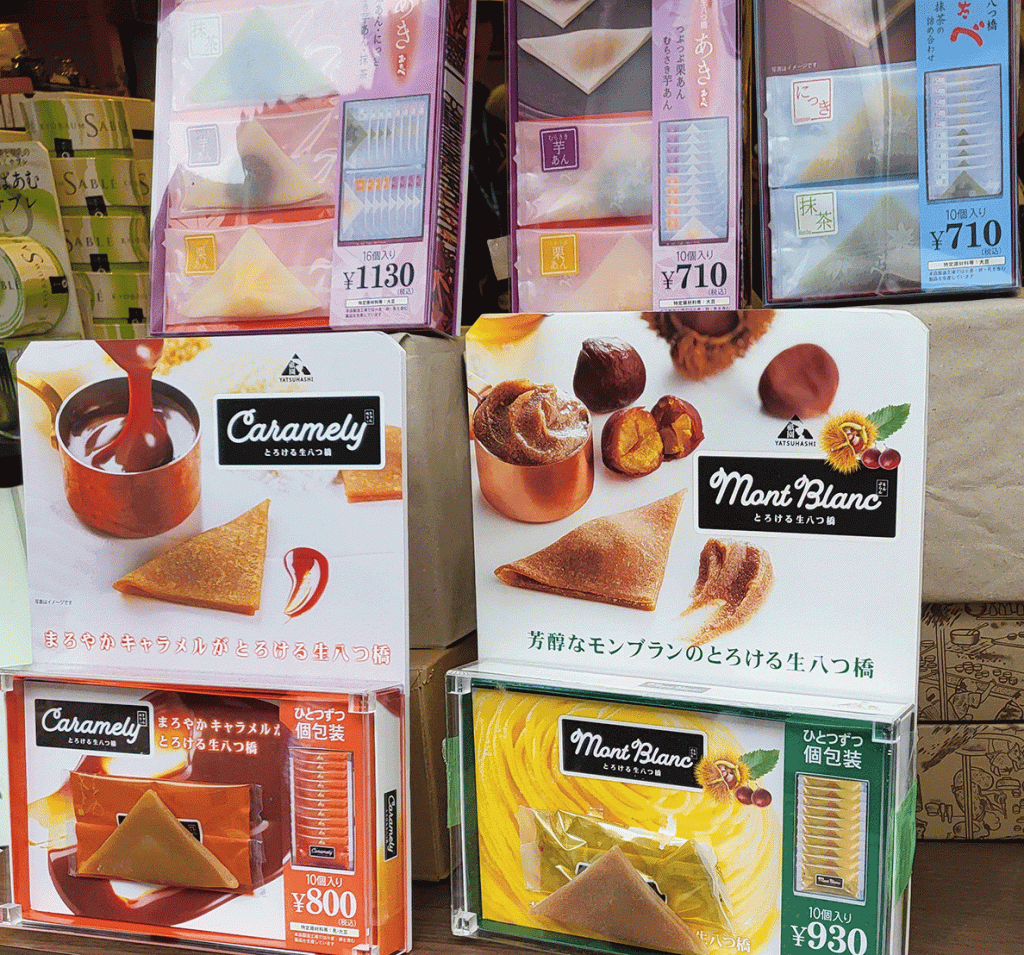
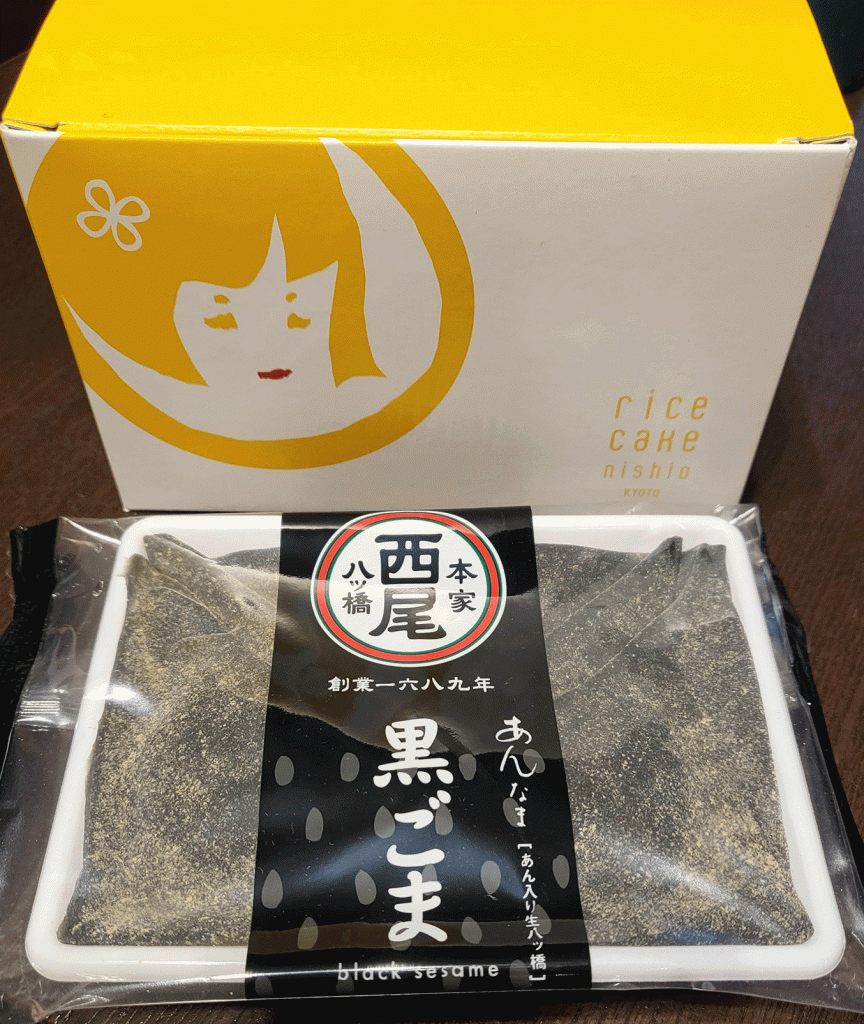
Yatsuhashi is the name given to a speciality from Kyoto. You can find them on every street corner and they are usually made without gluten. My favorite flavor by far was the black sesame. You can also find chestnut, cinnamon, banana, strawberry-chocolate…
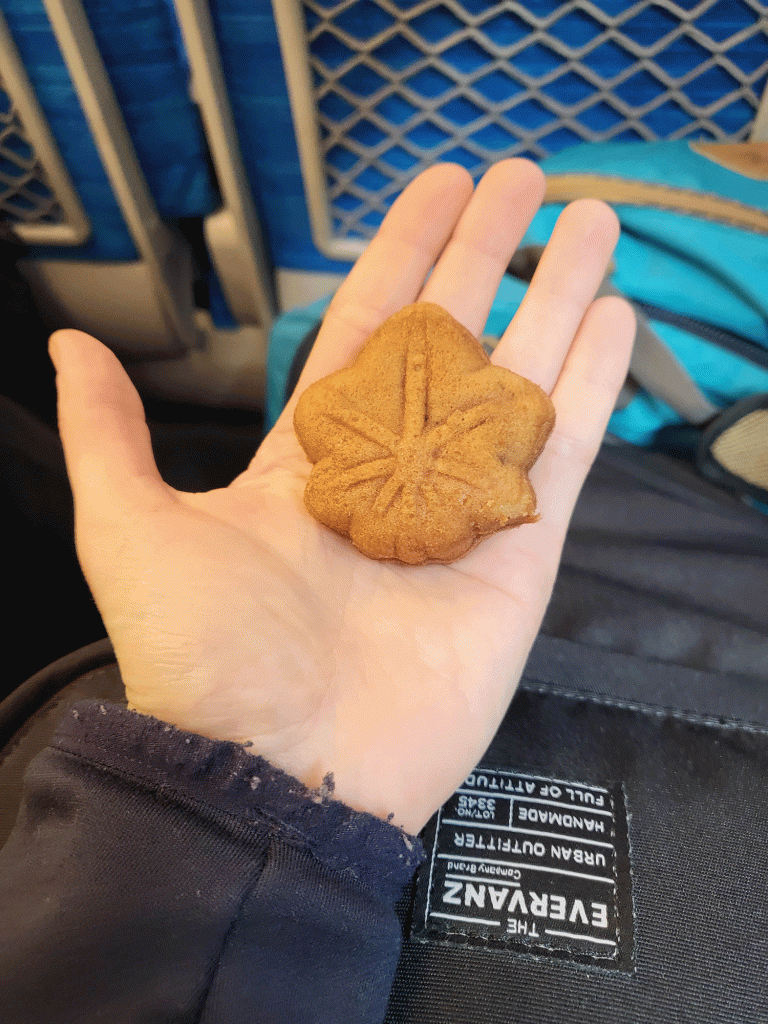
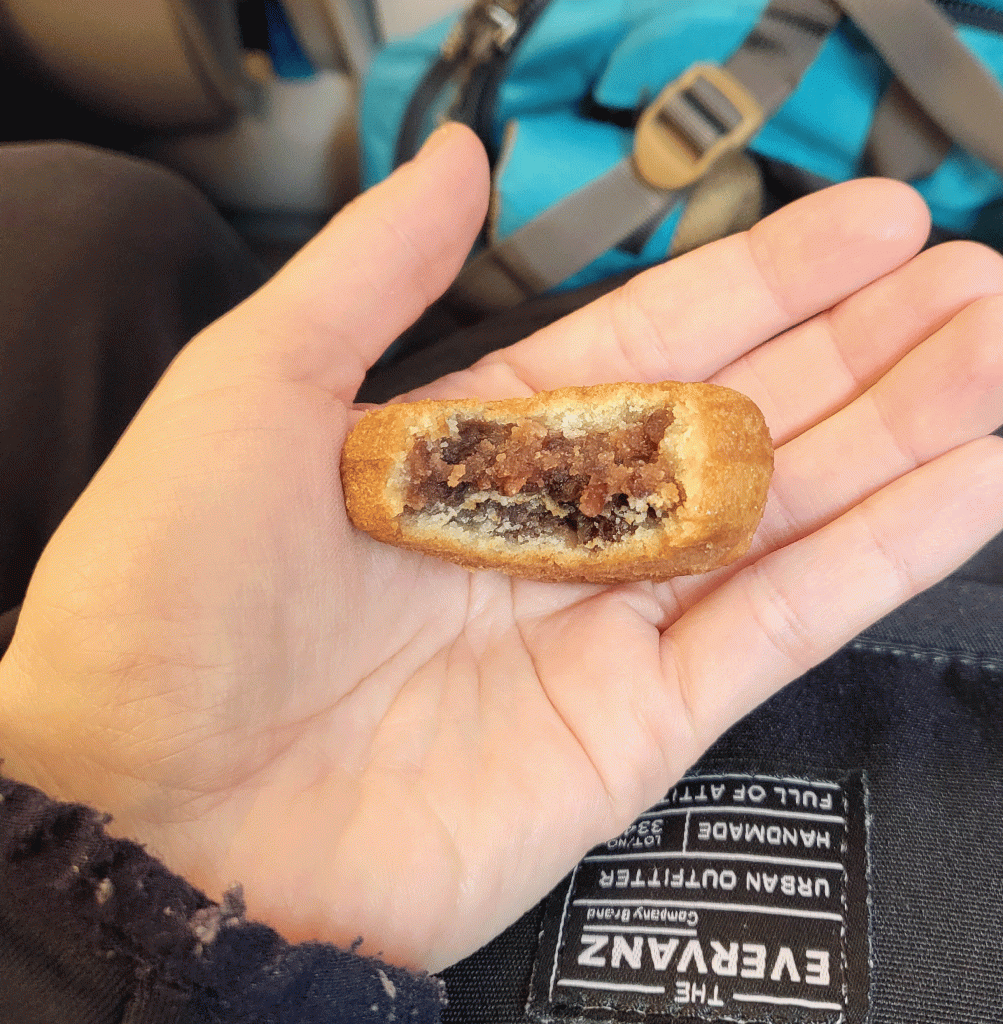
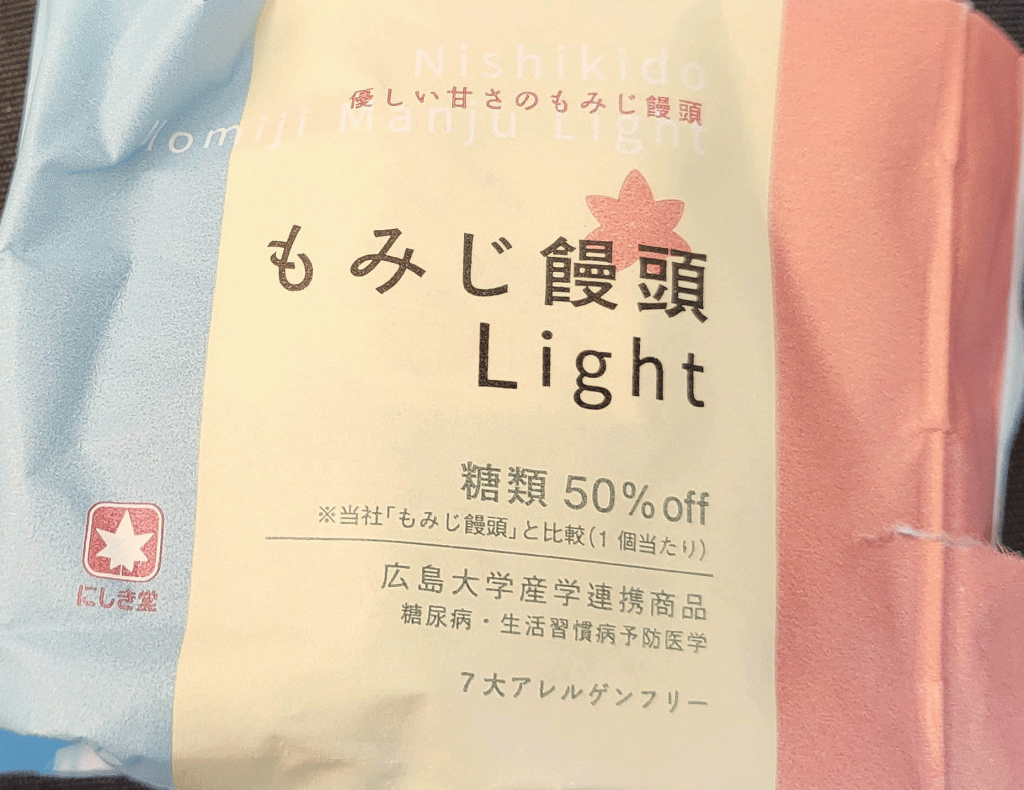
Nishikido is a chain that can be found in Miyajima and Hiroshima, among other places. They offer a gluten-free version of the famous momiji manju.
https://www.nisikido.co.jp/en/
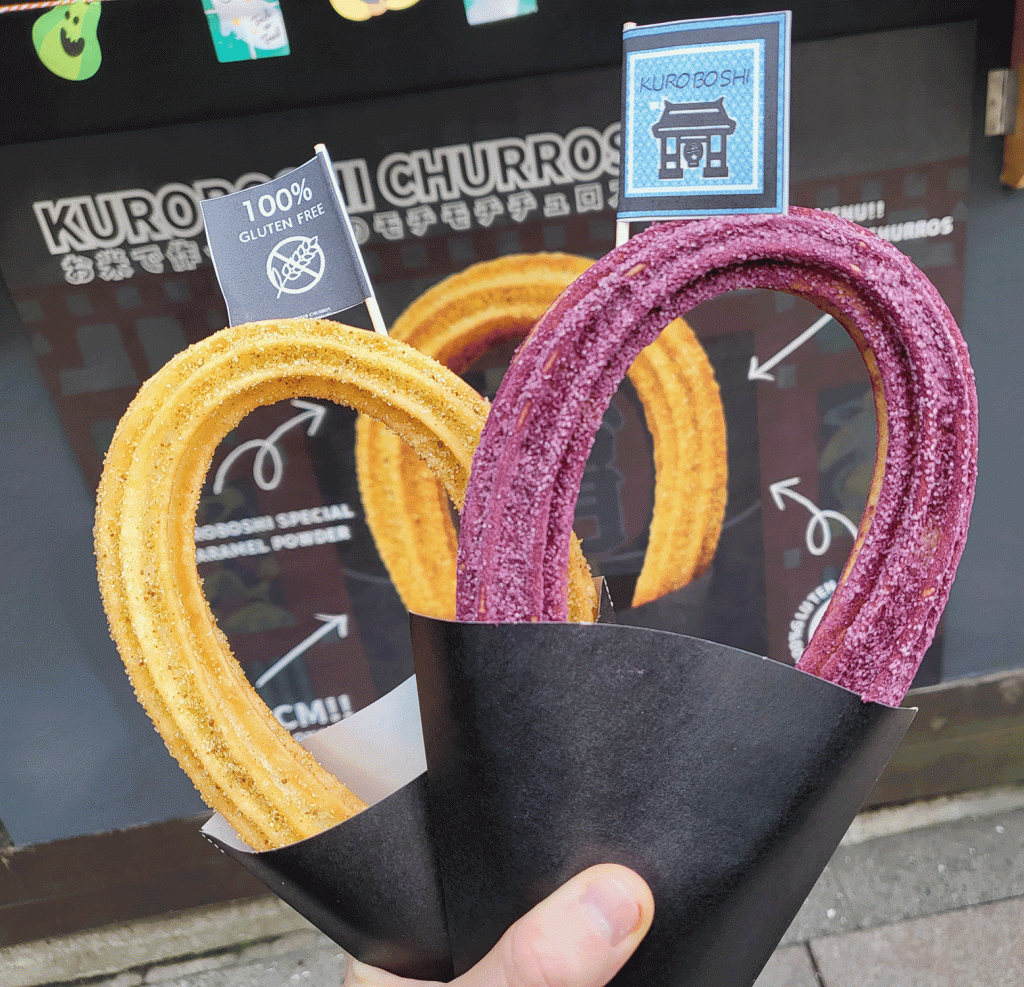
Kuroboshi is a chain that offers, among other things, gluten-free churros. There is no risk of cross-contamination here, as the fryer is only used for gluten-free products. You will find a stand in Tokyo, specifically in the Asakusa neighborhood.
https://maps.app.goo.gl/hSGSAW9zxGtR63dH9 (the pin won’t indicate that it’s Kuroboshi as the establishment doesn’t seem to be listed on Google maps yet).
https://www.kuroboshi-nasu.com/
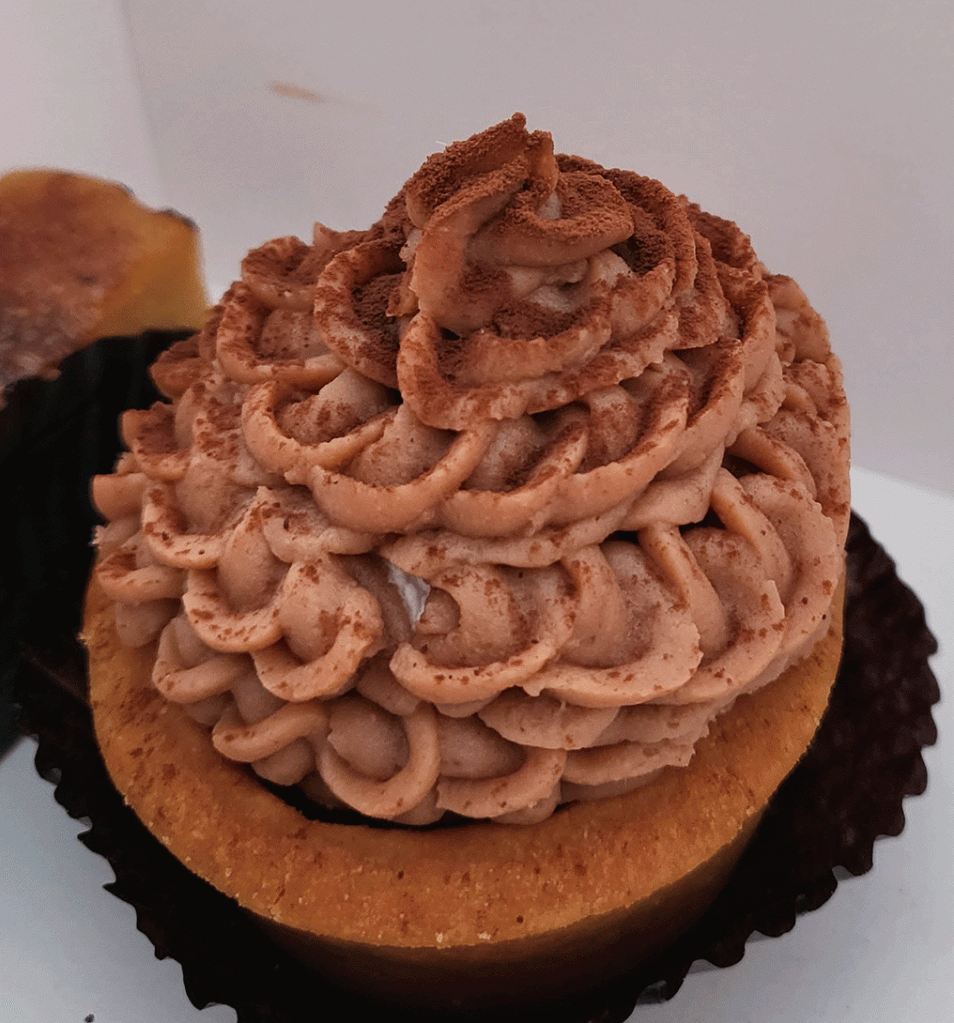
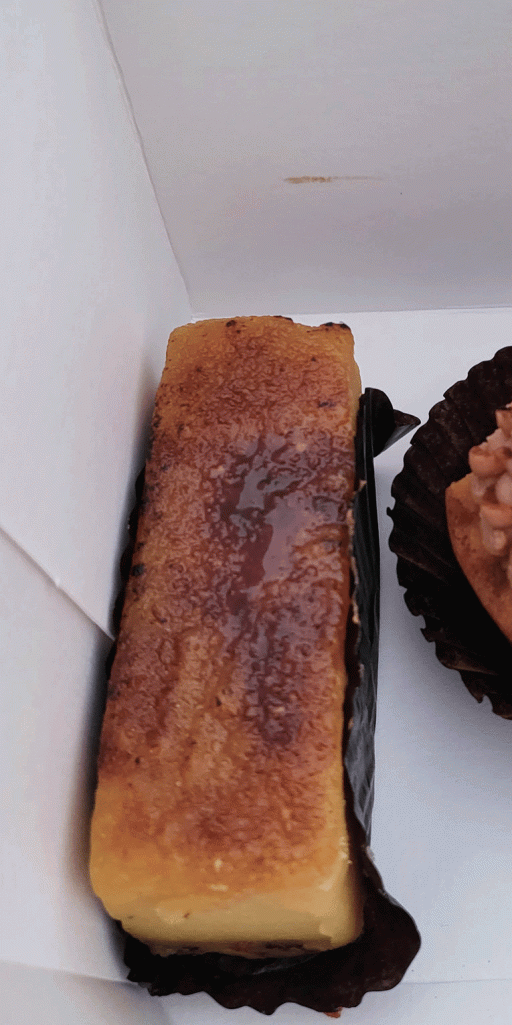
Bio Cafe is a gluten-free café located in Tokyo’s Shibuya neighborhood. Their pastries are more similar to those found in Western countries.
https://maps.app.goo.gl/5bRnFFsLE53t3wV18
Japan interactive map
To facilitate your search for gluten-free establishments, an interactive map of Japan is available. This map lists gluten-free restaurants and stores in different regions of the country so that you can easily find options that suit your dietary needs.
So far, I have only made the exercise for the major cities of Japan: Tokyo, Kyoto, Nara, Osaka, Hiroshima. Based on your feedback, I may expand it.
View Japan – Gluten-free options map in a full screen map

Conclusion and references
By following these tips and preparing adequately, your gluten-free trip to Japan will undoubtedly be a memorable and enriching culinary experience. Remember that the Japanese are extremely helpful and patient. They will take the time to answer your questions, so you should be able to find what you’re looking for.
Enjoy the unique flavors of Japan!
Finally, if you want to delve into the subject, don’t hesitate to take a look at the references used to write this article.
Eat without gluten in Japan
https://www.nippon.com/fr/japan-topics/b00143/?pnum=2
https://www.legalnomads.com/gluten-free/japan/
https://japan-glutenfree.com/category/restaurants-shops/
https://fukuokaeats.com/eats/gluten-free-japan
Labels in Japan
https://gogonihon.com/fr/blog/etiquettes-produits-alimentaires-japon/
To know everything on miso
https://www.miyajima-soy.co.jp/english-site/en-fermented-foods/about-miso
https://www.ourmodernkitchen.com/all-about-miso/
To know everything on shabu-shabu
https://japan-glutenfree.com/shabu-shabu/
https://findglutenfreejapan.com/gluten-free-shabushabu-japan/
Articles about our trip in Japan
The budget for a pleasure trip to Japan
How much does a post-Covid trip to Japan cost? We present here a detailed and commented article on our expenses to help you best estimate what you can expect to spend on your trip.
4 days in Kyoto: between tradition and modernity
We continue our trip to Japan with the ancient Japanese capital of Kyoto. We tell you about our 4 days between modernity and tradition.

An unforgettable and guenine night in a ryokan
Our trip to Japan was motivated, among other things, by a desire to experience Japanese culture from the inside. When we heard about ryokan, those typical and rather unspeakable Japanese accommodations, we thought we had to add it to our program. After canvassing the market, asking around a bit more and finding establishments that could…
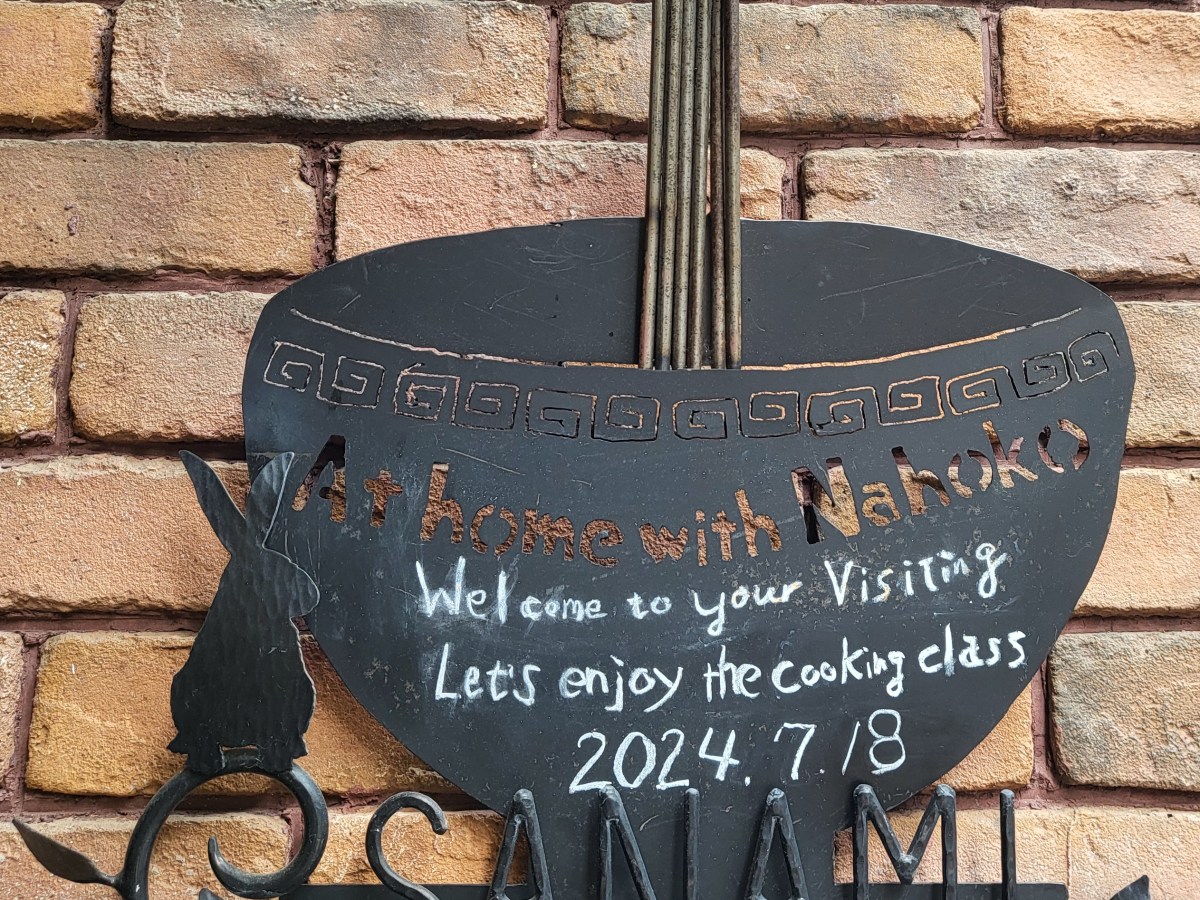
At Nahoko’s to learn how to cook Japanese and gluten-free dishes
What about learning how to cook delicious and typical Japanese dishes without gluten? That’s what we did during our stay in Tokyo. We went to Nahoko’s to learn how to cook delicious ramen: from the noodles, to the broth everything is homemade and gluten-free.
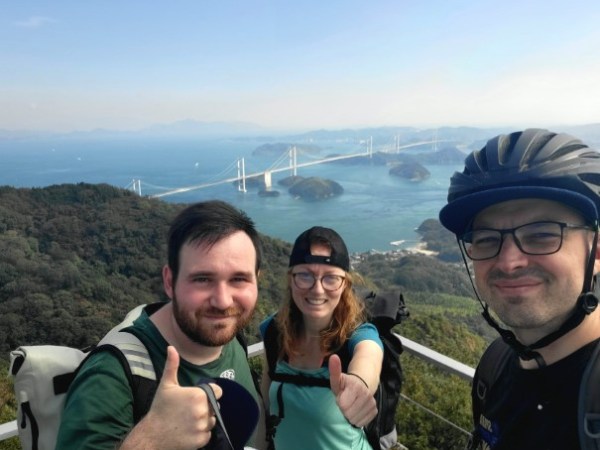
2 half days to do Shimanami Kaido path: our story and practical information
Do you know the Shimanami Kaido route ? It is a cycling road well-known in Japan. It allows to cross 6 islands and to join Shikoku. We are sharing our experience as well as information if you are interested to to be part of this adventure.
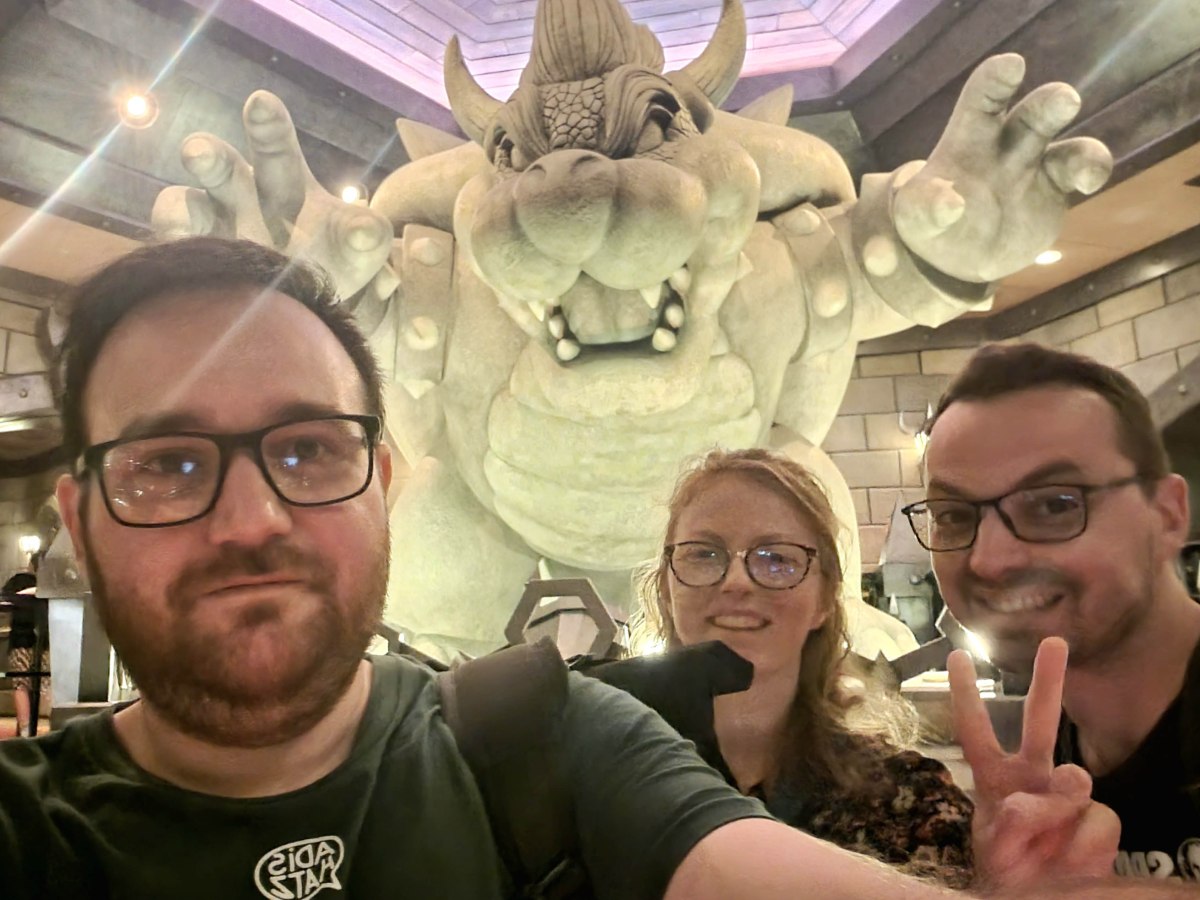
A glimpse of Osaka and a lot of fun in Universal Studio Japan over 2 days
2 days to visit Osaka, this is the time we had to discover this city. We mainly visited Universal Studio Japan and we detail our immersive and unforgettable experience in this article
COMMENTARY
 Le goût du monde sans gluten
Laisser un commentaire