
|
Gluten-free travel guide: Vietnam
Published
on
Last
modified
on


Vietnam is seen as a gluten-free paradise and it’s true that wheat is very rarely used in Vietnamese cooking. However, Vietnamese cuisine is elaborate. It incorporates numerous sauces such as soy sauce, oyster sauce, plum sauce, or hoisin sauce, all of which may potentially contain gluten.
Because of that, traveling gluten-free in Vietnam is not a smooth journey, and this guide provide you tips for a safe travel. You will find informations such as typical dishes, addresses where to eat, and much more.
However, keep a critical eye on what is written there. Here I share what I learned during my month and a half in Vietnam, it remains brief and it is possible that I missed some elements. Also, you will need to assess the level of risk you are willing to accept and ask again about the current restaurant procedures to ensure that they have not changed or that it is consistent with your expectations.
Vietnamese culture to better apprehend a gluten-free travel
Vietnamese cuisine: what is it like ?
As stated in the introduction, Vietnam is known to be a paradise for anyone following a gluten-free diet. Many Vietnamese dishes indeed consist of noodles or rice accompanied by vegetables, meat, sauce, and broth.
The country has an agriculture based on rice cultivation and imports wheat. This leads to a range of 100% rice noodles that is quite appreciated.
However, there’s a catch: the country was under Chinese domination for 1000 years. It’s during this period that the use of wheat starts to enter Vietnamese cuisine. The withdrawal of the Chinese from the territory and the absence of wheat cultivation in the country lead to the local cuisine using this cereal less and less. Nevertheless, there are still traces of this past, and some dishes maintain this Chinese touch with their wheat noodles and gluten-containing sauces.
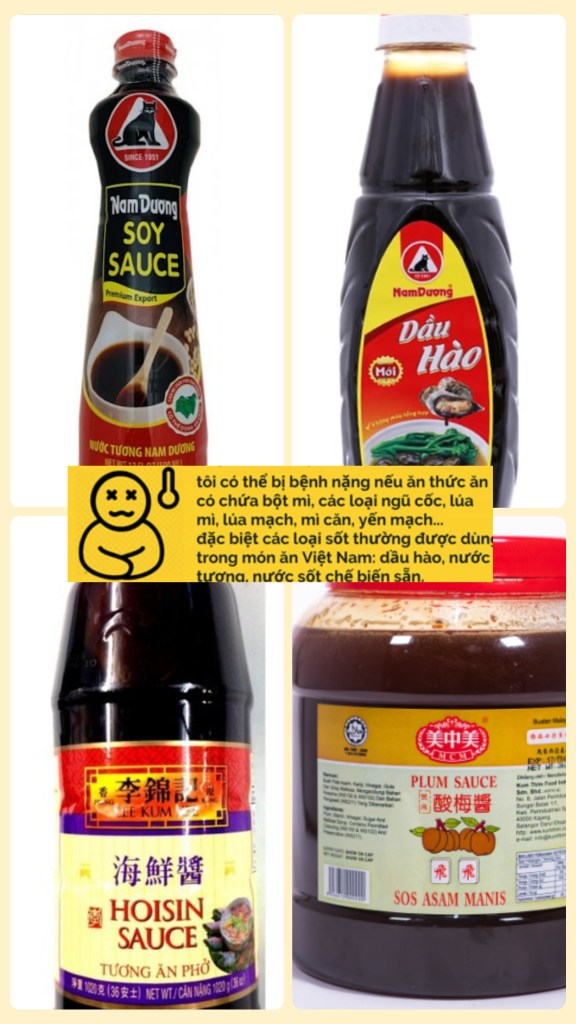
These are those sauces that pose one of the biggest problems for following a gluten-free diet in Vietnam. Vietnamese cuisine uses various elaborated sauces, including soy sauce, oyster sauce, plum sauce, hoisin sauce, fish sauce, and nuoc mam sauce. Some of them may sometimes contain gluten, depending on the brand. They are used to marinate meat or to enhance the dish.
When it comes to dry dishes, the sauces are generally served separately from the main dish, and if in doubt, you can simply choose not to pour the precious sesame. When it comes to soup and marinade, unfortunately, you will have to manage to make yourself understood.
When it comes to soups and broths, it will also be necessary to pay attention to the use of stockcubes, a point of caution known in Western cuisine as well.
Finally, due to its history, at every street corner, whether in small or large cities, you will find bakeries or street stands selling « sandwiches » called Bánh mì. So don’t be surprised to see a significant culture of Western style breads and cakes. Just avoid those but still enjoy the aroma emanating from them.
As a side note, the baguette was introduced by the French colonists. At the time, this product was a luxury item because it required the importation of wheat. When this was disrupted, bakers began replacing some of the wheat flour with rice flour. This blend is still used, making the bread crust thinner and crispier. Like many words that have evolved from French, such as phô mai for cheese, ốp la for sunny-side-up eggs, it’s thought that Bánh mì could come from « pain de mie » (soft bread) but without certainty.
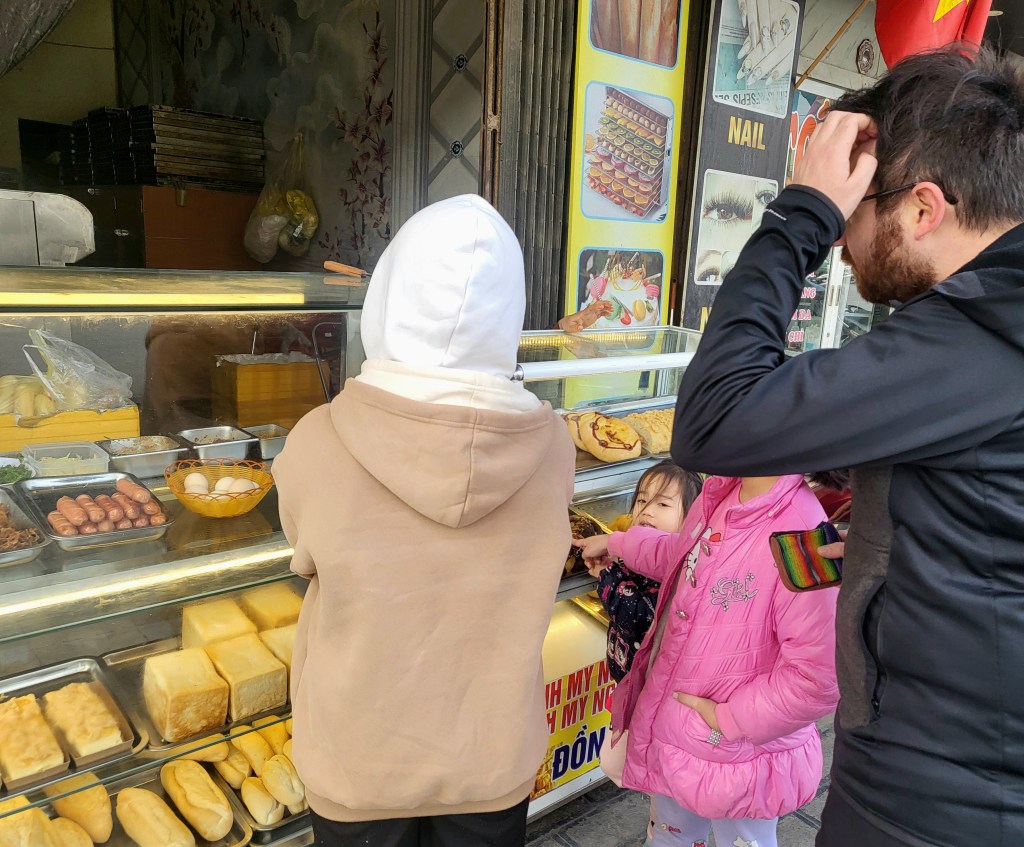
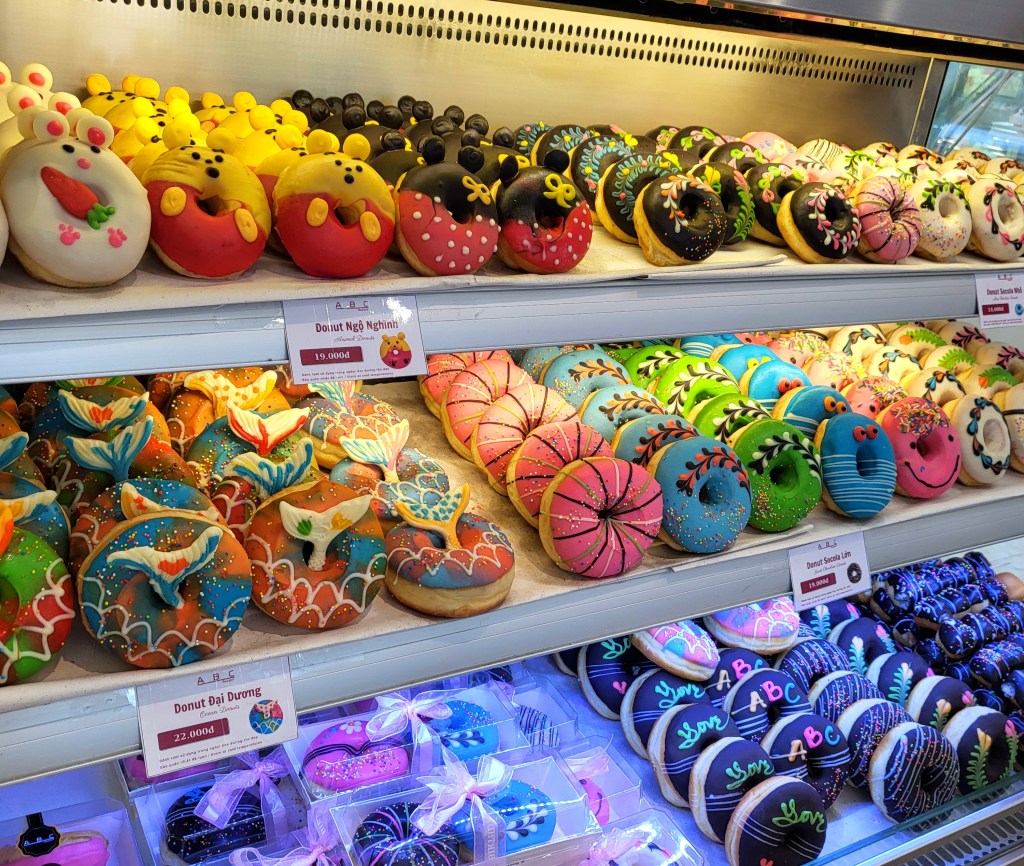
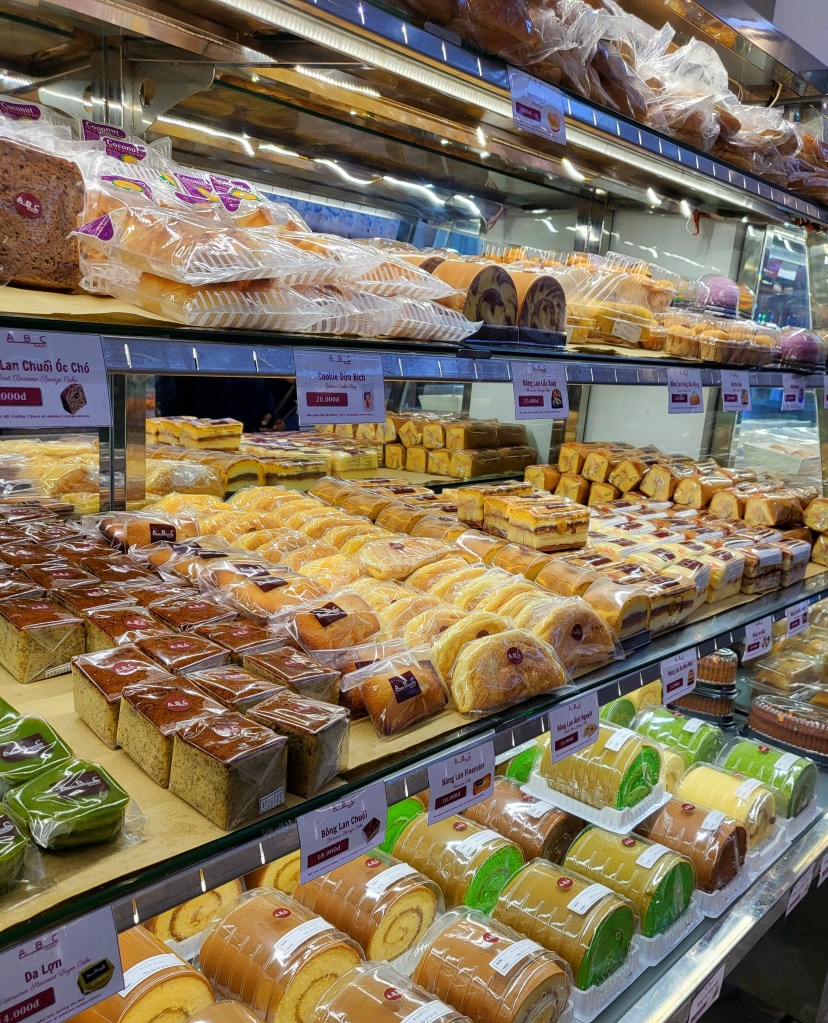
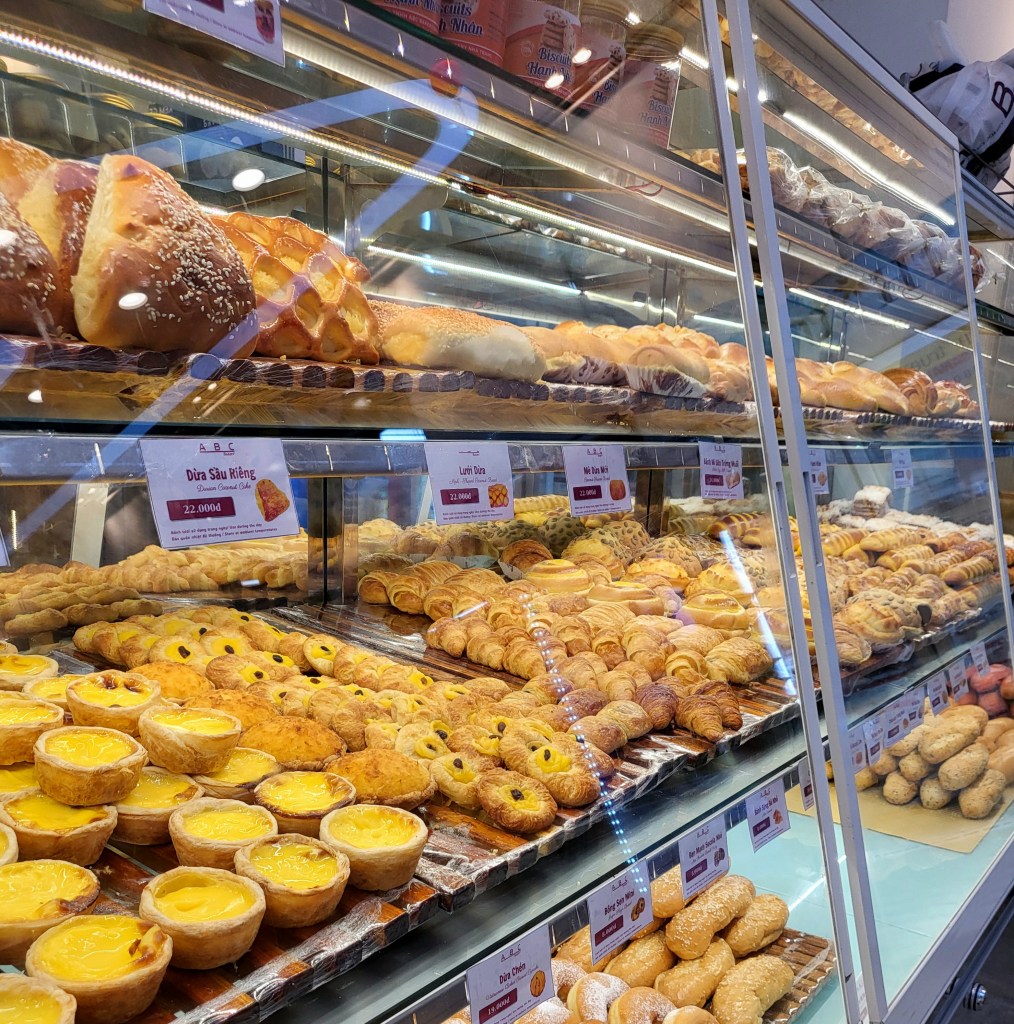
In the section « Some Vietnamese dishes detailed« , a non-exhaustive list of dishes that may be gluten-free is shared.
Their knowledge about gluten
Like many Asian countries, there is little knowledge of what gluten is, and there isn’t even a Vietnamese word for « gluten. » Few Vietnamese people follow a gluten-free diet: is this due to low detection or low occurrence of the disease in the population? The question remains open.
No matter the answer to this question, it means that the knowledge of gluten-free and what the diet entails must be provided by tourists or expatriates. The moderate influx of Western tourists in the country does not allow for the issue to be known by everyone, including and especially restaurateurs
In the most touristy cities, this is beginning to happen. It is certainly in Hoi An where I found that the staff had the most knowledge about gluten-free options.
When it comes to tourist activities related to cuisine (street food tours, cooking classes), the gluten-free option is offered in the majority of cases. The difficulty lies in finding a service that truly understands it. Sorting through is not simple and few opinions are left on this subject. I share in the section « my feedback« , the organizations I went through and with which I had no issues. This is only indicative and other providers must offer a serious service.
Communication with vietnamese
Due to this lack of knowledge, it is necessary to communicate well with the staff to educate them about what gluten is and to find out if you can eat at the establishment or not.
In my case, communication was difficult. The Vietnamese speak very little English. I had anticipated this issue by bringing an explanatory card, but it didn’t really help me.
I have not found a universal way to get my message across. At times, if not often, I took risks because I had a strong feeling that we did not understand each other. I discuss this in more details in the section « Preparing your communication with restaurants« .
Recipes, a well-kept secret
In addition to language issues with the Vietnamese, you will have to deal with the uncertainty around the secret ONthe recipe. At times, I had the impression that I wasn’t being told if certain ingredients were present simply to avoid giving me hints about the recipe.
This was somewhat confirmed by the guide we used for our street food tour. I had mentioned to him that I needed to follow a gluten-free diet and asked questions to make sure the dish was safe. He replied that he didn’t know the full list of ingredients and even if he asked, he wouldn’t know because the recipe is what makes the stand successful or not. It has been passed down from generation to generation, and that’s it.
Of course, some people will be more inclined than others to share, and I would even say that generally speaking, restaurants are more cooperative in this regard.
Street food culture
Everyone eats outside, including the locals. You will quickly see that either they sit with you on the small chairs at the stalls or they stop with their scooters for take away.
All of this means that supermarkets are not well developed, and for people following a gluten-free diet, it is often where they find a comfort area. We scan the labels, scrutinize them, and then take note of this product for the next cities. I haven’t done this much here simply because the products are expensive, the selection is limited, and the labeling is more approximate than back home, as I’ll detail in the paragraph below.
Raw materials such as vegetables or rice noodles are very accessible in the market (if you know the prices and negotiate) but you still need to have a kitchen in your accommodation which is not always easy as I detail it in « Looking for accommodations with a kitchen?« .
Product labeling
I have done a lot of research on this and I have not found anything very clear. I found many texts that mention good practices for labeling but I don’t think there is an obligation.
In the texts, gluten appears as one of the 8 necessary food ingredients to be shown on products containing it. But is this really followed? I don’t know, but I feel that when it comes to local products (i.e products that are neither exported to Western countries not imported from Western countries), it’s a bit up to each individual.
Regarding cross contamination during processes and traces, it’s a bit like playing the lottery: sometimes you’ll have it, sometimes not.
The essentials to prepare your trip
Learn some food related basic words
One extremely practical thing in Vietnam is that the name of their dish is very precise. Let me explain with the example below. While in the English version everything appears as « noodles », we can see that the Vietnamese name changes and these modifications indicate whether it is wheat, rice, or tapioca noodles! It’s so practical: no need to ask, no need to trust, everything is in the name or almost… In fact, there is at least one exception to the rule: Mì Quảng, whose name suggests wheat noodles while in the majority of cases it is actually rice noodles.
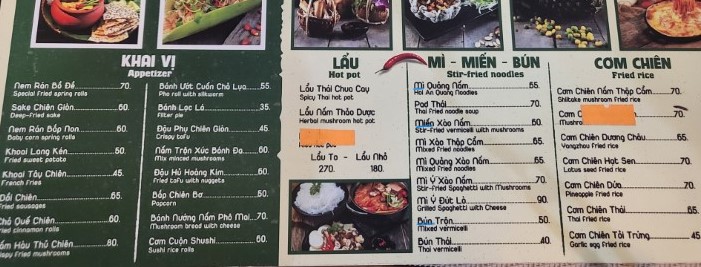
Useful words for a gluten-free diet
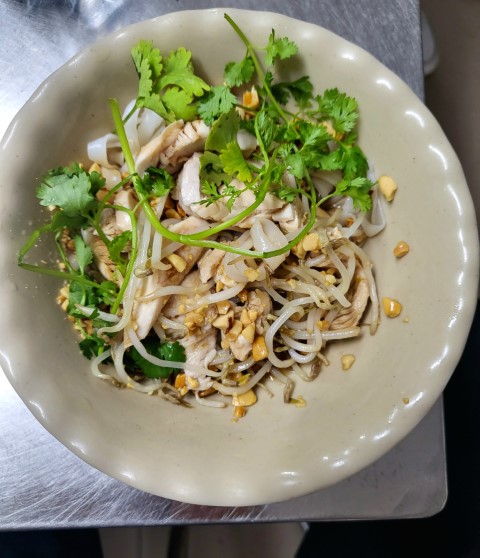
/!\ Some words below can refer to an ingredient as well as a dish. For instance, Phở refers to both rice noodles and a dish that can be served as a soup with chicken (Phở ga) or as a dry dish with chicken (Phở gà trộn). The small glossary below is only valid for the ingredient. The list of dishes and their specific points are detailed later in the article.
❌ Mì or my means wheat. The pasta dishes that result from it are served in the form of soup or stir-fried noodles. A notable exception is Mì Quảng, which is generally made with rice noodles instead of wheat noodles.
❌ Nui refers to macaroni made from wheat flour.
✅ Bánh canh refers to thick noodles that can be made solely from tapioca flour or with a mix of tapioca flour and rice flour. They are served in the form of soup.
✅ Bánh tráng means rice paper. You can find it in various forms, and these words appear in many dishes/snack names.
✅ Bún means rice vermicelli. They can be served in soup or dry form depending on the dish.
en
✅ Cao lầu refers to brown, crispy, and thick rice noodles that are said to originate from Hoi An. They are served in the form of soup.
✅ Cơm means rice.
✅ Miến refers to noodles made from mung bean flour. They can be served in the form of soup or stir-fried noodles.
✅ Pho: In addition to referring to the iconic Vietnamese soup, this word also denotes rice noodles whose appearance varies between the north of Vietnam (wide and white) and the south of Vietnam (thin and translucent).
Other useful words
Bò: beef
Chả : grilled pork
Chay: vegetarian
Gà: chicken
Nướng : grilled
Phô mai: cheese
I could write many more, but these few words will give you a little basis for understanding what you eat.
Be aware of hidden gluten sources
The main points of vigilance stands in the sauces, broths, marinades, and cross-contamination.
The main hidden sources of gluten are:
Soy sauce: It is mainly used to marinate meats in Vietnamese cuisine. It can also enhance sauces or broths as it is done in Cao Lau. In this case, it is simpler and you can request the soy sauce not to be added, and potentially ask for yours, if you have any, to be used. Most of the time, the staff does not know if they use gluten-free soy sauce, so do not hesitate to ask and you may be pleasantly surprised.
Also I read that the south tends to use more gluten-free soy sauce than the north. I cannot confirm this, but it seems to me that in the south, dishes more often contain soy sauce than in the north. For example, spring rolls are likely to be accompanied by Nuoc-mâm sauce in the north, while in the south they are more likely to be accompanied by soy sauce.
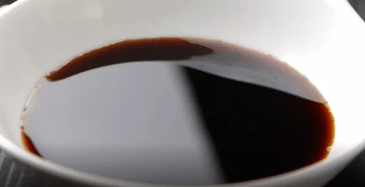
Oyster sauce: it is mainly used in stir-fried noodle dishes, marinades and soups. This lesser-known sauce has a brown color similar to soy sauce and is thick. This sauce, which was once only repared from oysters, is now made with oyster extract, soy sauce and usually cornstach. The contamination comes from soy sauce but also from the thickener which is not always cornstarch. Therefore, this sauce may or may not contain gluten
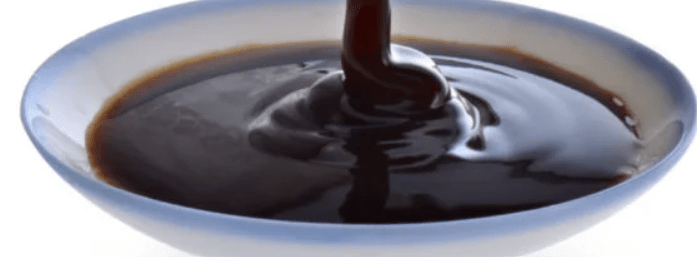
Plum Sauce: It is a sauce mainly used for dipping fried foods, but also as a marinade sauce. This sauce originally is gluten-free but some industrials will use wheat vinegar and/or wheat flour as a thickener for its preparation.
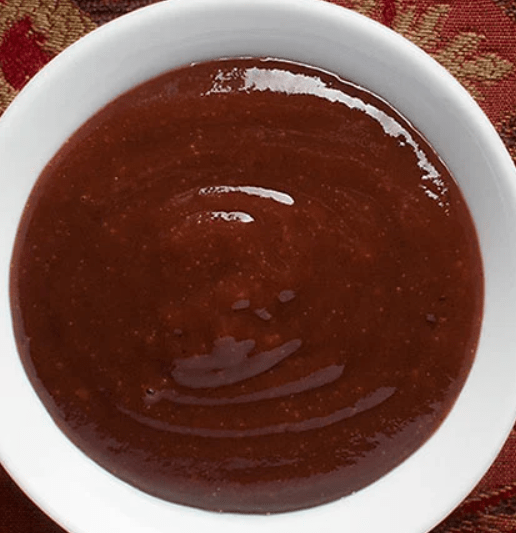
Hoisin sauce: it is a sauce mainly used for stir-fries, marinades and dipping. It is a dark and thick sauce that can be gluten-free. However some industrials will use a soya paste, which is the main ingredient of the sauce, prepared with wheat flour and/or wheat flour as a thickener for the sauce.
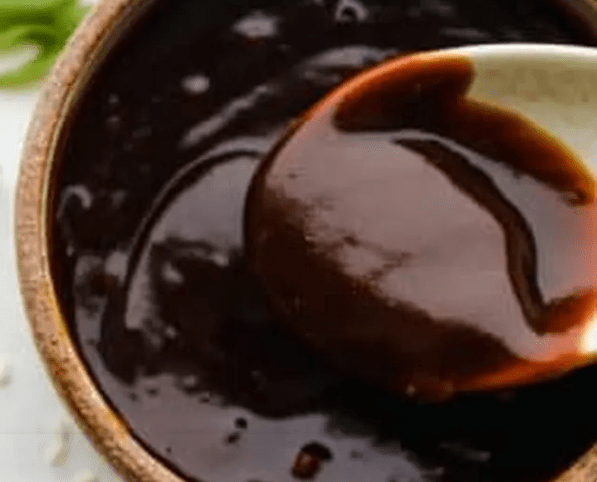
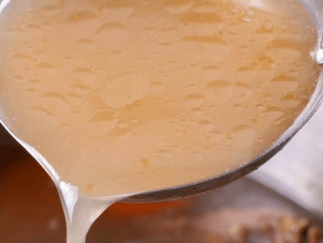
Stock cubes can be used in any soup depending on the restaurateur, as it is in Western countries. I prefer restaurants with few items on the menu: it’s oftren a guarantee of quality and homemade cooking. However, this rule is not unmistakable and Bun Cha Ta Hoi An, a restaurant specialized in Bun Cha, has used stock cubes. It remains to be seen if they will adapt their recipe to imitate the Hanoi branch, which doesn’t use stock cubes.
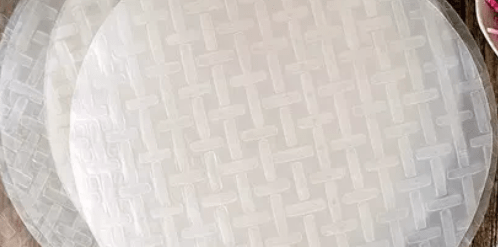
Rice Paper Wrappers used in spring rolls and many other dishes can sometimes be made from rice, or sometimes cut with wheat. I have come across them, but always in restaurants with endless menus. I have also taken part in cooking classes where I used completely yellow rice paper wrappers and was assured that they were indeed made of rice. Turmeric is often added to rice paper wrappers, giving them the yellow color, which does not necessarily mean wheat. This is a practice I have mostly found in the north.
Despite all these potential sources of contamination and the contamination issues I have encountered, I have never been glutened in a 100% Vietnamese restaurant.
However, I think I have been contaminated twice in 2 different restaurants that offered Vietnamese and Western dishes. The options were tempting because the menu clearly indicated naturally gluten-free options, and this variety allowed Kévin to diversify his meals. While I don’t necessarily need 2 separate kitchens to avoid getting sick but simply a good cleaning, I have been sick here almost every time gluten was used in a significant amount. So keep in mind that in restaurants offering Western dishes, you will need to particularly insist on the importance of cleaning, with the best option being simply not to eat there.
Save some addresses than can help you before and during your trip
I share here the websites and people who helped me prepare my trip through their content:
- Legal Nomads: https://www.legalnomads.com/gluten-free/vietnam/. This a coeliac fellow who has lived in Vietnam so I think all her tips are super valuable.
- Gluten-free Hanoi: https://www.instagram.com/glutenfreehanoi/?hl=fr lives in Hanoï and regularly shares good addresses consistent with a gluten-free diet.
- Find me gluten-free: https://www.findmeglutenfree.com/ to find places shared by the community.
Get ready for your communication with the staff
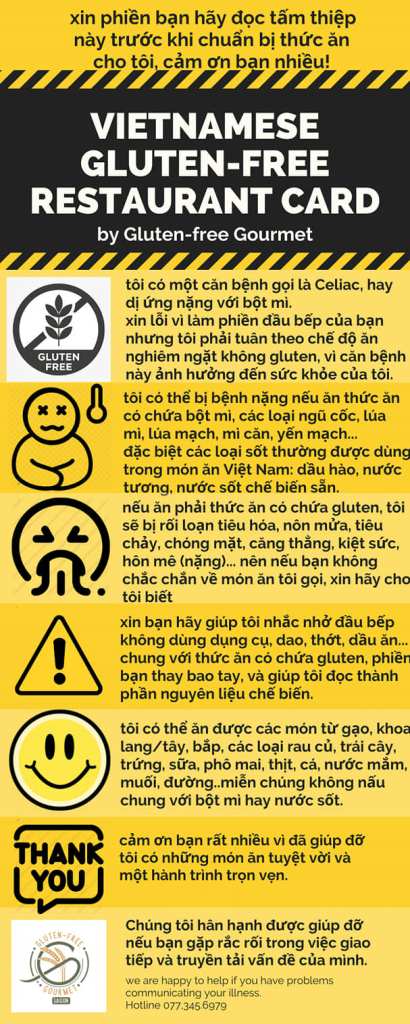
Before my trip, I downloaded the opposite explanatory map made by Gluten-Free Gourmet, but to be honest, I am perplexed about its usefulness. I have the feeling that it was too long and the staff tended to either not read it in full or just skim through it.
After several unsuccessful attempts, I decided to use Google Translate to only type the key points. I made sure they understood my message by asking questions that couldn’t be answered with « yes » or « no. » Unfortunately, after asking what dish I could eat or what flour they used, I would still hear « yes » over and over again.
My last resort was to make gestures, for example taking the soy sauce on the table and making the sign of the cross. But even then, we couldn’t understand each other…
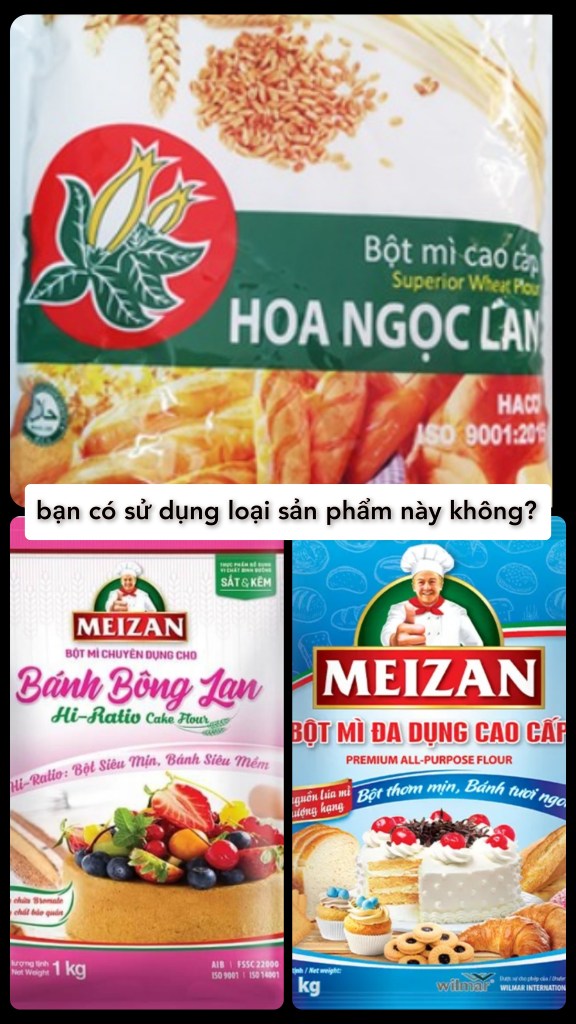
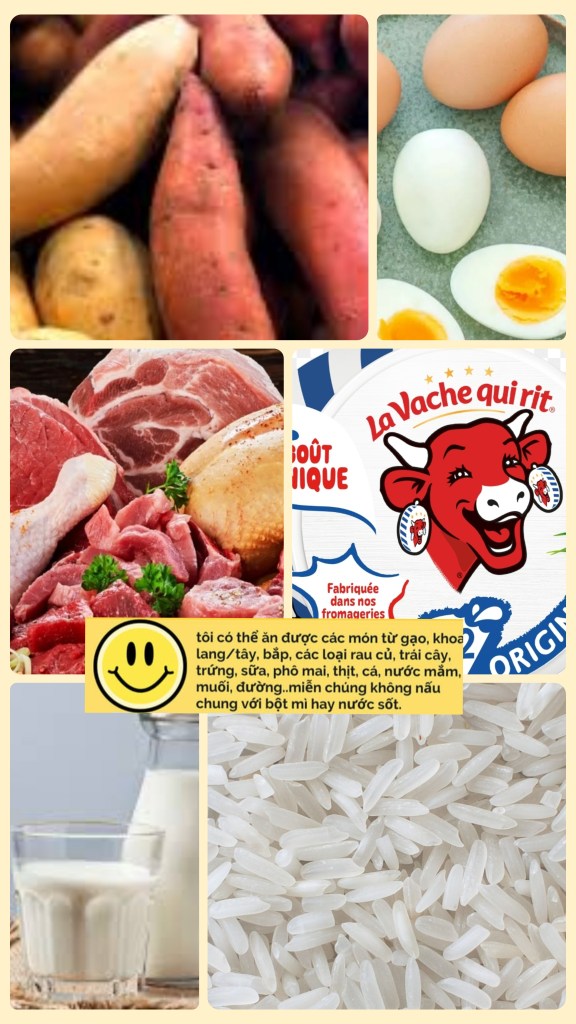
My experience was similar in Cambodia and Thailand. It was only when I was in Thailand that I decided to change my approach. I noticed that the term « wheat flour » didn’t resonate with them. When I went to grocery stores, I found that the terms used were more often « multi-purpose flour » or « cake flour« . I created a photomontage with the packaging of these flours and added a sentence asking if their products contained these ingredients, and finally, I felt that they understood what I was asking for!
As you have understood, I have not tested this approach in Vietnam, but I have the feeling that, just like in Thailand, it would help to make oneself understood. Therefore, I am sharing below a similar photomontage to the one I used in Thailand, which I recommend you to try if you face similar difficulties to mine.
Finally, learning more about the composition of dishes has greatly helped me and allowed me to target my requests as precisely as possible. In the section « Detailed Vietnamese dishes » I share with you the information I have learned on this subject.
Book accomodations with a kitchen ?
As mentioned earlier, there is a real eating out culture and finding accommodations with a kitchen can be more complicated than it seems.
If you are planning a short-term trip, I highly recommend trying to find accommodations with a kitchen: it will relieve you from stress, logistical issues, the risk of getting sick, and not being able to fully enjoy your stay. With a budget higher than what we had, meaning over $16/night, it is possible to find accommodations with a private kitchen. Don’t hesitate to ask your host whether the kitchen is shared or not. This happened to us several times to only get a shared space, and in the end, it was of limited use: it requires spending a lot of time cleaning each utensil. Regarding the ingredients, I recommend doing your shopping at the market, it will be much cheaper than at the supermarket. Pay close attention to how much the locals are paying, otherwise, you might end up with a personalized and higher price.
If you are traveling long-term and trying to limit your expenses, you will probably be less inclined to choose accommodations with kitchens. It is doable, and we have done it. However, it’s important to be aware that it involves taking risks.
I’ll let you make your choice based on your situation and, above all, your preferences.
Pack gluten-free food?
If you are travelling for a few weeks, I recommend bringing gluten-free snacks such as cookies, energy bars. These products can be found in some grocery stores, and street vendors offer snacks, however, this may cause you to lose time finding them or take additional risks.
Regarding sauces, I left without any and didn’t miss it. Vietnamese cuisine remains very flavorful despite the absence of sauce thanks to the numerous herbs they use.
I would tend to say that if you plan to mainly stay in the south, why not take your soy sauce. At the same time, southern cuisine tends to use more gluten-free soy sauce.
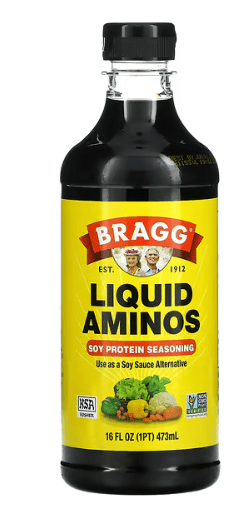
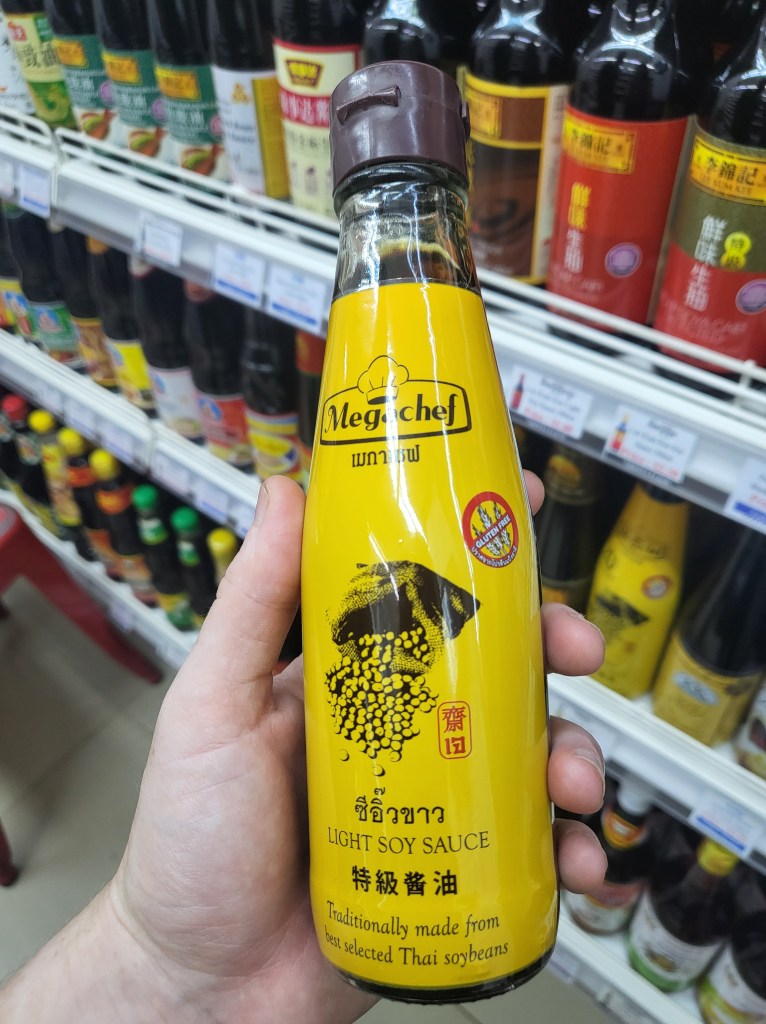
Another alternative is to adjust while you are in the country depending on your experience. In Hanoi or even in Ho Chi Minh, you can easily find gluten-free soy sauce at Annam Gourmet (all their current locations are tracked on the interactive map below). Gluten-free soy sauces can also be found in mini marts. I have provided alongside an example of gluten-free soy sauces that you can find there.
Once there: where and what to eat?
The paragraphs below provide details on what and where to eat, which dishes are available for a gluten-free diet as well as the precautions to be aware of.
Stalls vs restaurants
Overall, once on site, you can find similar dishes between a food stall and a restaurant, with the former being known for delivering more flavorful dishes when the place is trustworthy.
The major issue with street vendors is that they aim to serve as many customers as possible. There’s no customer service here – they simply serve your dish and it’s all about productivity. During peak hours, they aim to have you served, fed, and over within 15 minutes. There’s no room for questions here. When I arrived in Hanoi, I wasn’t aware of this and several street food vendors didn’t bother to interact with me when showing tgem my card. Instead they redirect me elsewhere. I found the approach somewhat abrupt, initially thinking that they didn’t want to bother with understanding foreigners. The next day, I went on a guided street food tour and the guide explained that this is how they are with everyone. Once, he asked for a slight modification to his dish and was told to go to the supermarket. Another time, when he was hesitant in making a choice, he was asked if he was illiterate. In a nutshell, most of the time street food vendors are not there to joke around, and their motto is truly « time is money ».
For a good start in the country, I strongly advise you to first start with the restaurants where you will be very well received in the vast majority of cases. Here, they will take all the necessary time to answer your questions, understand the situation, read your menu, tell you which dish you can eat, and which one you cannot. The risk of cross-contamination remains present, however. It is best to go to Vietnamese restaurants that do not offer any Western food to limit the risk of cross-contamination and offer few à la carte dishes to hopefully get a home-made and traditional dish (i.e gluten-free). Also, vegetarian restaurants are another good alternative: they were often more patient and cautious to the card I presented to them. Several times, they took a photo of it to show to the chef and returned with a concrete answer. International hotels are another option. On the Find me gluten free app, many users report this type of establishment because the staff speaks better English and likely has a better understanding of gluten. The only drawbacks to this are higher prices (but you’ll say that health has no price) and, above all, a greater risk of cross-contamination, as these establishments often offer wheat-based products (pizzas, Italian pasta, burgers…) without having a separate kitchen.
Once you have gained some experience and knowledge about Vietnamese cuisine, you will be much less stressed to go to street stalls to get gluten-free dishes and sometimes even venture to dishes that may contain gluten or not depending on the sauces used. It is best to do this in large cities where they speak better English but small enough for the customer flow to be interrupted. You can also come at off-peak times, but in that case, you need to be more careful to ensure that the food is always fresh! Finally, most guided tours of street stalls in big cities offer adaptations of their tour based on each person’s dietary restrictions. Taking one of these tours is a good opportunity to learn about the street stalls you can visit and those you cannot. We did one in Hanoi Hanoi street food tour with local delicacies. The tour lasted 3 hours and we tried 7 street stalls, which allowed us to diversify our meals during our stay in the city. I will talk about it in more detail in my feedback.
Some vietnamese dishes detailed
Below you will find a list of dishes that may potentially be gluten-free, the points of attention should help you know on which point you should insist. This is, however, only a starting point to assist and guide you during your stay in Vietnam, but it by no means represents an absolute truth: everyone can have their own recipe and I am just sharing here what I was able to understand during my stay. The aim is to help you see more clearly, to ask the right questions, and to assess the levels of risk involved.
In the list below, the dishes are sorted in alphabetical order so that you can find your way more easily.
Finally, since Vietnamese cuisine is very rich, I have no doubt that there are many other dishes that are compatible with a gluten-free diet. Feel free to leave their names in the comments if you know any, it will make the article even more comprehensive.
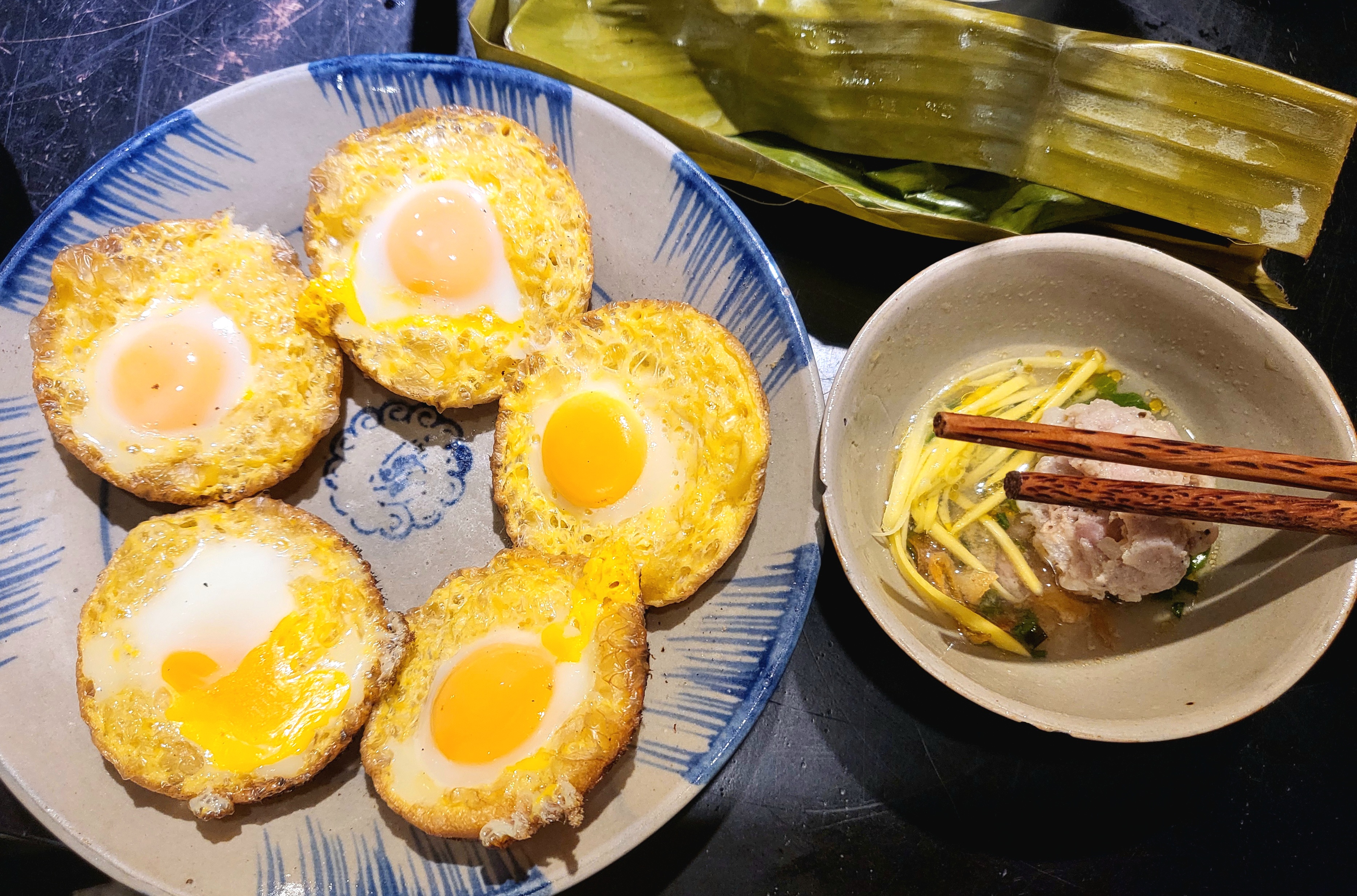
Bánh căn
Composition
The specific relevant content for this request, if necessary, delimited with characters: Bánh căn** are small pancakes made from rice flour. They are eaten savory and can be filled with eggs, pork, beef, cheese, and more.« `
Points of attention
Ready-made mixes can be used, and in this case, it is very likely that the pancakes contain gluten. Make sure that only rice flour is used, and if they talk to you about cake mix, it’s not a good sign.
Meat can also be marinated with different sauces (oyster sauce, plum sauce, hoisin sauce, soy sauce). Make sure they are not used or used in their gluten-free version. The Bánh căn filled with eggs, as shown in the photo, are less risk.
Cross-contamination risks are usually very limited because the molds used in their preparation are normally dedicated to these pancakes.
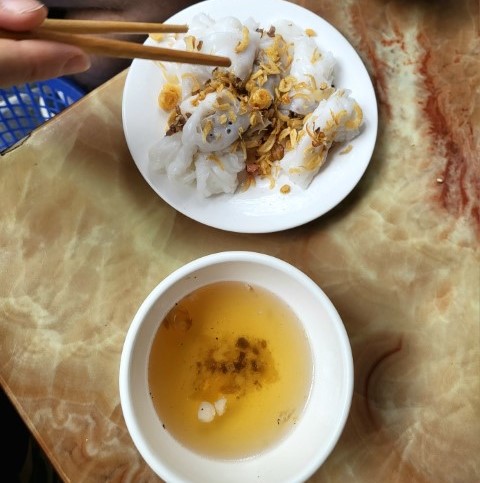
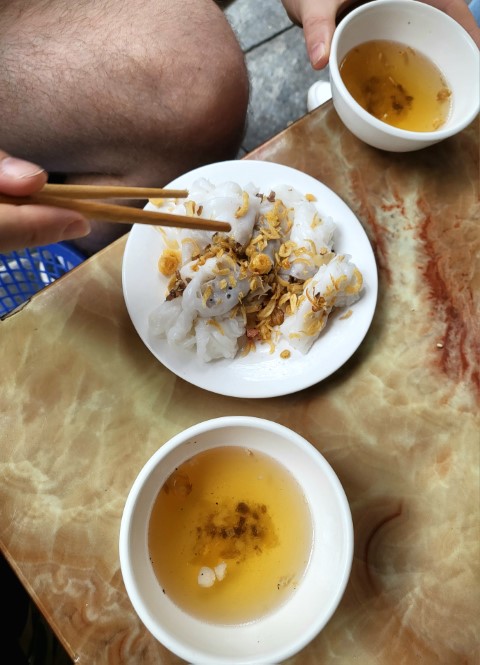
Bánh cuốn
Composition
The Bánh cuốn is a popular dish in northern Vietnam. It is a rice sheet filled with minced pork and black mushrooms, sprinkled with fried onions. The dish is typically enjoyed hot with nuoc nam sauce.
Points of attention
Be mindful of the onions. They may be fried with flour. So if in doubt, ask for them to be removed. Everything else is normally gluten-free and safe.
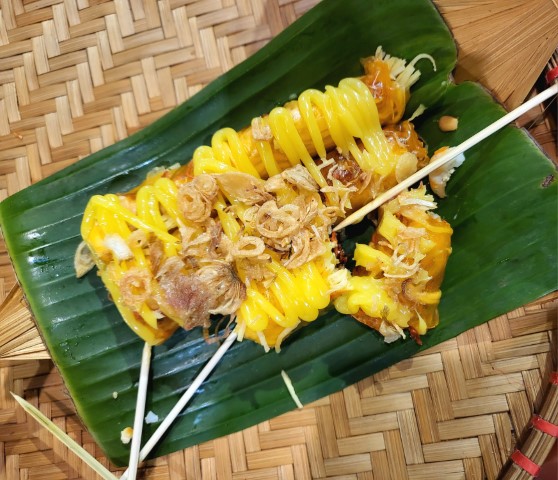
Bánh tráng cuốn
Composition
The Bánh tráng cuốn is a Vietnamese snack consisting of rolled rice sheets. Traditionally, they are filled with pork, but they can also be found with beef, tofu, and other protein sources. Everything is seasoned with spices and vegetables, then topped with sauce (usually mayonnaise) and previously fried shallots.
Points of attention
Fried shallots can be arranged on top. Ensure that they do not use wheat flour to fry them.
Inquire about the sauce as well.
Bánh tráng nướng 🌶
Composition
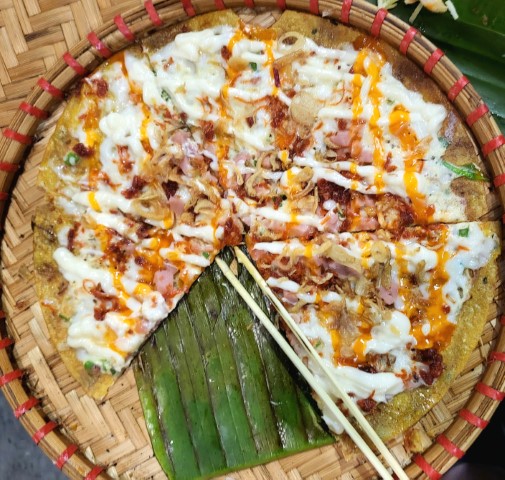
Bánh tráng nướng, which literally means grilled rice paper, is a kind of Vietnamese-style pizza. The dish consists of a grilled rice paper base topped with various ingredients such as eggs, onions, green peppers, pork sausage, cheese, and more. It is then complemented with a mildly spicy chili sauce. This dish is commonly enjoyed as a snack and is particularly popular among children. In the streets of Hanoi, there is no specific age or time for enjoying it.
Points of attention
Fried shallots can be sprinkled on top. Make sure they are not using wheat flour to fry them.
The sauce is usually also safe, but if you have any doubts, you can always ask to not have it (it will take away a bit of the spiciness ;-)).
Bánh tráng trộn
Composition
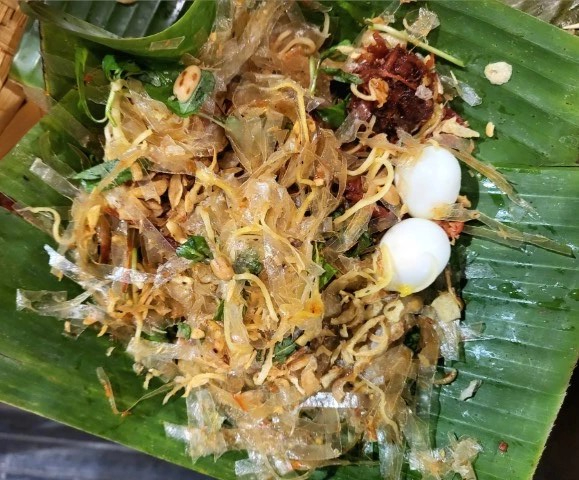
The Bánh tráng trộn is another Vietnamese snack. It is a kind of rice paper salad with various ingredients such as eggs (quail eggs in the photo), squid, onions, peanuts, mango, shallots, and numerous spices.
Points of attention
The dish can use soy sauce and oyster sauce, both of which may contain gluten.
Fried shallots can be sprinkled on top. Make sure they do not use wheat flour to fry them.
Bánh xèo
Composition
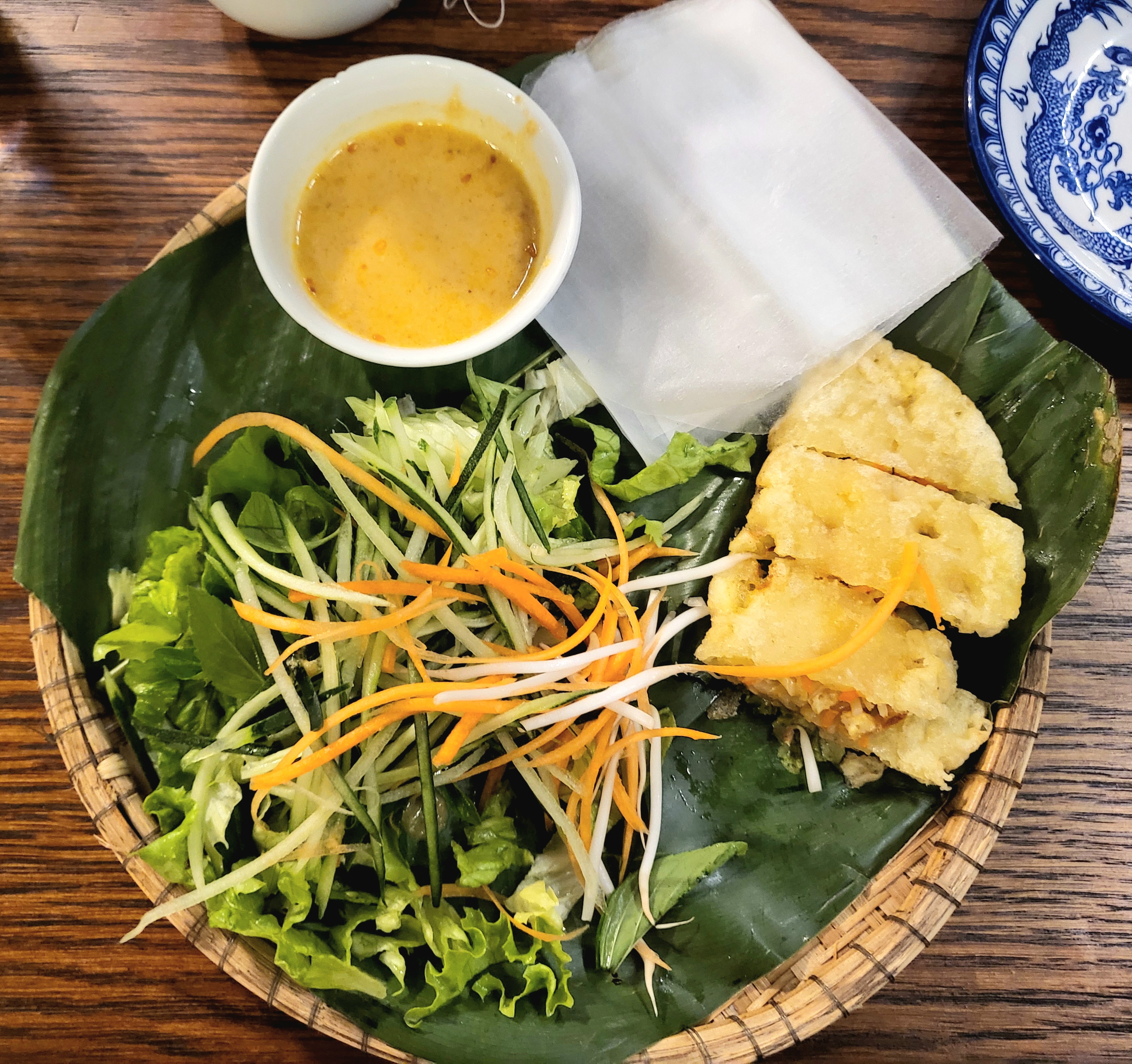
The Bánh xèo is a large pancake made from rice flour. It is usually filled with meat and vegetables. It is served with rice paper that you will fill with pieces of Bánh xèo and vegetables.
A peanut sauce or nuoc-mam is served separately and used to dip the rice paper filled with Bánh xèo and vegetables.
Points of attention
Ready-to-use mixes can be used to prepare the Bánh xèo batter. Make sure that only rice flour is used. If someone mentions « cake mix, » that’s not a good sign.
If the Bánh xèo you want to eat contains meat, make sure that none of the sauces to avoid have been used, or if they have been used, ensure they are gluten-free.
The peanut sauce can be prepared with oyster sauce. Make sure this is not the case or inquire about the ingredients of the oyster sauce used by the establishment. You can always ask for Nuoc-mam sauce as a replacement; it’s different but safer.
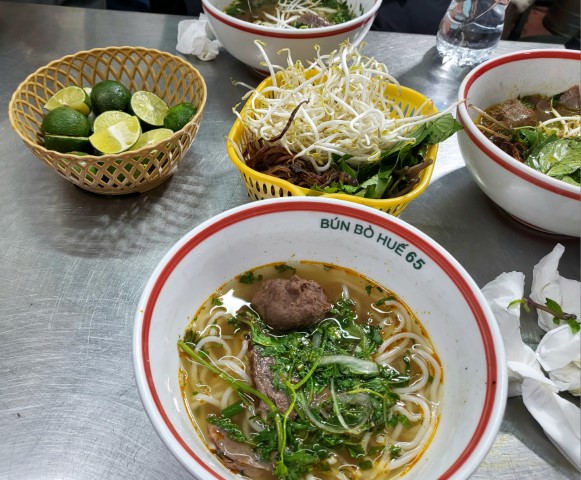
Bún Bò Huế
Composition
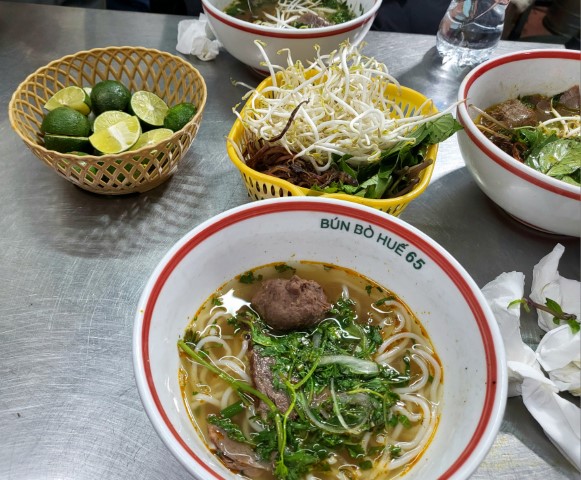
The Bún Bò Huế is a rice vermicelli soup with beef originating from Huế (Bún = vermicelli or rice noodles / Bò = beef / Huế = from the city of Huế). Originally very spicy, the recipe tends to be milder, and I have never had a problem eating it even though I’m really sensitive to spices. The Bún Bò Huế is also systematically prepared with pork in addition to beef.
The broth is composed of lemongrass, coriander, banana blossom, raw white onion, green onion, and Chinese chives.
Points of attention
Stock cubes can be used to prepare the soup. Make sure this is not the case. Generally, specialized restaurants will not use them. Also, pay attention to the cooking water if they also offer wheat pasta. It is likely that they use the same cooking water.
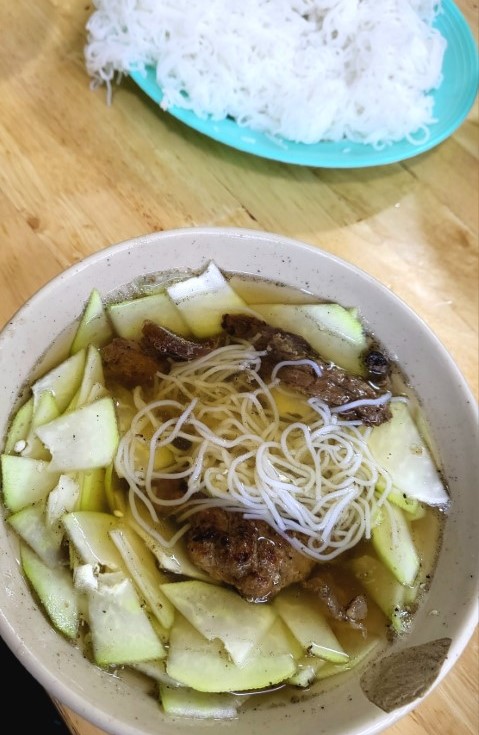
Bún chả
Composition
The Bún chả (Bún = rice vermicelli / chả = grilled fatty pork) originates from Hanoi. It consists of a broth, rice vermicelli, aromatic herbs and salads, and grilled pork. All these elements are served separately and will be dipped in the broth before being eaten. It’s excellent.
Points of attention
Stock cubes can be used to prepare the soup. Make sure this is not the case. Generally, specialized restaurants will not use them.
Also, pay attention to the cooking water if they also offer wheat pasta. They might use the same cooking water.
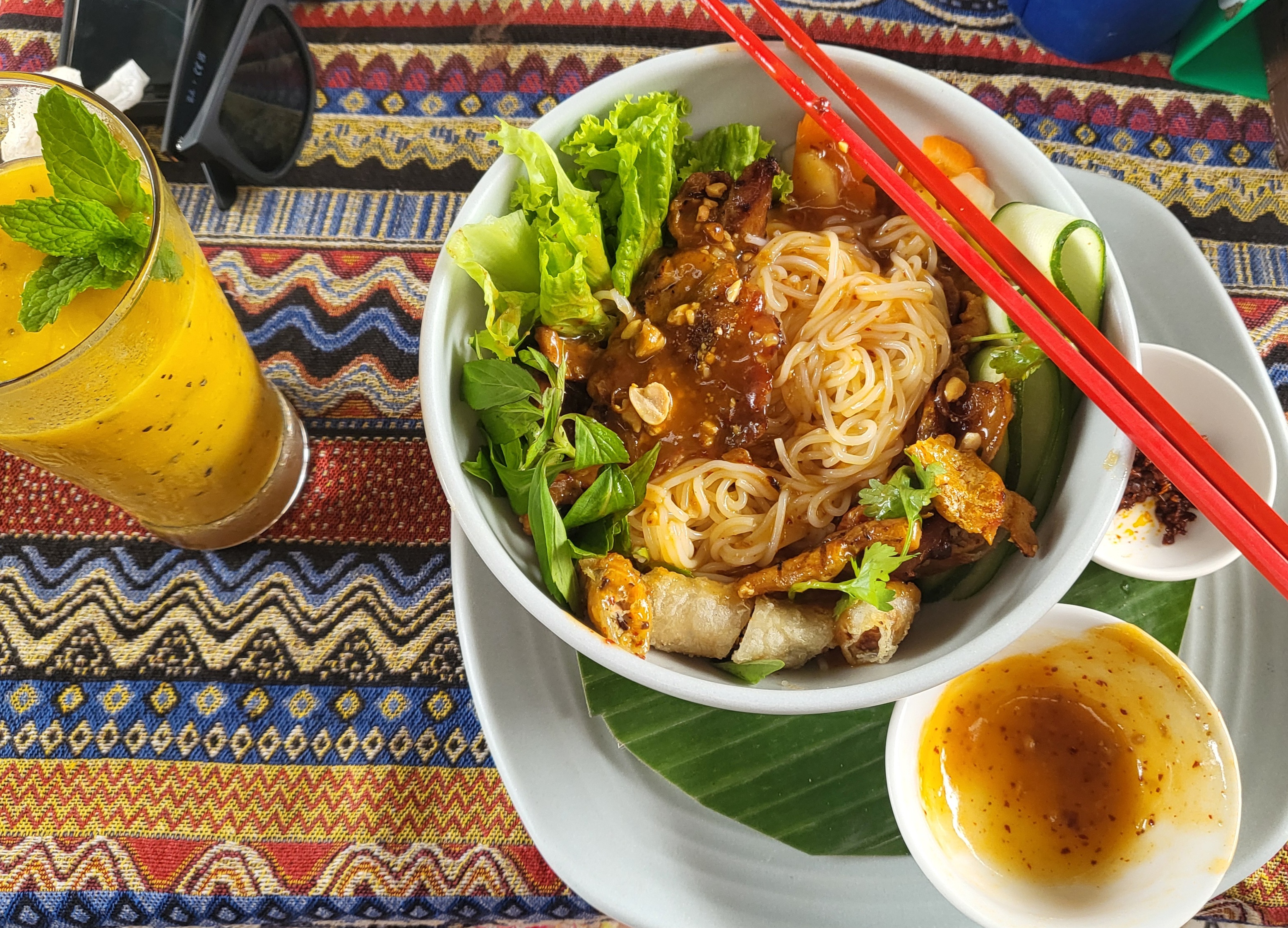
Bún thịt nướng
Composition
The Bún thịt nướng is served in a bowl with rice noodles, raw vegetables, meat, and sometimes spring rolls. It is then sprinkled with roasted peanuts. Peanut sauce is provided separately and should be poured over the noodles according to your preference.
Points of attention
Peanut sauce can be made from sauces to avoid (such as soy sauce and oyster sauce). For more information, ask the staff. When in doubt, you can always use your soy sauce or ask for Nuoc mam sauce. It won’t taste the same, but it will still allow you to taste the finesse of Vietnamese cuisine with its carefully selected blends of herbs.
If your version includes spring rolls, make sure they are made with rice paper and that the fryer used is safe (look at the other dishes offered by the establishment to determine the level of caution you should have). Also, pay attention to the cooking water if they also offer wheat noodles. They may use the same cooking water.
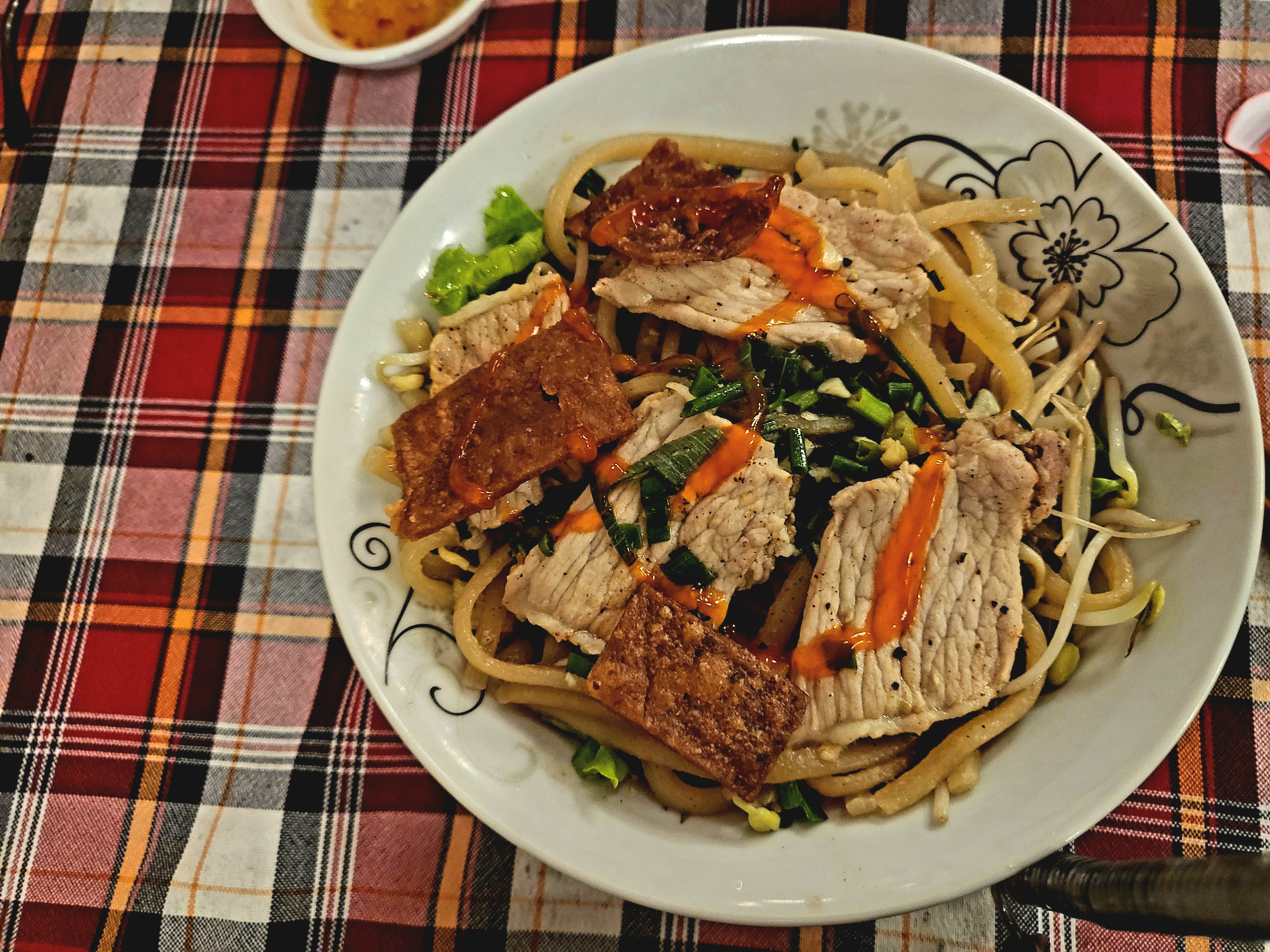
Cao lầu
Composition
Cao lầu is served with noodles of the same name, meat (pork, shrimp, etc.), and raw vegetables. Croutons made from dried cao lầu noodles and fried pork skin are placed on top. The dish is accompanied by some soybean sprouts and a broth base.
Spicy sauce is often poured on top.
Points of attention
Soy sauce is used for making the broth. Make sure that the sauce used is gluten-free. Otherwise, ask to be served withouy broth and use your own soy sauce. It will be different but it will allow you to taste these noodles that have a very particular texture.
Depending on the establishment, the making of the croutons can vary widely: made from rice paper, other types of noodles, or wonton (wheat sheet). There is also a risk of cross-contamination during frying or simply by using wheat flour. If you have trouble making yourself understood, the simplest thing is probably to ask for the dish without these croutons.
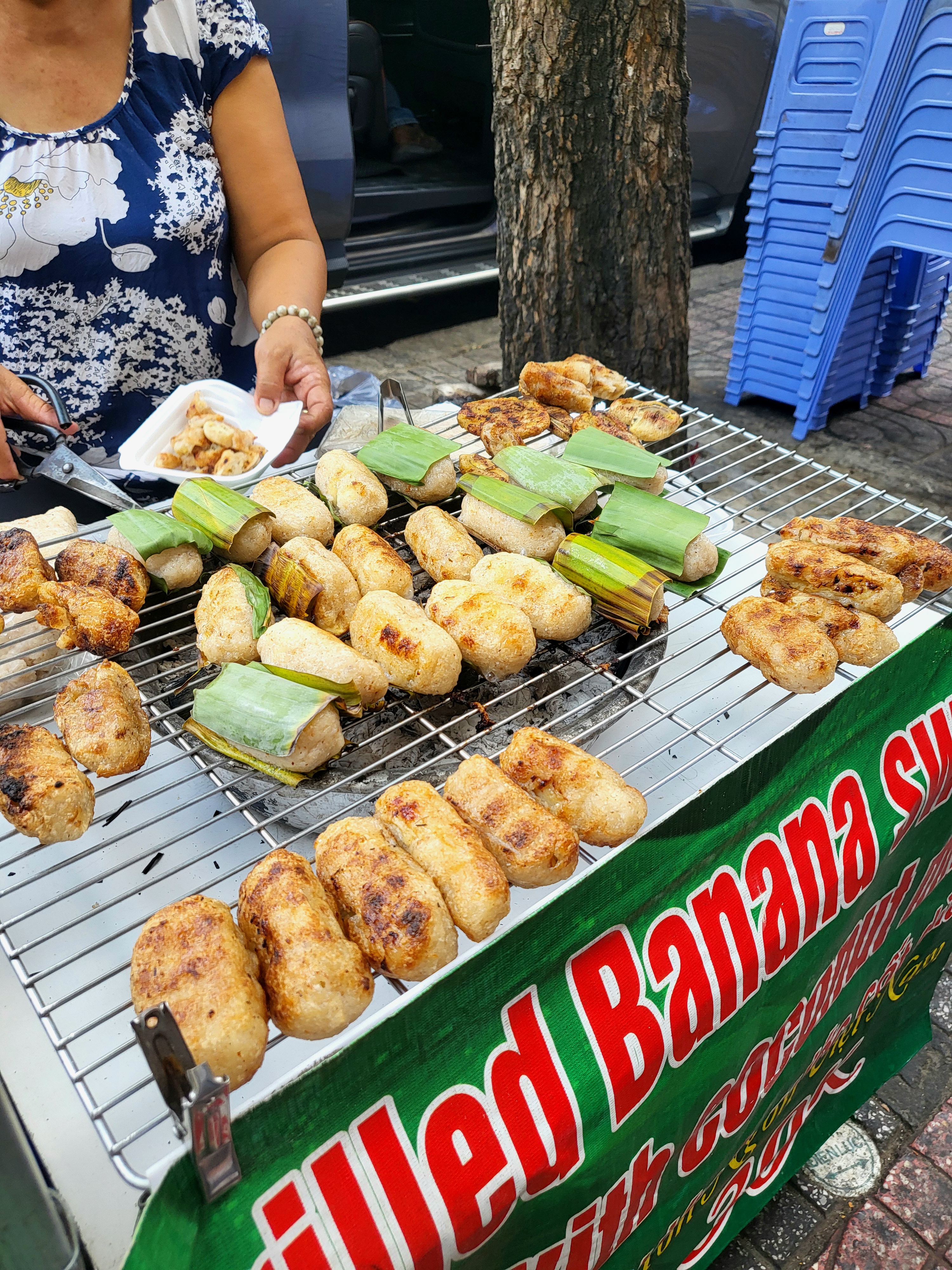
Chuối Nếp Nướng
Composition
Very popular in the southern part of the country, Chuối Nếp Nướng is a popular snack made of grilled banana wrapped in sticky rice. It is served with a sauce made of coconut milk and peanuts. Tapioca pearls can also be used as toppings.
Points of attention
The coconut milk sauce is thickened. Normally, tapioca starch is used as a thickening agent. I haven’t heard of other versions, but if you prefer not to take any risks, you can always eat the bananas without the milk; it’s another popular option.
Cơm gà
Composition
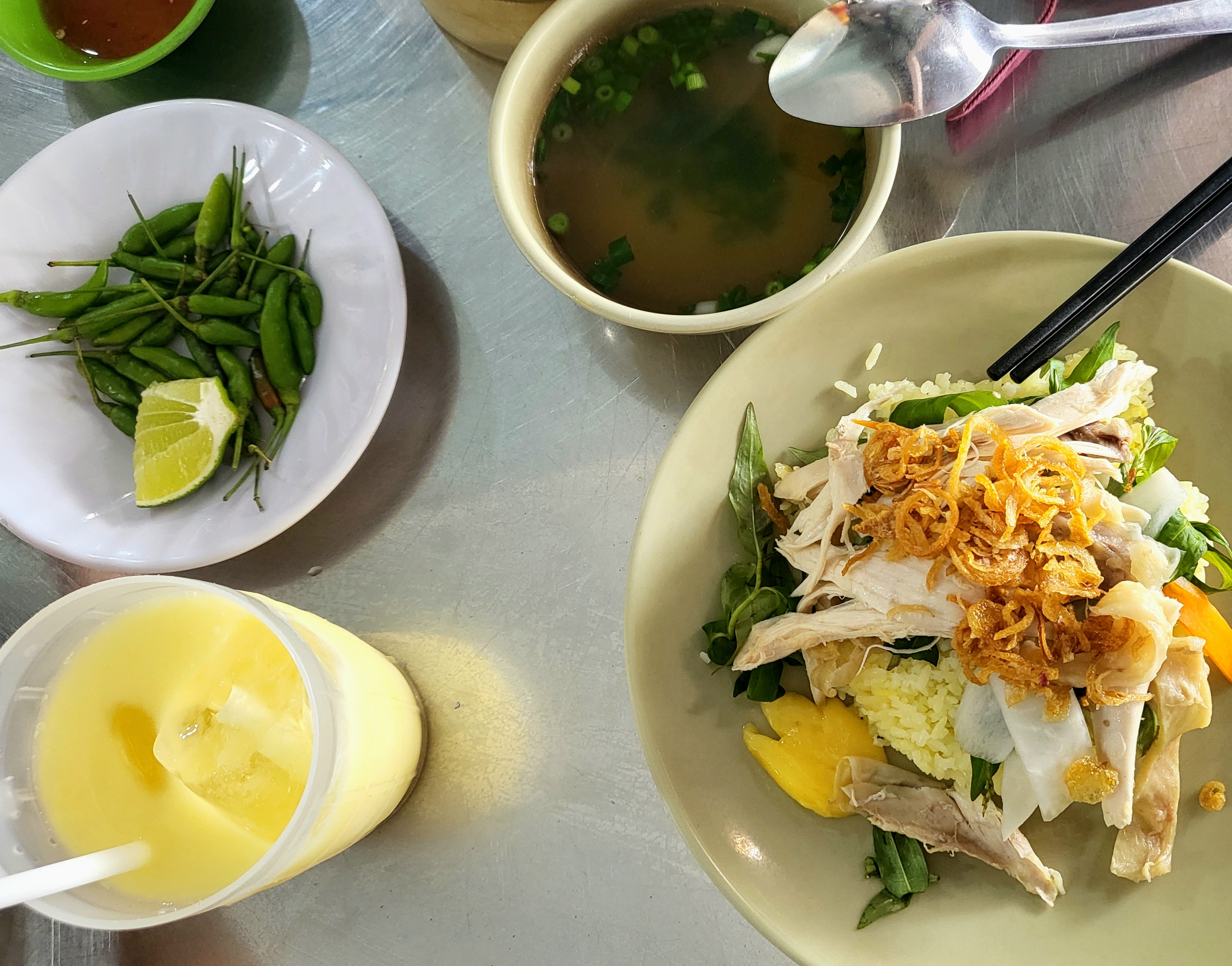
The cơm gà is a dish made of rice cooked in chicken broth and accompanied by herbs, chicken, and fried shallots. A touch of Vietnamese-style mayonnaise sauce is added to make the dish less dry. A broth is also served separately to moisten the dish to your liking.
Points of attention
Rice is normally yellow and gets its color from the chicken fat. Some restaurants do not make their own broth and use bouillon cubes, which means there is a high risk of gluten content, and they color the rice with turmeric. The color is then more intense.
The Vietnamese-style revised mayonnaise may also contain gluten. If you have trouble getting your message across, it’s best to ask for a dish without it.
Finally, the separately provided broth may also be made from stock cubes with a high risk of gluten content. If in doubt, do not use it. The dish will still be delicious!
Mì Quảng
Composition
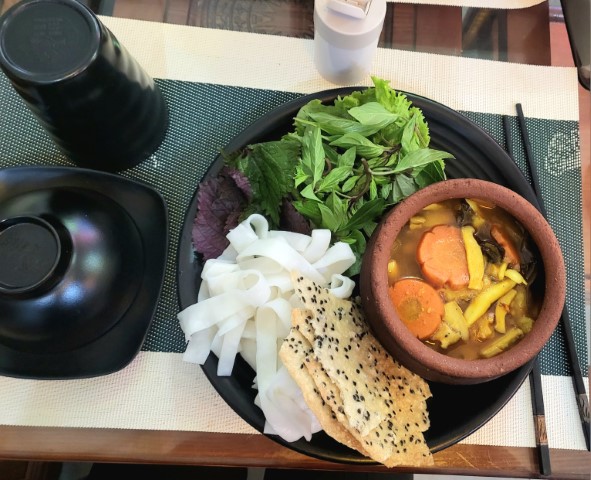
Mì Quảng ? You are going to tell me that since the beginning of the article I have been telling you to avoid « Mì » noodles, so why is this dish here? Mì Quảng is the first dish that introduced egg noodles (mostly with wheat) to Vietnam. This type of noodle was brought by the Chinese, whose influence was very strong in Hoi An, an important port for commercial activities with Japan and China. However, this dish has evolved a lot afterwards. Rice remains the most available local ingredient, and the noodles used later are rice noodles.
The photo depicts a meat-free version but the original recipe incorporates pork, shrimp, and eggs.
The dish is accompanied by rice crackers.
To find out more or to cook it yourself, feel free to follow this link: https://guidefrancophone.com/mi-quang/
Points of attention
Before placing an order, I always prefer to inquire whether the dish includes rice noodles. Also, pay attention to the cooking water if they also offer wheat noodles. They might use the same cooking water.

Nem ou Cha gio
Composition
Nems (name given in the North) or Cha gio (name given in the South) normally consist of a rice paper sheet fried with a very flavorful filling introduced beforehand. They can be found in versions without meat, with chicken, with pork, or with seafood.
A prepared fish sauce, called nước mắm, is served alongside the nems.
Points of attention
Although rice paper is the most common version, some use sheets made from wheat. This trend would be more pronounced in the north, but for my part I have not seen any difference and both versions existed everywhere in Vietnam.
Soy sauce can also be brought to you instead of nước mắm sauce.
Finally, you will need to be careful about the risks of cross-contamination in the fryer.
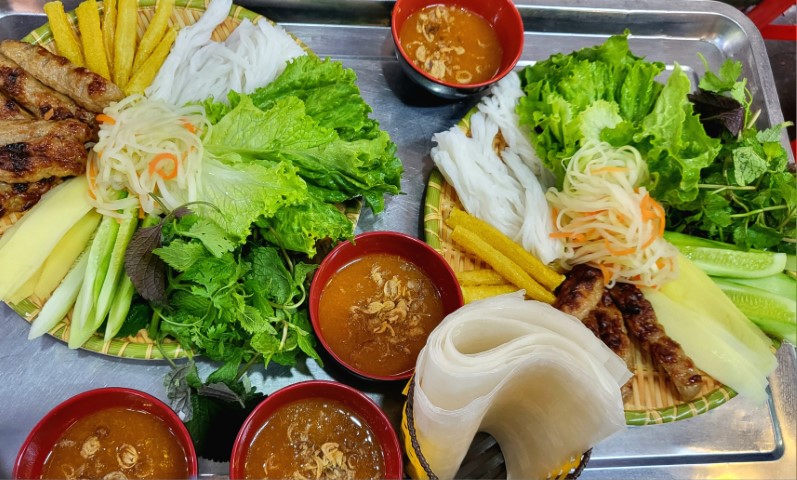
Nem nướng
Composition
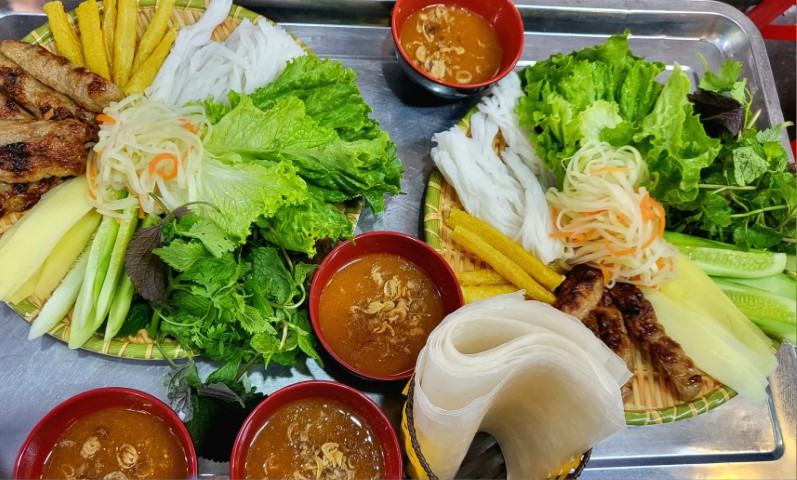
The Nem nướng (literally grilled sausage) is a Vietnamese grilled pork sausage or grilled meatball that is served with mango, rice vermicelli, dried and grilled rice, cucumber, lettuce, and other raw vegetables. Everything arrives separately, and you will roll the food to your liking in a rice paper sheet that you can then dip in peanut sauce.
Points of attention
The peanut sauce is generally prepared with hoisin sauce, which almost always contains soy sauce. Make sure to confirm before dipping your roll, or abstain if in doubt. It will still be very tasty nonetheless. Also, ensure that the meat has not been marinated in risky sauces, or that they have been used in their gluten-free version.
Phô
Composition
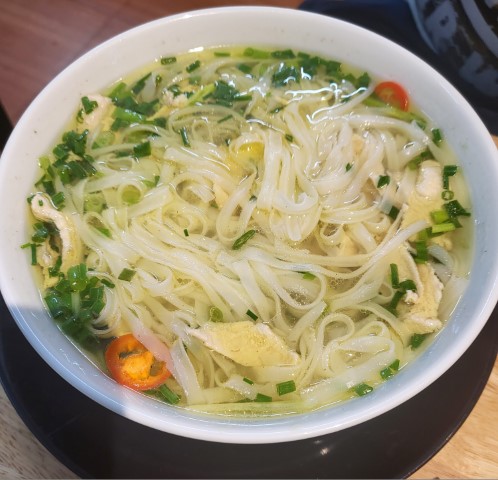
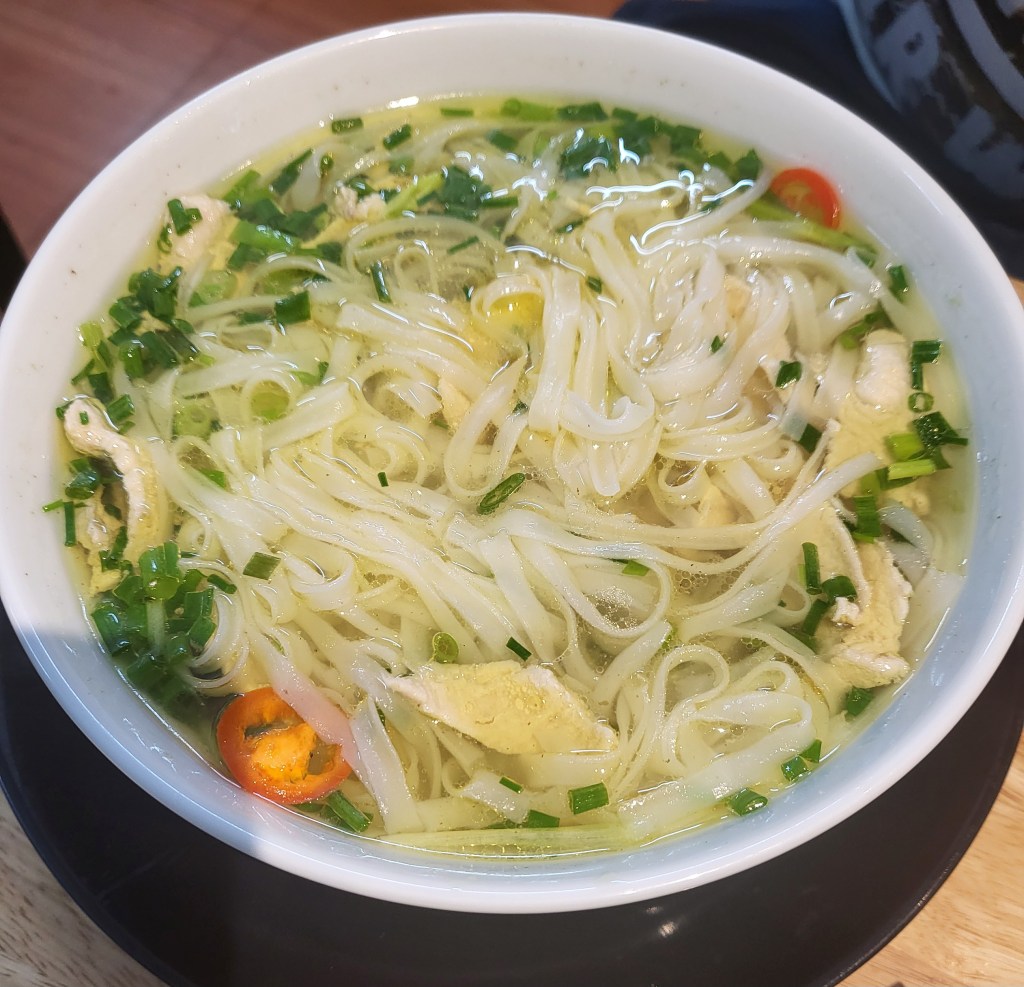
Pho is an iconic Vietnamese rice noodle soup. There are many variations, but the soup will always be made with rice noodles. The broth is also very characteristic and is made with spices such as cinnamon, star anise, ginger, cardamom, and cloves. Sometimes in northern Vietnam, the broth can be simpler with spring onions, coriander, and chili. In this case, the broth is slightly spicy.
Pho is traditionally made with beef, but can also be made with chicken.
There is also a summer version that does not include broth. The dish is then served warm.
Once served, you can season it with lemon, coriander, Thai basil, and bird’s eye chili.
Points of attention
Stock cubes can be used to prepare the soup. Ensure this is not the case. Typically, specialized restaurants will not use them.
In its broth-free version, pho will usually be seasoned with soy sauce. Make sure this is not the case, or that a gluten-free sauce is used. If you have your own soy sauce, you can offer it to avoid any disappointment, as it is added to the noodles after preparation.
Also, pay attention to the cooking water if they also offer wheat noodles. They may use the same cooking water.
Groceries
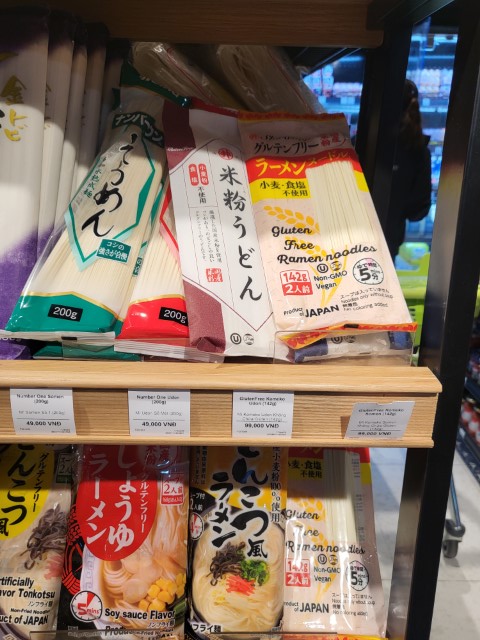
Overall, the prices in grocery stores and small supermarkets are much higher than the food you will find outside (whether in street stalls, restaurants, or on the market). As a result, we also did not do much grocery shopping, except to try to find some snacks.
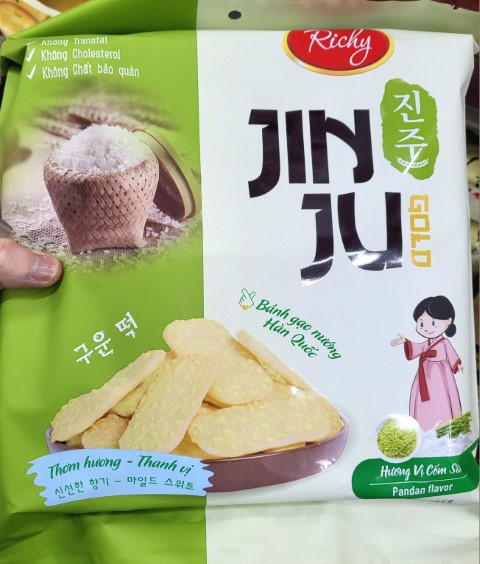
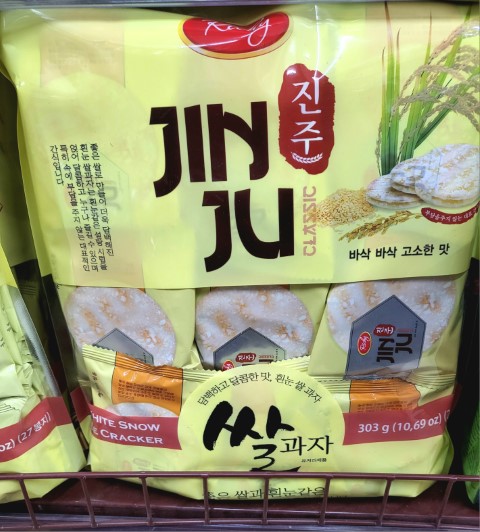
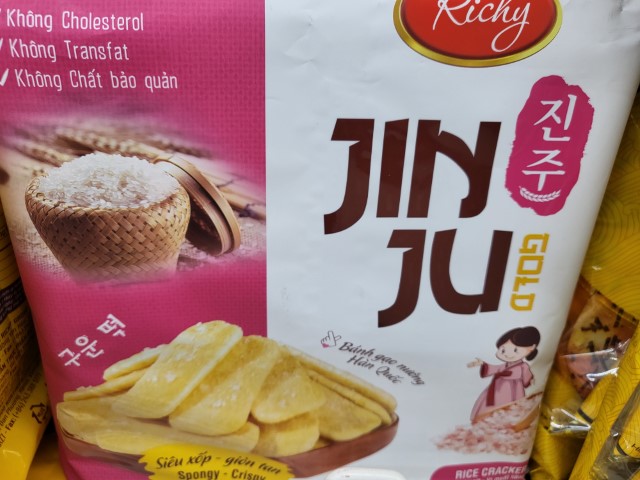
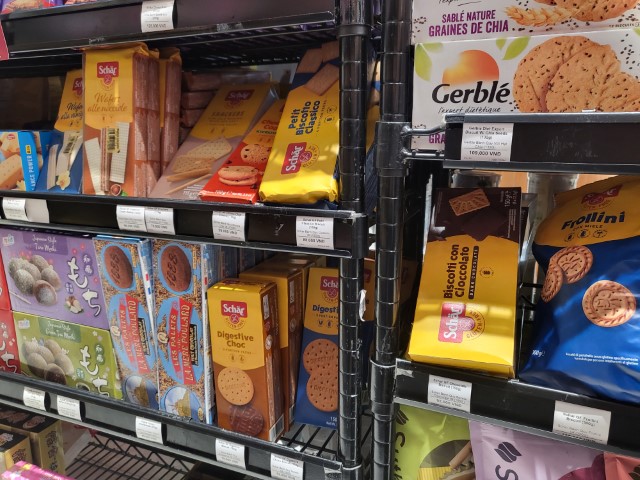
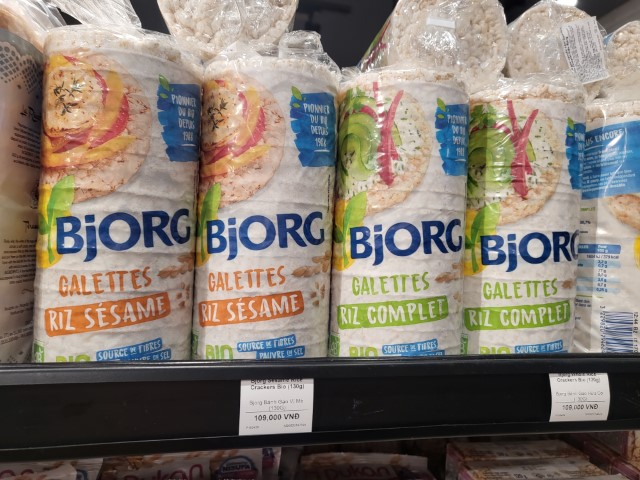
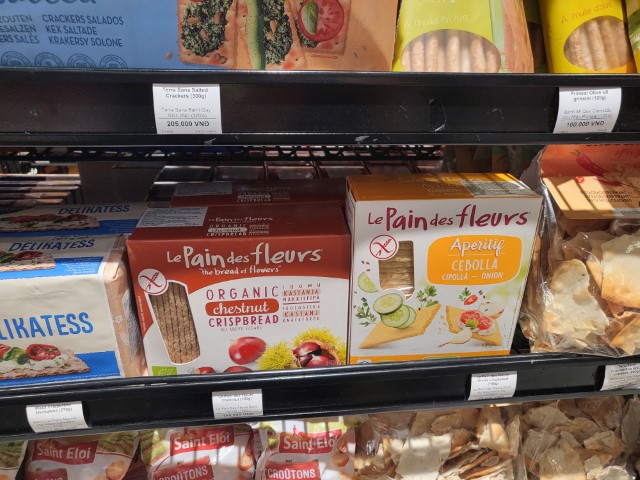
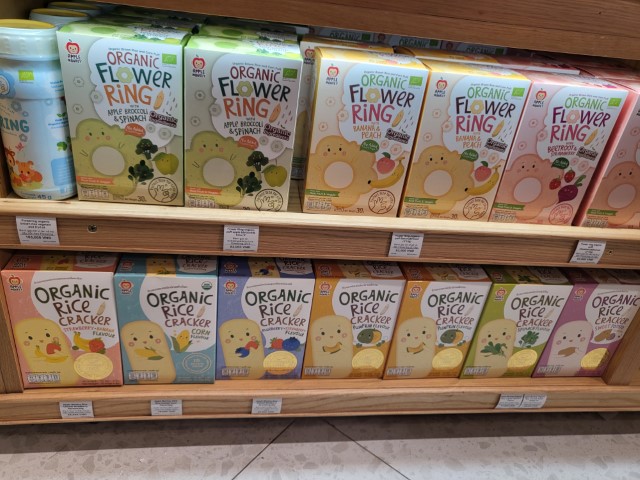
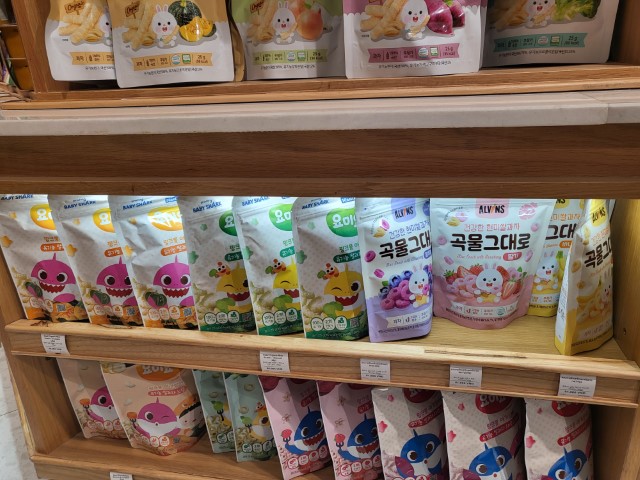
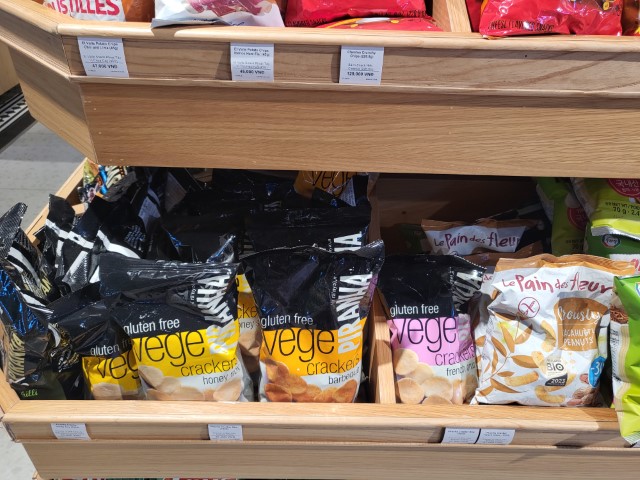
In standard grocery stores, you won’t find certified gluten-free products, but you may come across a few emergency products such as dried fruits and yogurts. I also managed to find some rice crackers that do not contain gluten, although it’s harder to determine whether they may contain traces or not. I found them at Winmart and co.opmarket. It’s possible that these could also be available at other convenience stores.
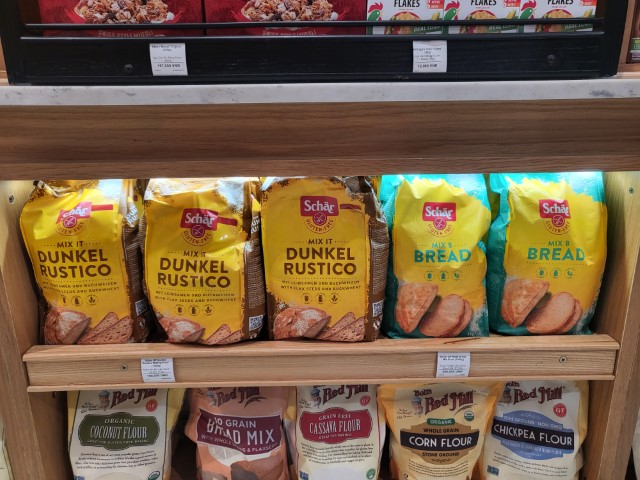
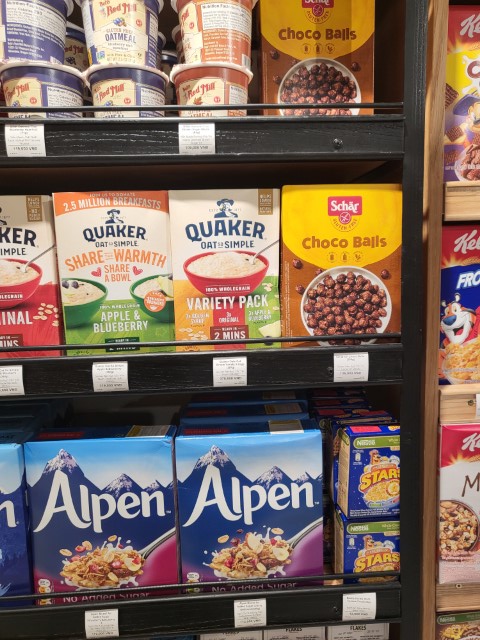
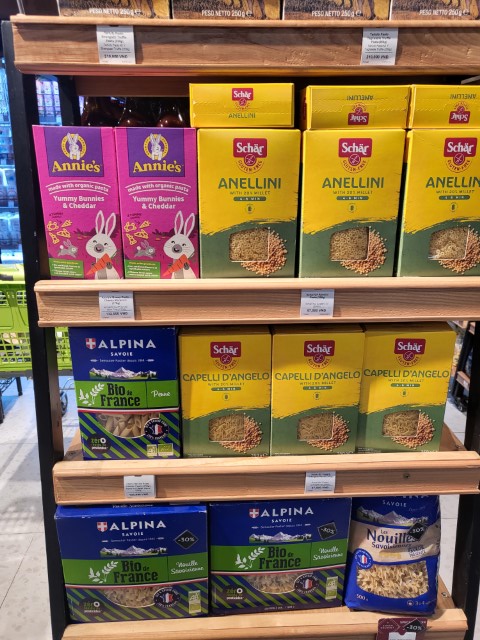
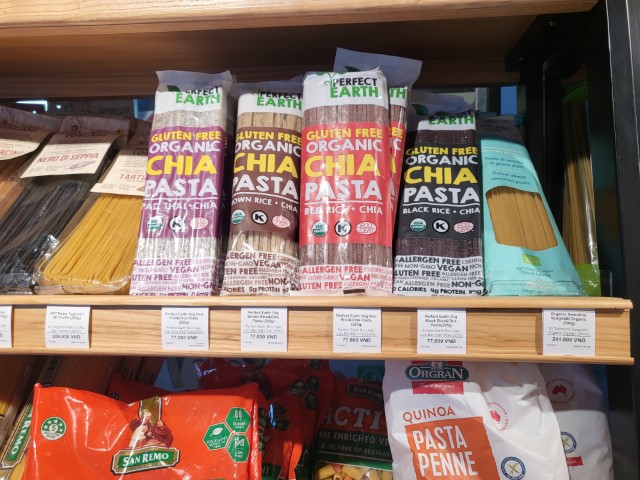
Specialized but also more expensive supermarkets exist, such as Annam Gourmet located in Hanoi and Ho Chi Minh. There, you will find a wide range of certified gluten-free products, which is a great opportunity to stock up on snacks for your trip.
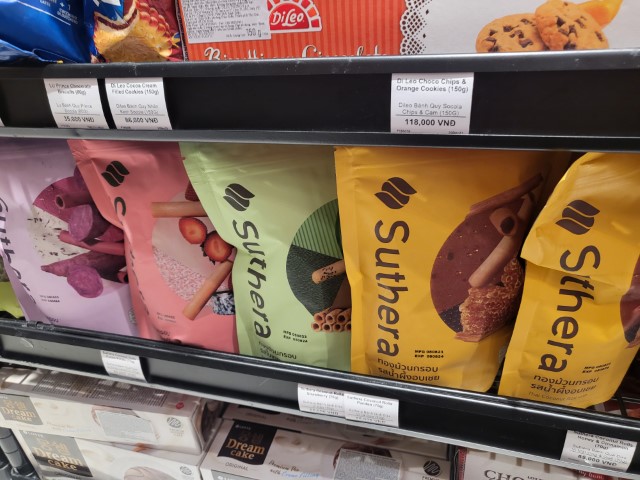
The Suthera biscuits shown in the first photo are small cookies imported from Thailand. They are available in different flavors and are naturally gluten-free. There is no indication in regards to traces but personally, I did not get sick.
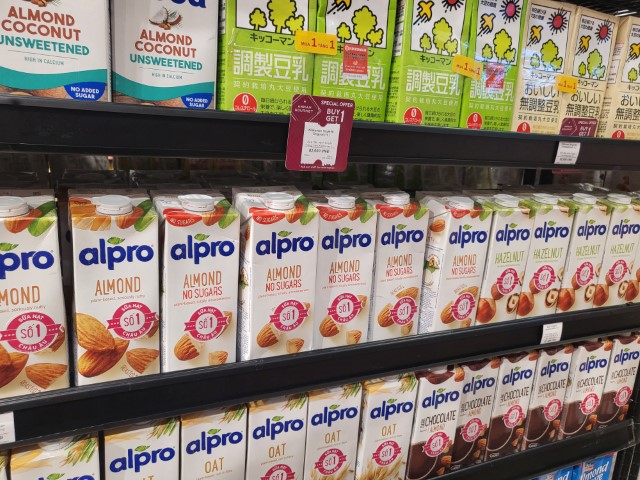
You will also find Schär products, rice cakes from Bjorg, and numerous alternatives for those with lactose intolerance. Additionally, you will also find flour, pasta, and chips.
There are no dedicated gluten-free shelves, so you will need to search for these products. It will be a pleasant surprise each time you come across a new item.
Activites and addresses I have personally tested
I present here some of the activities and restaurants that I particularly enjoyed during my trip.
Activites around food
Street food guided tour – Hanoi street food tour with local delicacies in Hanoi
In the first few days of our arrival in Vietnam, we took a guided tour of the street food stalls with Hanoi street food tour with local delicacies.
The tour is conducted in English and costs $27/person. We were able to taste 5 dishes, 1 drink, and 1 dessert. The guide was able to accommodate a gluten-free diet. He even had his own gluten-free soy sauce to complement the dishes when the stalls did not have any.
This tour was incredibly helpful for the rest of the trip and allowed me to eat at street stalls with more confidence.

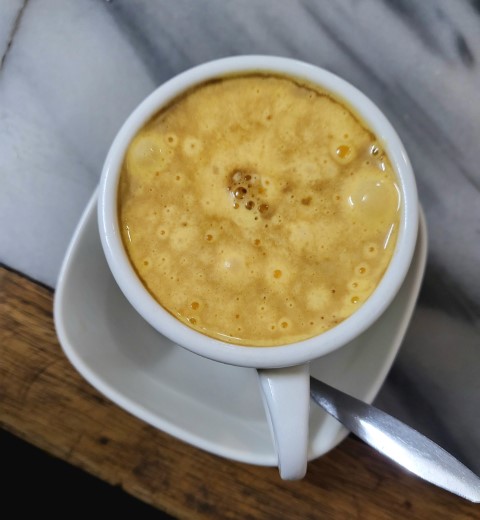
Cooking class – Lemon basil in Hoi an
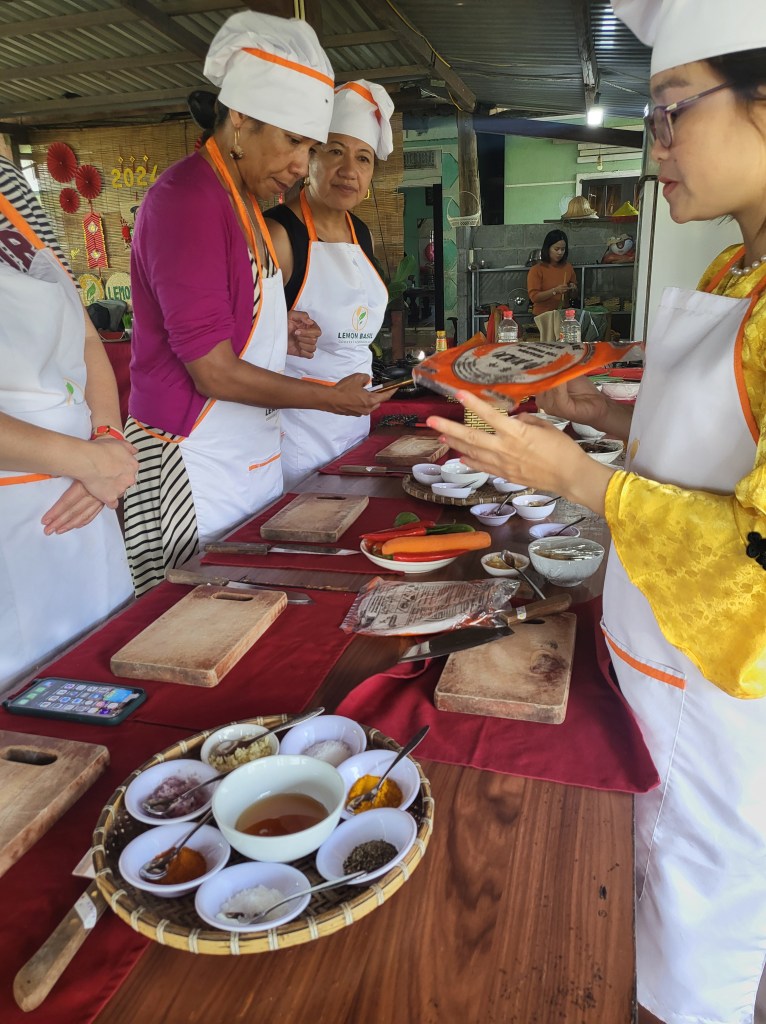
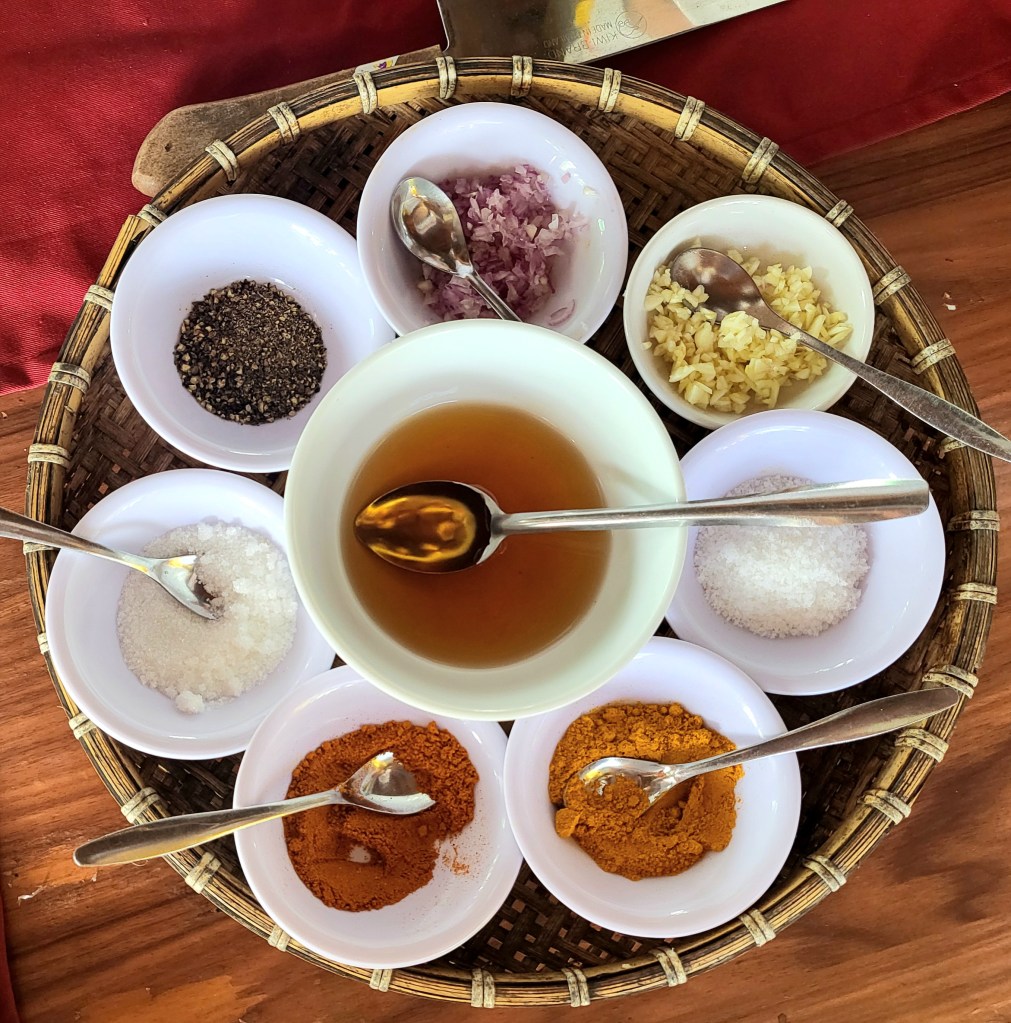
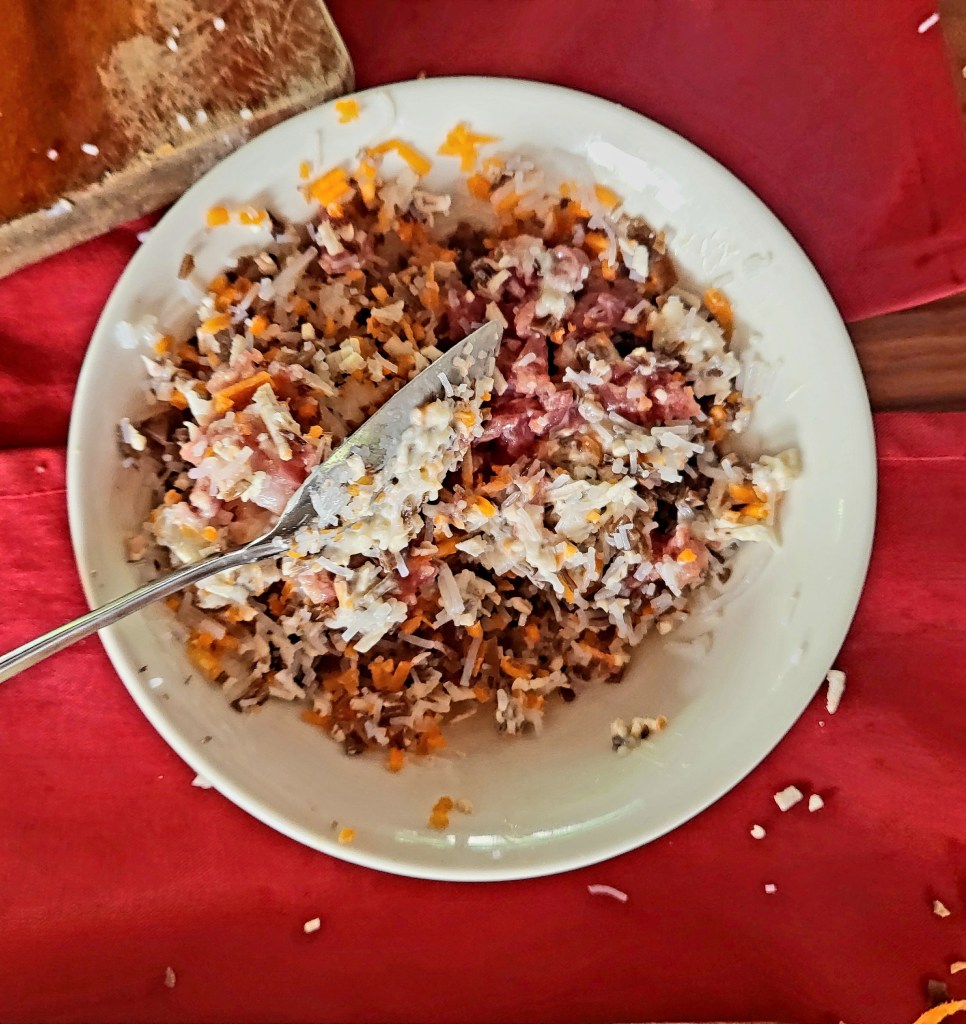
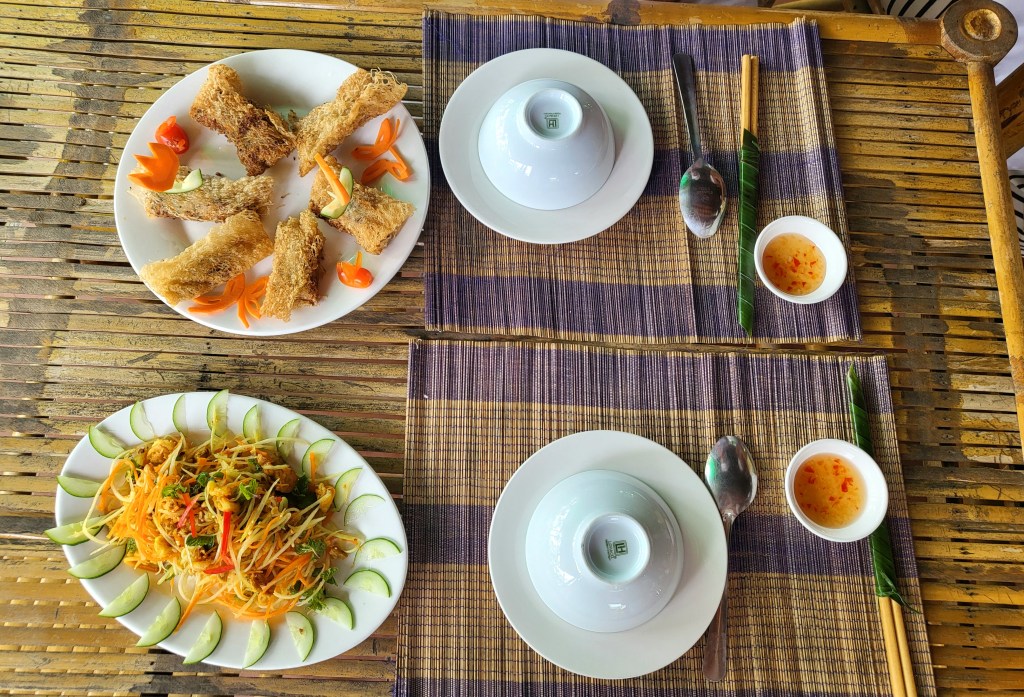
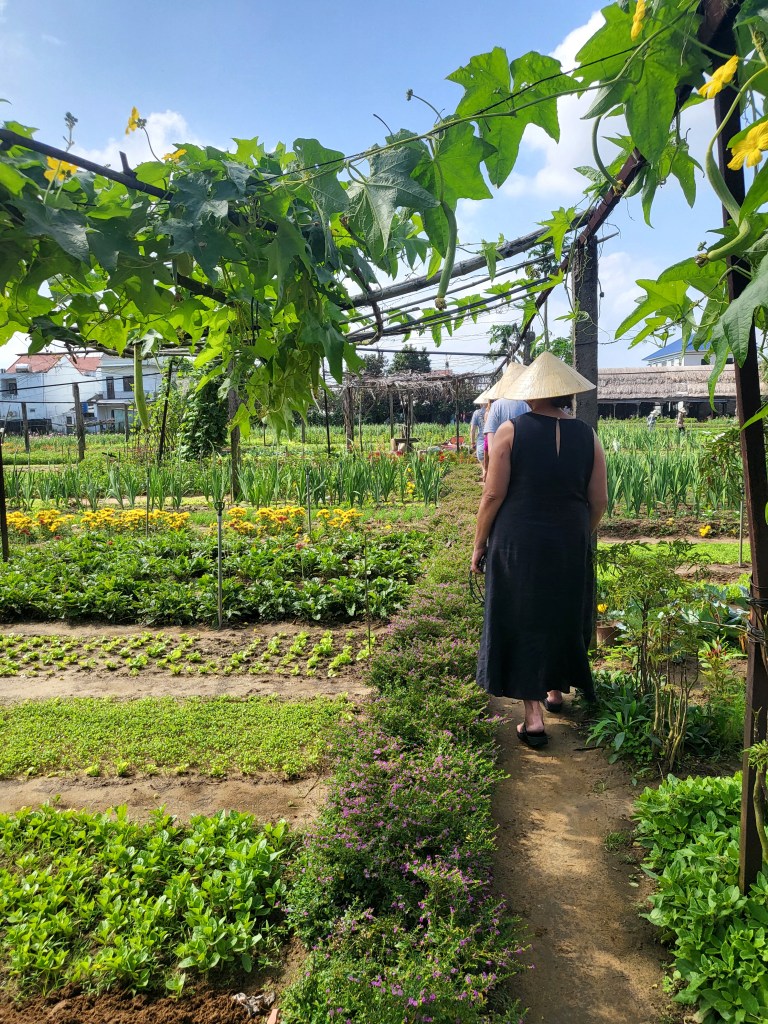
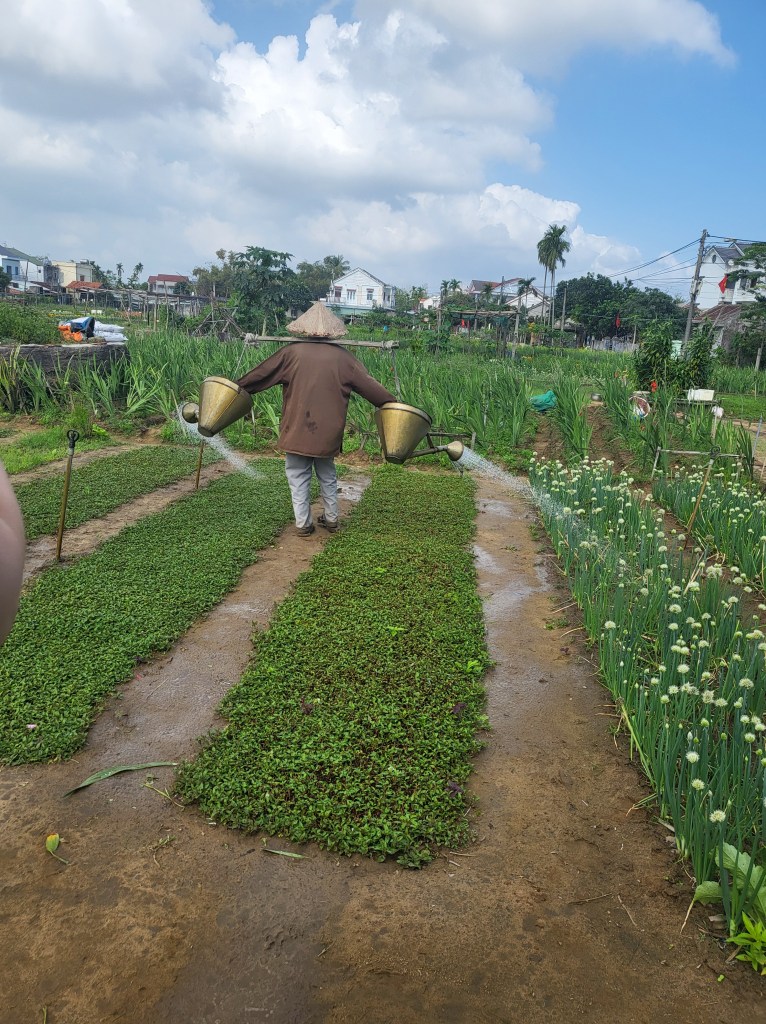
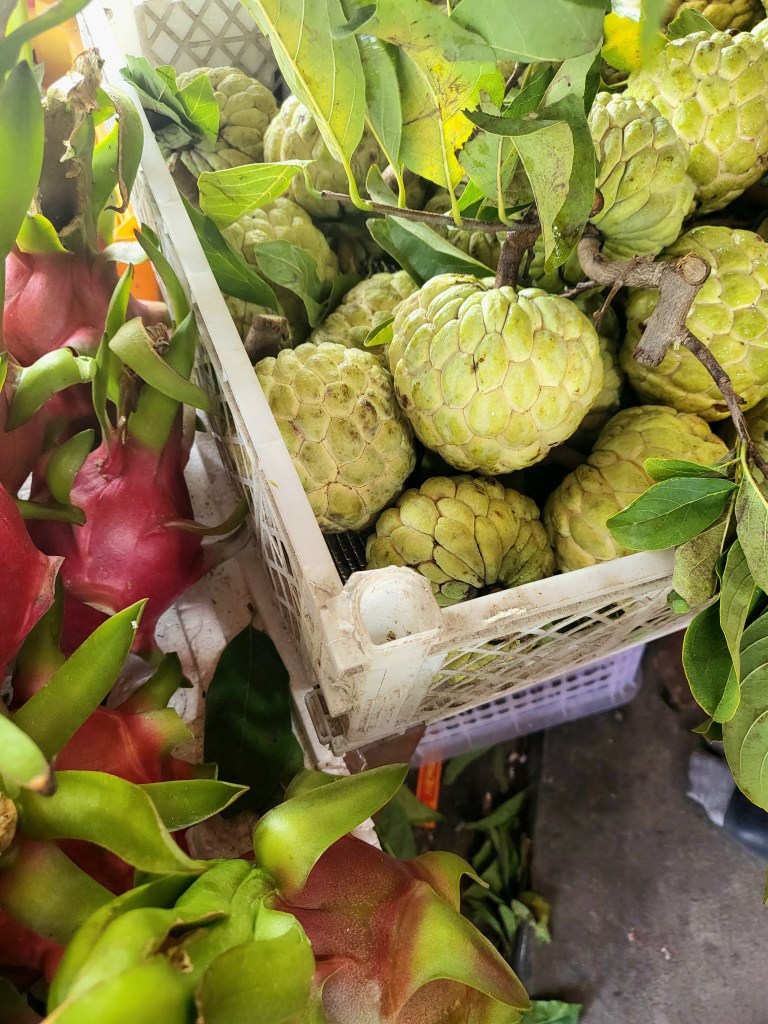
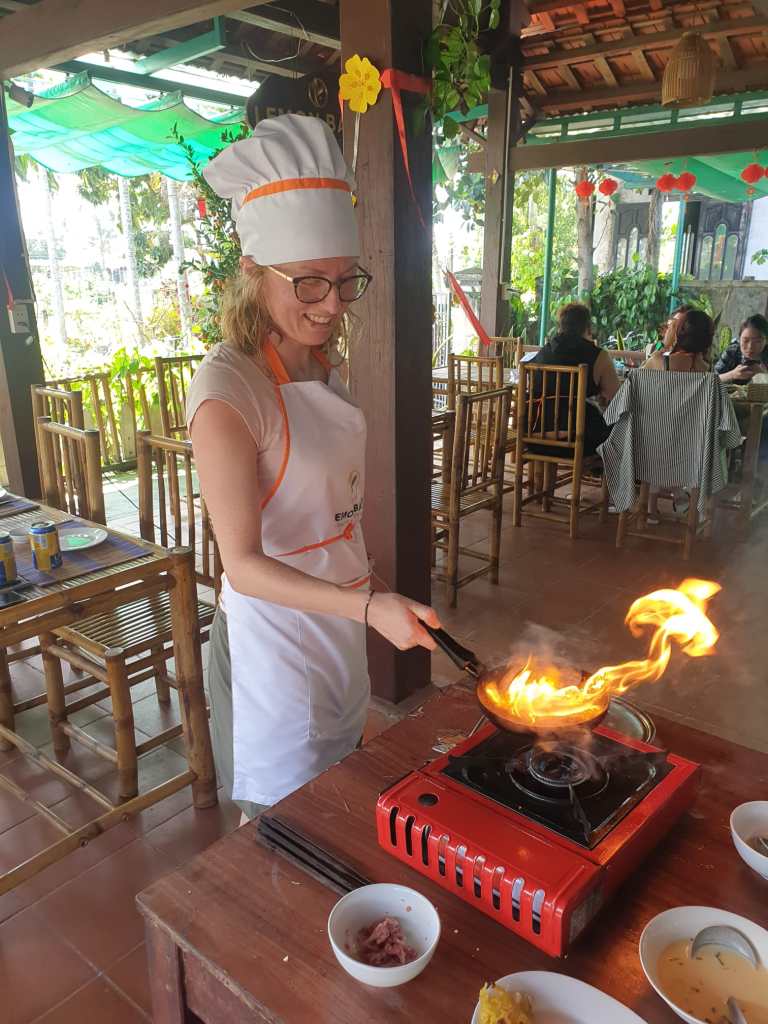
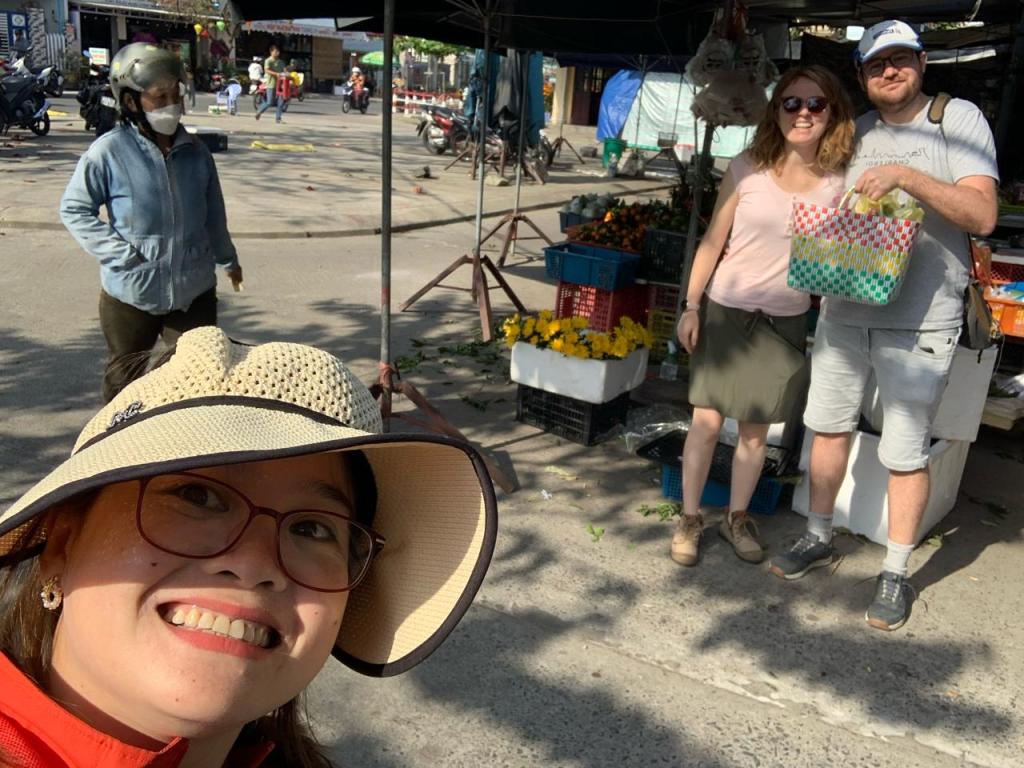
In Hoi An, we decided to take a cooking class with the organization Lemon Basil. We chose the market tour, garden visit, and cooking class package. This package costs $38.
Jessica picked us up from our accommodation. She brought bycicles to reach the market. The tour was very informative: Jessica showed us various vegetables and fruits that we don’t have in our contries, she explained us how to know if the products are fresh, and their prices.
We took the bicycles again to reach Tra Qué, a small village not far from Hoi An known for its gardens. This part was more touristy and we learned only a little. We planted some seeds, watered the seeds with their watering can. Although it was not very informative, it was at least fun.
Then we cooked a papaya salad, spring rolls, banh xeo, and a ca kho to, which is a fish cooked in a clay pot. It was playful, but other organisation can probably offer more learning by cooking more elaborate dish. The advantage of Lemon basil is that Jessica has knowledge about gluten-free options, and without me even mentioning it, she talked to me about the soy sauce and oyster sauce. So, you can go there with confidence.
Some addresses that I have tested sorted by city
Dong hoi
Nhà Hàng Chay Bồ Đề Duyên – GF Friendly – Menu – Vietnamise food – €€
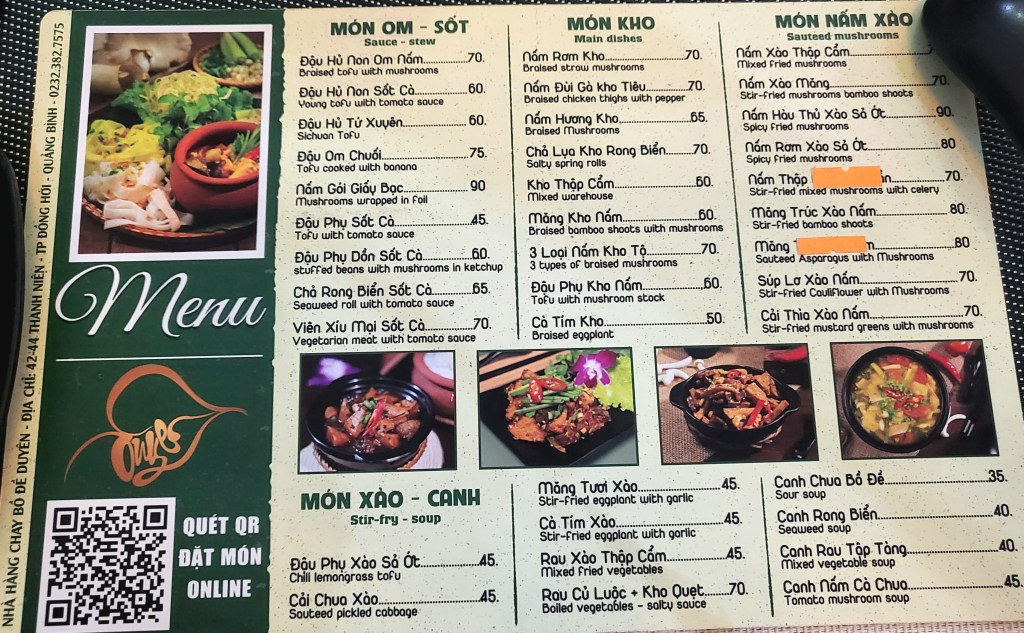
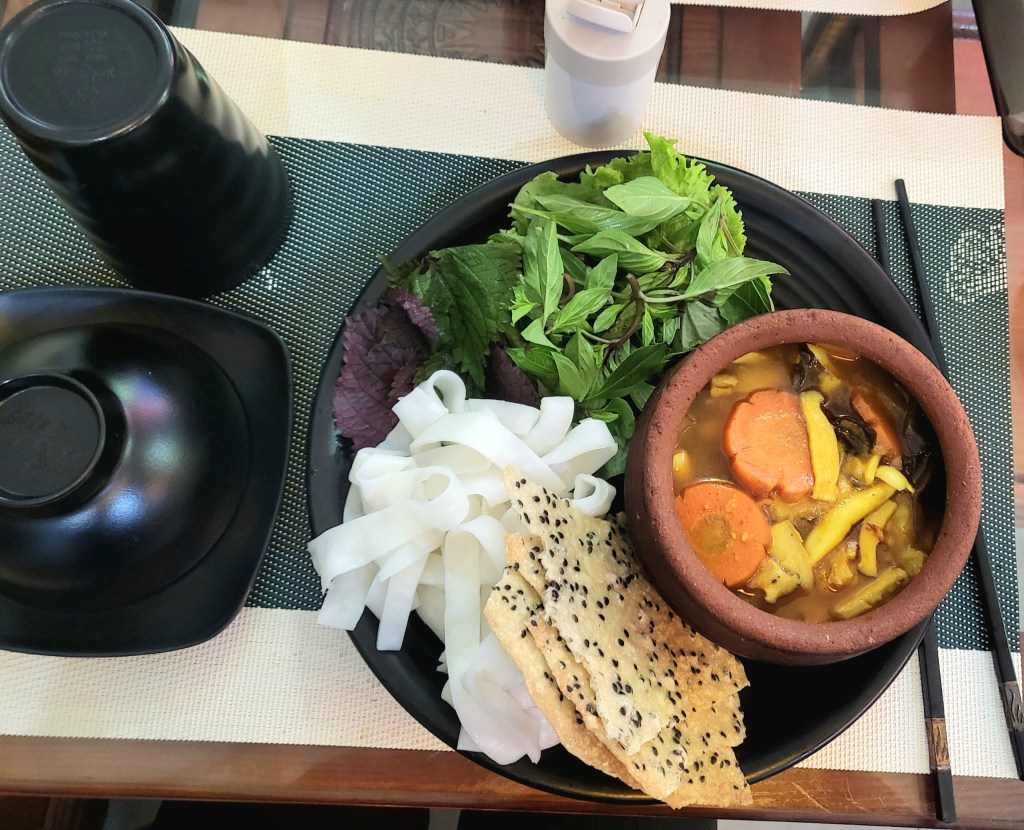
The restaurant does not claim to have gluten-free dishes, but some of their dishes are gluten-free without them knowing it.
Communication was not the simplest, as the staff spoke very little English. However, they showed a lot of patience and paid a lot of attention to my situation. They took a photo of my explanatory card and showed it to the chef. After a discussion in the kitchen, they told me what I could eat.
The risks of cross-contamination are definitely present, especially since they also cook wheat pasta. All I can say is that I did not get sick.
Lien Google maps: https://maps.app.goo.gl/HZUauqL22KDZszJw7
Hanoi
Bep Viêt – GF Friendly – Menu – Vietnamese food – €€
This restaurant has literally been my refuge during my stay in Hanoi, especially on days when I was tired of explaining my situation.
The owner has a friend who is also gluten intolerant, which is how she gained knowledge about the gluten-free diet. The English communication is decent even though I didn’t always understand everything in the dishes (probably due to secrets around recipe…).
I have been there several times and have never gotten sick. You can enjoy spring rolls, pho, chicken salad, and much more.
The prices are quite reasonable for a restaurant (around €1 to €2 more expensive per dish than what you would find in street food).
On the Find Me Gluten Free app, 11 people with celiac disease have reported the restaurant as safe.
Google maps link: https://maps.app.goo.gl/yBrSamT1KABeSZScA

GF gourmet – 100% GF – Menu – Western food – €€€
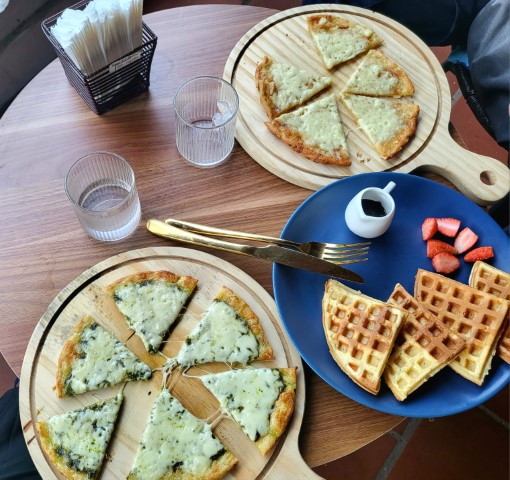
GF Gourmet is one of the few 100% gluten-free restaurants we have found in Vietnam. They have a restaurant in Ho Chi Minh and Hanoi, and this is the latter that we have visited.
On menu, you can find Western dishes adapted into gluten-free versions. We were tempted by the pizzas and waffles. They are tasty but quite small, especially considering the price this is why I ranked them as « €€€ ».
The choices are limited in Hanoi while the menu is more extensive in Ho Cho Minh city.
Both restaurants can be difficult to join as they are not in the city center. Check if you can be delivered through Grab (the equivalent of Uber in Asia).
Location in Hanoï:
https://maps.app.goo.gl/FY9QW2GfRhBz9uDq9
Location in Ho Chi Minh:
https://maps.app.goo.gl/4KXgtcetHN6pDz6F8
Ho Chi Minh
In’joy café and bake – 100% GF – Menu – Western food – €€€
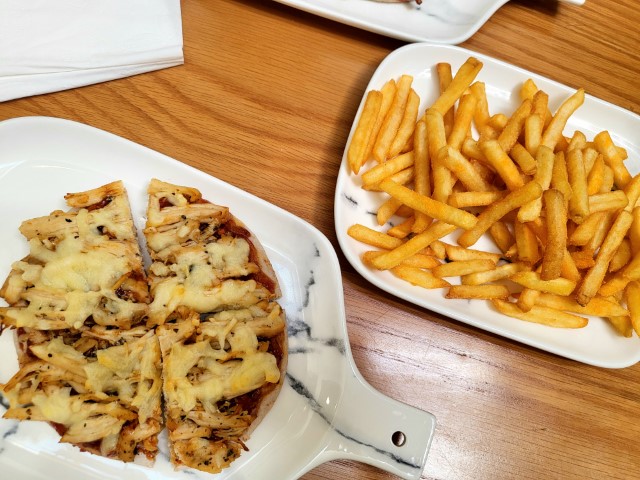
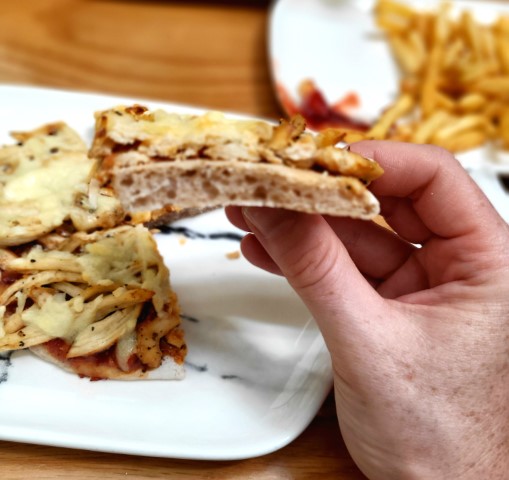
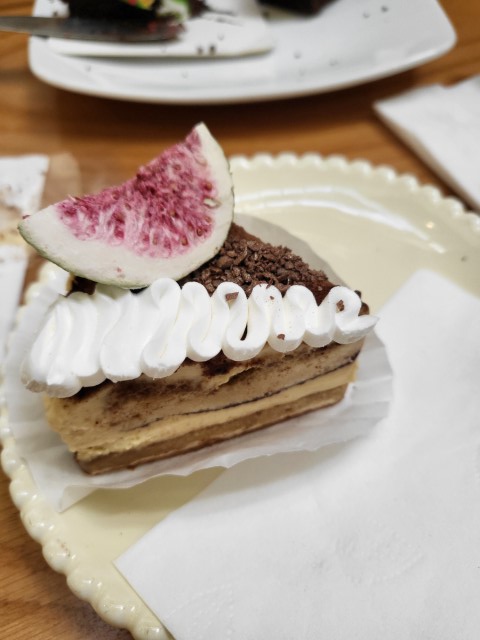
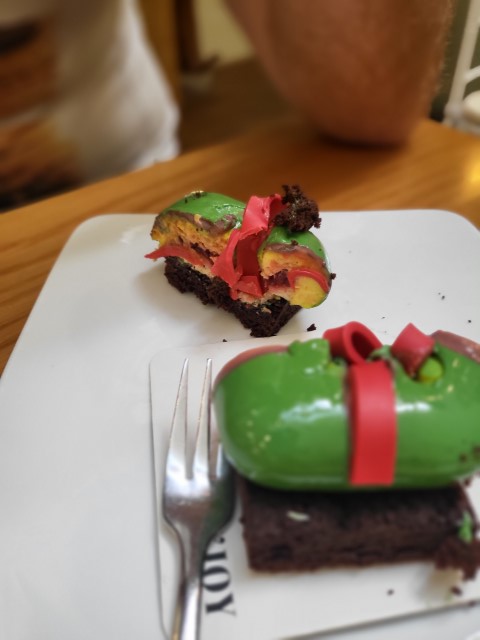
In’joy café and bake is a café restaurant located in the first district of Saigon and offers 100% gluten-free Western dishes. The menu features starters, main courses, beverages, but most importantly, cakes and pastries!
If I had one thing to remember, it would be the latter. They are good, and it’s especially rare to find them. The dishes are good, but the portions are small, especially for the price asked, explaining the « €€€ » I put.
Google maps link: https://maps.app.goo.gl/iLrMWbUhaBpKzCVi9
Kashew cheese deli – GF friendly – Menu – Western food – €€€
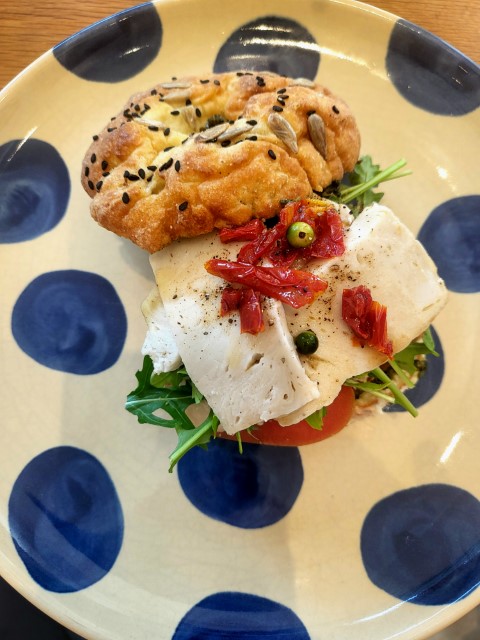
Kashew Cheese Deli is a restaurant cafe located in the second district of Saigon and offers Western dishes with gluten-free options. This ranges from gluten-free pasta to gluten-free bagels. They also offer a range of gluten-free raw bar options.
The dishes are good but the portions are small especially for the price asked, which earns it a « €€€ ». I admit that I still fell for the pesto bagel which was very tasty!
Google maps link: https://maps.app.goo.gl/iLrMWbUhaBpKzCVi9
Hoi An
Dingo deli – GF friendly – Menu – Western food – €€
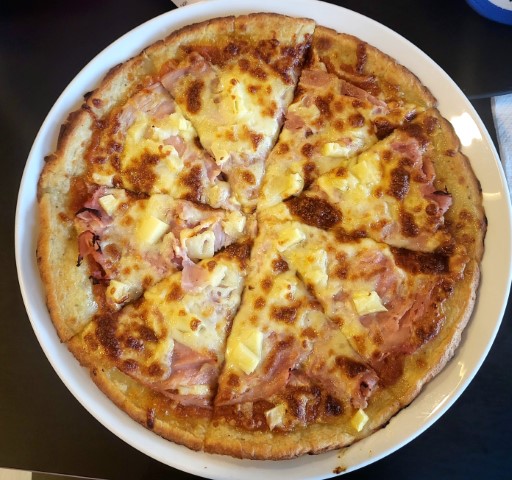
Dingo Deli is a restaurant offering Western dishes with gluten-free options located in Hoi An.
I won’t lie to you, and the fact that they only serve Western dishes means there is a high risk of cross-contamination if the staff is not vigilant enough. A person reported being ill after visiting the establishment, to which the management responded with apologies and a commitment to retrain their team on good work practices.
I dared to go there and I didn’t get sick. The dishes are hearty and generous. You will find on the menu breakfasts based on eggs and potatoes, pizzas, pasta, other dishes such as chili con carne and curry but also cakes like cheesecake.
Google maps link: https://maps.app.goo.gl/FdWmXwD6Pyve14iq7
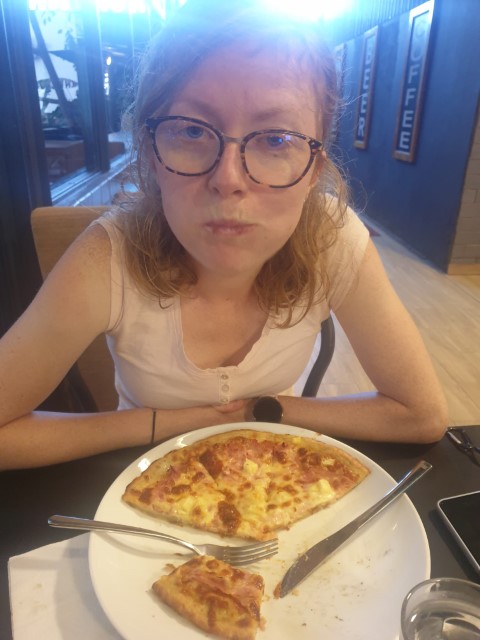
Sa Pa
Thong Dong Vegan Kitchen – GF Friendly – Menu – Vietnamese food – €€
Thong Dong Vegan Kitchen is a restaurant located in Sa Pa. It has two locations: one in the city center, and another one in the highlands of the city.
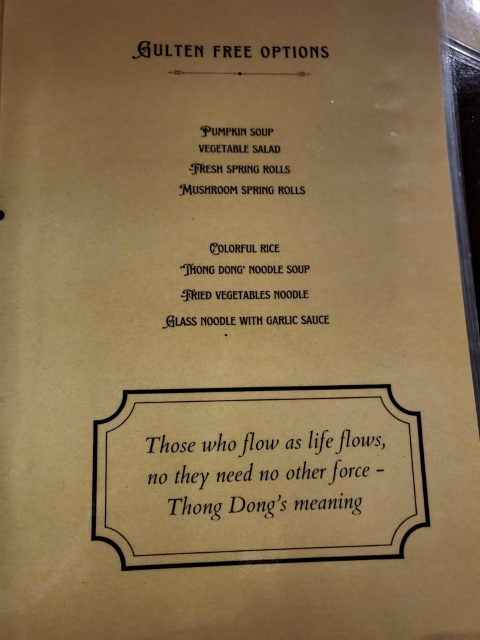
They offer a Vietnamese cuisine revisited to fit a vegan diet. Some dishes are also suitable for a gluten-free diet and are clearly marked on the menu.
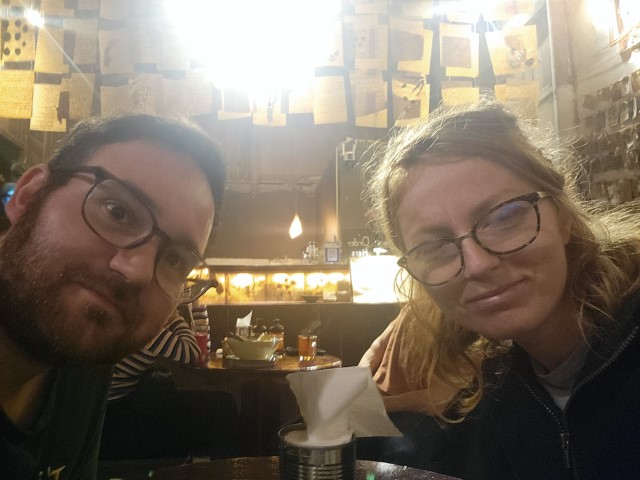
The atmosphere of the restaurant is very pleasant. I have been there to eat twice and have not gotten sick despite the risk of cross-contamination.
City-center location:
https://maps.app.goo.gl/TXUNcgxMptuyCzfEA
In the hill location: https://maps.app.goo.gl/z7hEtptAFhhTtUtz5
Interactive map
Below you will find the interactive map of restaurants offering gluten-free options in Vietnam.
It brings together the addresses I have tested (those mentioned above and many others) and those I have found on Google maps and Find me gluten free. The latter where not all captured and where selected based on security rating and available options.
An empty field for « Ok for most coeliac » means I did not have the necessary information to answer it. This means you will need to ensure their practices.
The link to access the map is located here.
And if you’re wondering how to use the map or what the different fields mean, feel free to check out this tutorial.

Final thought
Despite a significant use of rice in Vietnamese cuisine, traveling gluten-free in the country is more complicated than it seems due to the numerous sauces used and also due to cross-contamination.
Despite difficulties to communicate, I have never been sick in a 100% Vietnamese restaurant offering only a limited choice of dishes. However, this requires being willing to take risks.
In the case of short-term travel, I strongly advise you to choose accommodations with a kitchen to limit risks and ensure you will be able to fully enjoy your trip. And if you are adventurous, a guide offering a tour of street food stalls will surely help you see more clearly and limit the risk.
Articles about our trip in Vietnam
The budget for a trip to Vietnam
How much does a trip to Vietnam cost? Here we tell you about local prices. We comment on our budget without taboos nor omissions.
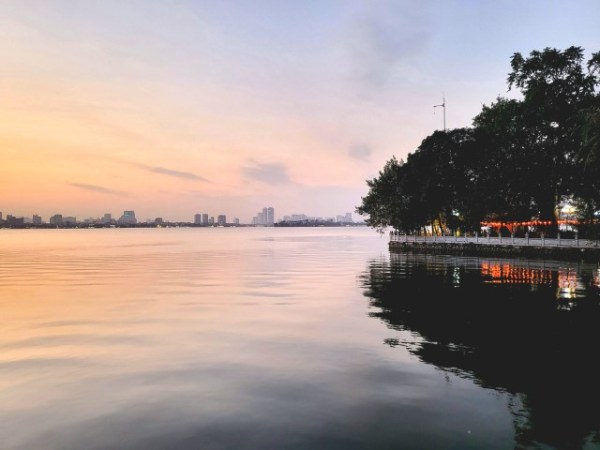
5 days in Hanoï: our arrival and first steps in the country
A rich cultural past, delicious food, live entertainment and a change of scenery are just some of the words that describe a visit to Hanoi in Vietnam. We tell you all about how we felt, and give you practical tips and budget advices for your visit.
 Le goût du monde sans gluten
Laisser un commentaire