
|
Gluten-free travel guide : Cambodia
Published
on
Last
modified
on



Cambodian cuisine is indeed simple, but flavorful. Like the rest of Southeast Asia, it honors the country’s spices and herbs, which are used judiciously. It has emerged from various influences, including Chinese influence, which introduced the use of soy sauce and oyster sauce, both of which are potential sources of gluten.
We arrived in Cambodia after a month and a half spent in Vietnam, which ended with a week of KO for Eva due to gluten. Therefore we approached Cambodian food a bit more cautiously, but our stay was not without learning experiences. In this article, we share what we learned during our three weeks in the land of the ancient Khmer Empire, in the hope that it will make your future trip as smooth as possible.
Of course, our learning has not allowed us to know everything about Cambodian food. Consider this article as a way to grasp the opportunities and challenges that the country will bring you.
Also, some information mentioned in this article may change, particularly regarding restaurant practices. During your visit, make sure that these practices are still valid.
A bit of context on Cambodia and the access to a gluten-free diet
What does Cambodian cuisine look like?
Cambodian cuisine is at the crossroads of different culinary influences: Thai, Vietnamese, Chinese, Indian, and French.
Rice is surely the most widely used cereal. It is not uncommon nor difficult to see how rice is transformed in Cambodia: into rice paper, rice wine, rice noodles… And for those who cannot eat gluten, it is quite pleasant to note that it does not necessarily need to be mixed with other flours.
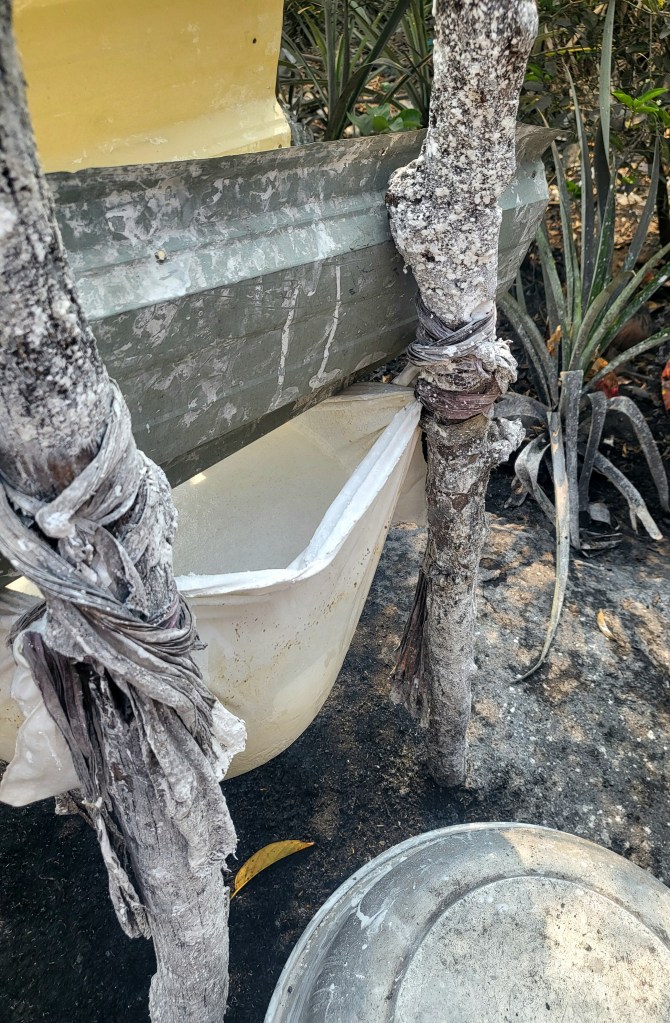
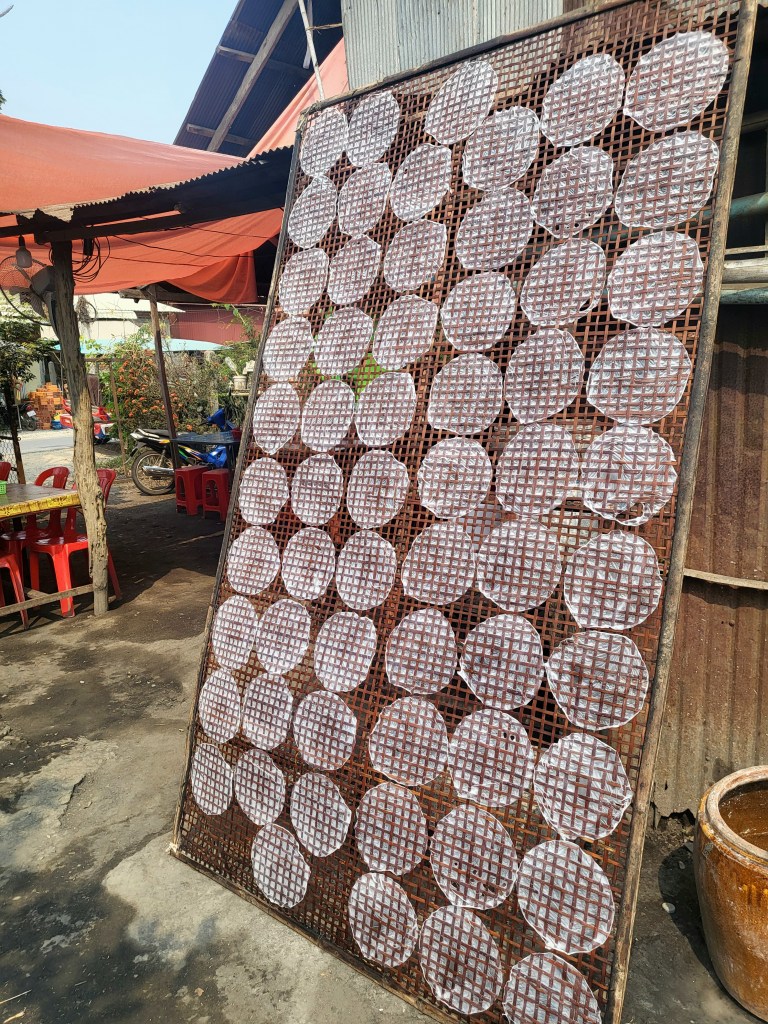

Soups, curries, fried rice… are just some of the typical Cambodian dishes you will find throughout the country.
Stir-fried wheat noodles are also quite common.
Cambodian cuisine, much like Vietnamese cuisine, has been influenced by France during its years of colonization. It is therefore not uncommon to find baguettes served in the form of sandwiches. The Num Pang (នំបុ័ង) is a sandwich made with mayonnaise, meat, vegetables, and herbs, which you should avoid. The presence of gluten in this dish is easily identifiable, so it should not be difficult to avoid it.
Like their neighbors, Cambodians season their dishes with sauces: soy sauce and oyster sauce are commonly used. They represent one of the major risks of your stay in Cambodia if you are bold enough to try the local cuisine.
Cambodia also offers a variety of desserts made from rice, coconut, banana, and other fruits that you should be able to try with little risk or difficulty.
The paragraph « Some cambodian dishes detailed » offers a non-exhaustive list of typical dishes that may be compatible with a gluten-free diet.
Knowledge about gluten
Like many Asian countries, there is only little knowledge of what gluten is, in popular culture.
Few Cambodians follow a gluten-free diet: is this due to low detection or low occurrence of the disease in the population? The question remains open, even though some studies are beginning to show that lifestyle and genetics may influence this low occurrence. Unfortunately, due to a very small number of participants in these studies, it is not yet possible to draw any conclusions.
Regardless of the answer to this question, it means that knowledge about gluten-free diets and what they entail must be brought by tourists or expats. The moderate influx of Western tourists in the country does not allow this issue to be known by everyone, including, and especially, restaurant owners.
In the most touristy cities, and more specifically in the tourist neighborhoodof these cities, this is beginning to happen. Phnom Penh and Siem Reap are examples of this.
Reading Khmer and communicating with Cambodians
The Khmer language does not use the Latin alphabet, making it quite challenging for Europeans to distinguish the various characters. It is not uncommon to find street stalls that do not display any photos of their dishes, but instead have a small sign listing the different items being sold. Navigating through this can be tricky, and even when scrutinizing the ingredients at their stall, it is often difficult to understand what is being offered.
Of course, Google Translate can come to your rescue, but
– with the surrounding crowd, it is not always easy to proceed as desired
– translations are often quite approximate. I’ll let you judge with the translation below.
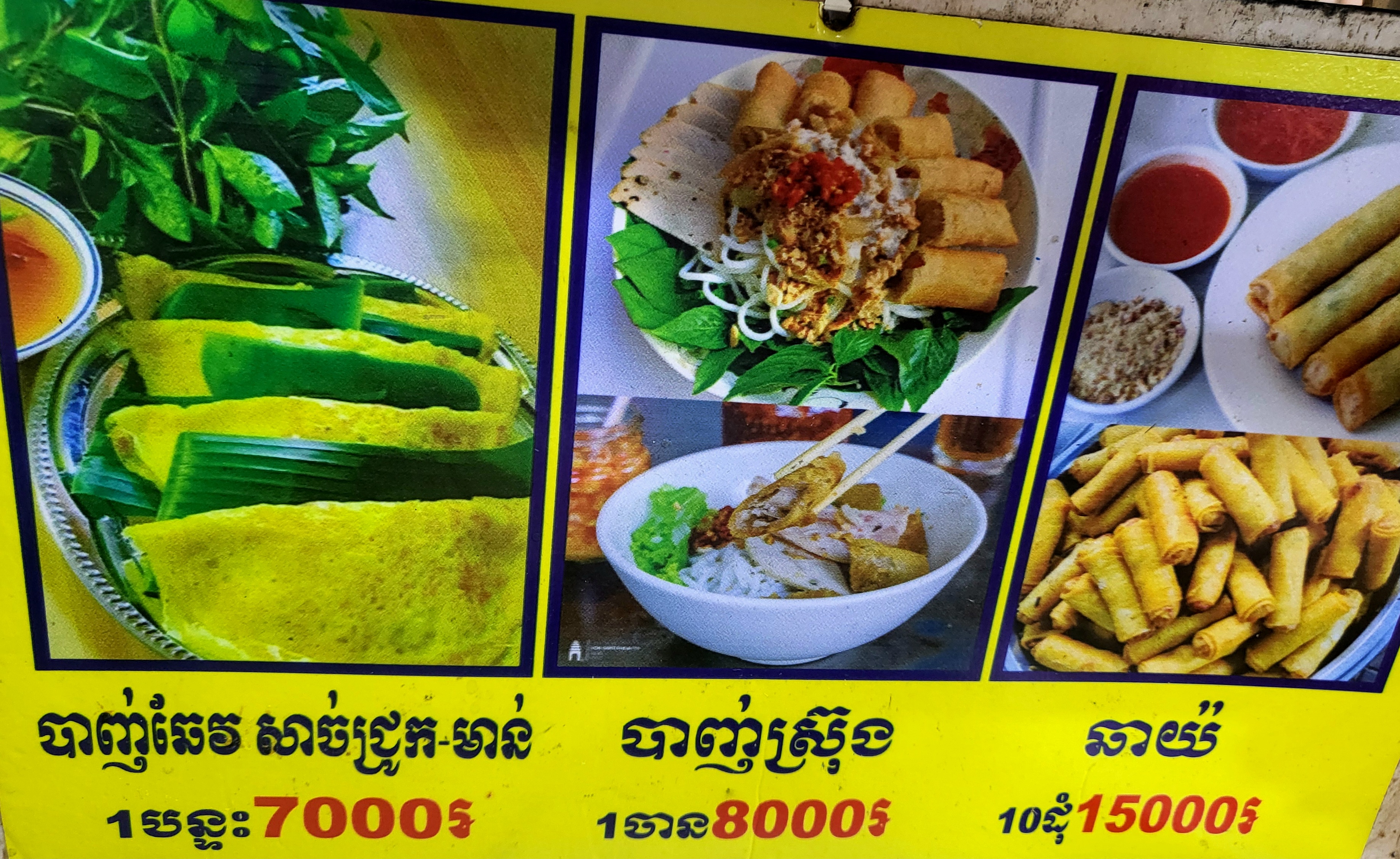
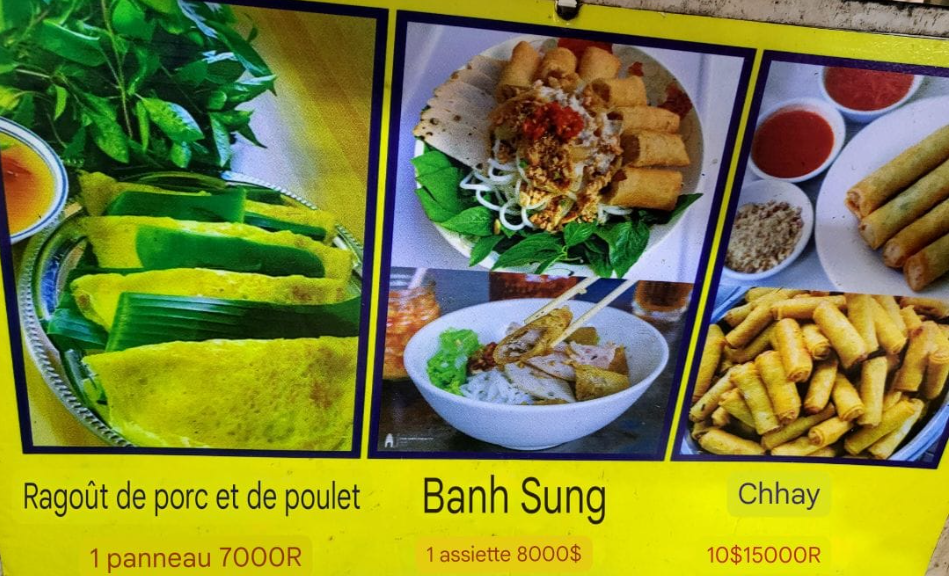
When it comes time to speak with Cambodians, who despite a generally good level of English (and French), it remains difficult because this knowledge is rarely found among street vendors and market sellers.
A street food culture
As in most Southeast Asian countries, everyone eats out, including most locals.
This results in supermarkets being small, and for people on a gluten-free diet, that’s often where they find a comfort zone. We scan the labels, scrutinize them, and then pick up that product in the next cities. Here, I did this less often, simply because the products are expensive, the choice is limited, and the labeling is more approximate than at home. It is also true that I didn’t really feel the need for it, as the products from the market and street stalls were sufficient for me.
Indeed, raw materials such as vegetables or rice noodles are very accessible in the market. The challenge of this solution lies more in the negotiation of prices, which is pervasive, and in accessing a kitchen. I will discuss this aspect further in the paragraph « Book accommodation with a kitchen?« .
Ressources about gluten-free travel in Cambodia
For our trip to Vietnam, I found numerous resources (website, Facebook group, Instagram accounts…), but I struggled to find as many for Cambodia.
My main resources were Find me gluten-free and Google maps. I also created an interactive map that I’m sharing with you in the paragraph « Interactive map: the tool that will ease your travel« . It was particularly useful in the larger cities.
The essentials when preparing your trip
Learn some basic words ?
I apologize in advance for what is to follow, but I must admit that I have not learned any words related to gluten to facilitate my exchanges with the locals.
On the one hand, I am unable to distinguish the different Khmer characters, making me incapable of recognizing the names of dishes, which is normally part of my preparation before arriving in a country. Moreover, pronunciation is difficult. It is not easy to make oneself understood. Even worse, due to this difficult pronunciation, a completely different word could be understood by your listener.
Know the pitfalls to avoid
The main points of concern lie in the sauces and the risks of cross-contamination.
The main hidden sources of gluten are:
Soy sauce: although used in Cambodia, its use is much less systematic than in other Southeast Asian countries. However, when it is used, it often brings high-risk because most of the sauces sold in the country contrain gluten.
From what we have been observing, it is generally not incorporated into curry preparations. However, it does appear in the preparation of stir-fried dishes (fried rice, stir-fried noodles) and the iconic Lok lak, for which vegetables and meat are sauted in soy sauce.
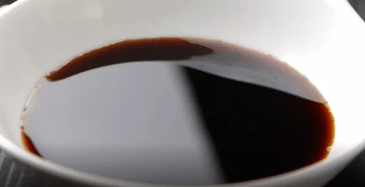
Oyster sauce: this sauce, which is less known in Europe, has a brown color similar to soy sauce and is thick. This sauce, which was once made only from oysters, is now prepared with oyster extract, soy sauce, and cornstarch. Contamination can therefore come from the soy sauce but may also arise from the thickening agent, which is not always corn starch. This sauce may or may not contain gluten.
It can be used to prepare stir-fried dishes (rice, noodles, vegetables). It can thus be found in the preparation of Lok lak. It can also be used in the preparation of certain soups.

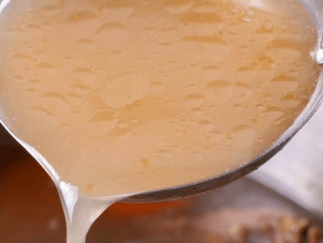
Stock cubes: to be completely transparent, I did not eat soup in Cambodia, and I have no idea if the use of stock cubes is something that is becoming popular in the country.
My advice would be to not hesitate to ask about any dish that is soup-based or has broth.
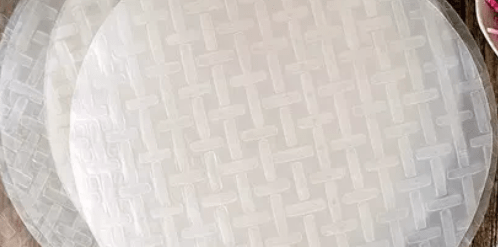
Rice paper sheets: while in neighboring countries (Vietnam, Thailand), it is particularly important to ensure that their preparation has not been mixed with wheat flour, I had less of that impression in Cambodia. My experience is also likely biased by the fact that I consumed them either at markets or directly from small rice paper producers. They were selling it by doing delicious fresh spring rolls. My experience might have been different in restaurants, so it is wiser to remain vigilant and not hesitate to ask the question.
Your biggest enemy is undoubtedly the risk of cross-contamination. Not always well understood by locals, it can sometimes be quite frightening to dive in. Moreover, few establishments offer 100% gluten-free options.
Please note that rice is always prepared in a dedicated rice cooker unless it is part of stir-fry dishes. Therefore, prefer dishes like curry: generally, neither soy sauce nor oyster sauce is included in these dishes, and the rice is served alongside directly from the rice cooker. That was my favorite solution during my stay.
A second option, more daunting, is to buy dishes directly from the market stalls. Why? Because each stall typically offers a very limited number of dishes. Thus, it’s not uncommon to find some that only offer rice, when this search is definitely trickier when it comes to restaurants. The downside of this approach is that you will likely meet people who speaks little or no English. In this case, my strategy was to show them pictures of the ingredients I could not eat (I will discuss this in more detail in the paragraph below).
The more daring can attempt stir-fry dishes in establishments where the risks of cross-contamination are high. I only dared to do this in places where their English level was good to very good.
Prepare your communication with restaurants
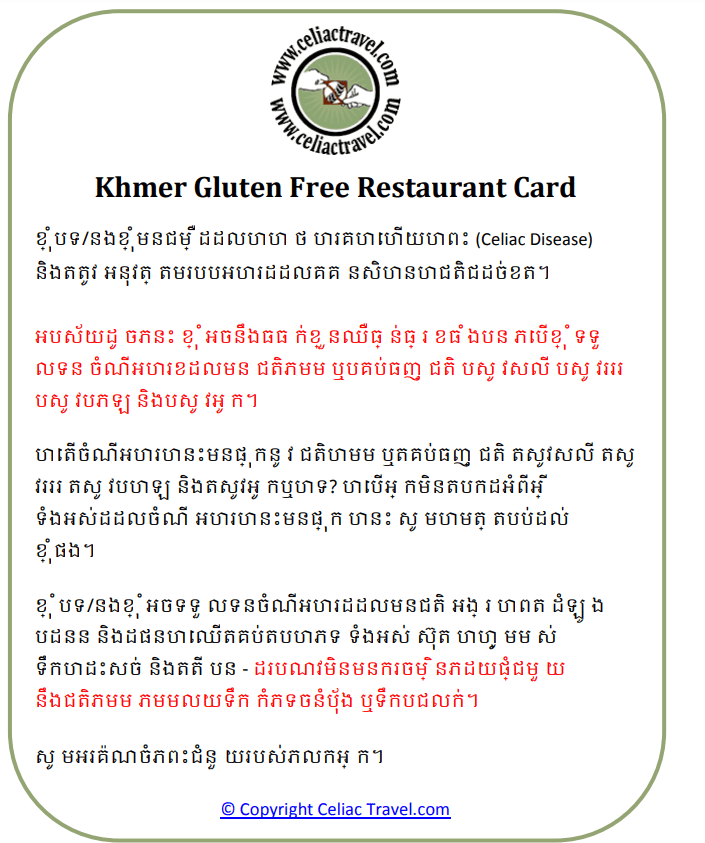
Before my arrival in the country, I downloaded the explanatory map created by Coeliac travel, which I have attached here (by clicking on it, you will be redirected to the PDF link of the map).
Just like in Vietnam, my feedback regarding this card is rather mixed. It was probably too long; people had to skim through it. Also, it is useful to know that a portion of the population has reading difficulties. Although the figures have improved significantly, with illiteracy rates dropping from around 20% to 12% between 2008 and 2020, this remains a reality, especially among seniors. Some will tell you directly, while others, being more timid, may not necessarily feel comfortable saying it.
That’s why my preferred solution was not the direct use of Google Translate, but rather the use of images to try to explain my situation. Feel free also to showcase the potential sauces already present at the stand (soy sauce, oyster sauce…) to help you make yourself understood.
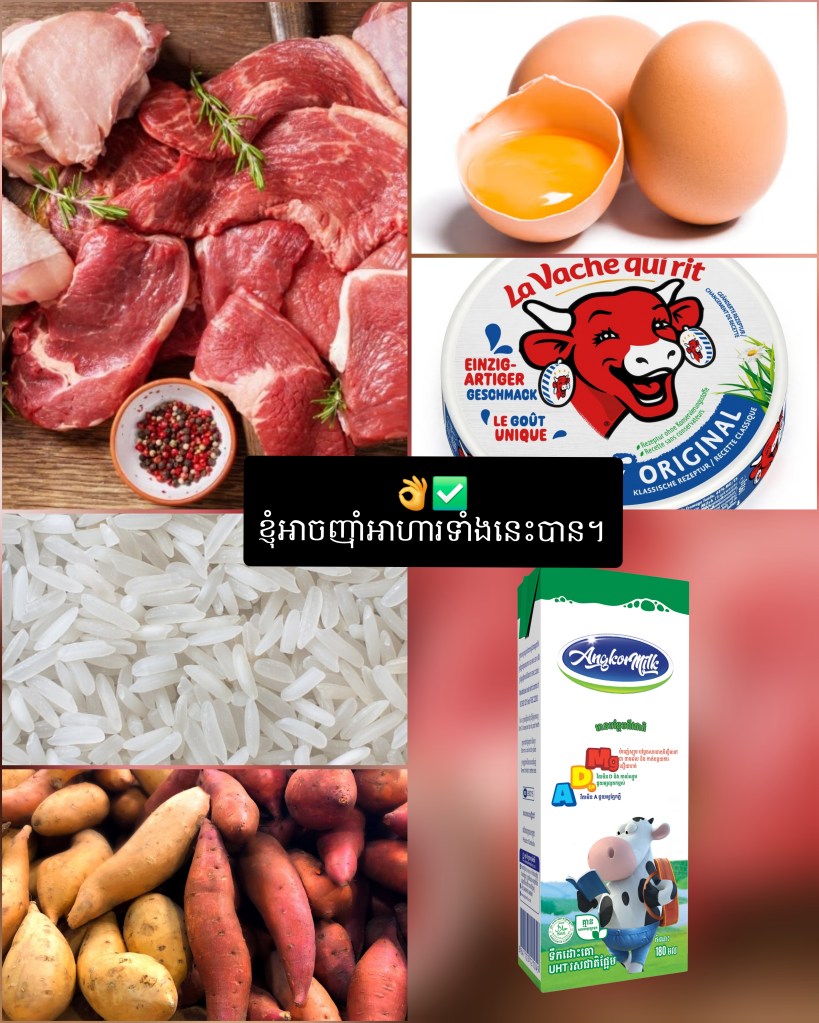
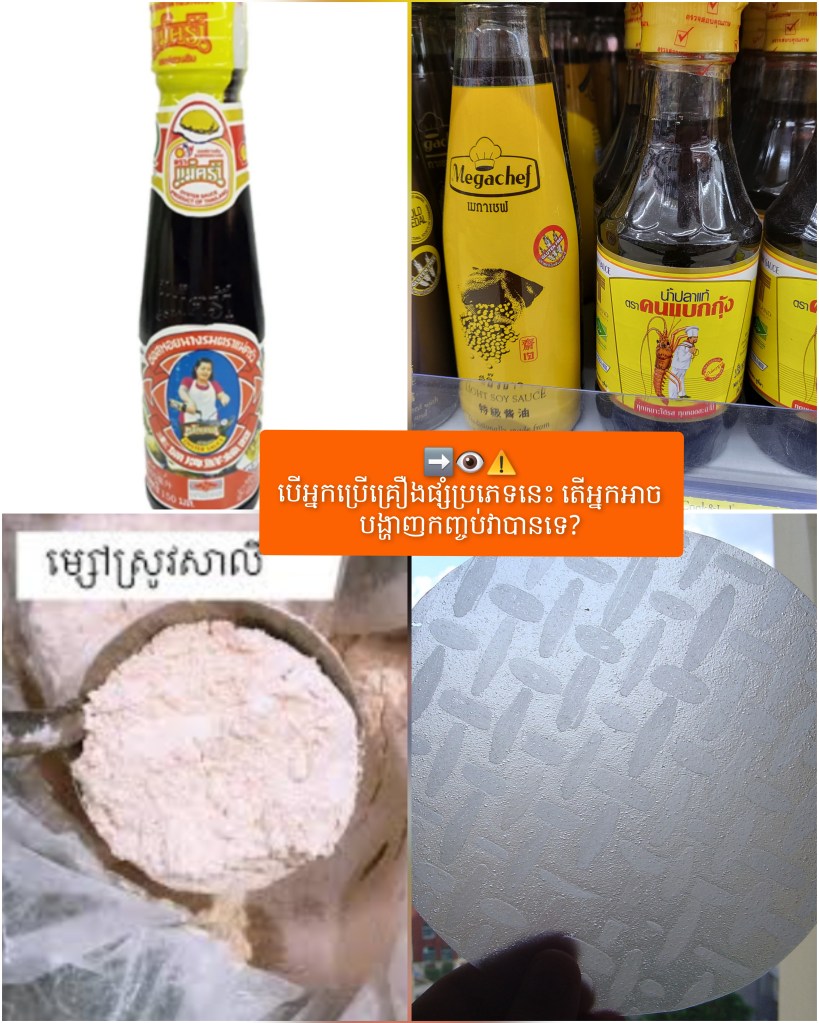
In addition to these very basic visuals that are not always understandable for someone who cannot read, don’t hesitate to use the voice function of Google Translate: type your message and instead of having your interlocutor to read the translation, press the small speaker icon in the app.
Learning more about the composition of dishes has greatly helped me and allowed me to better target my requests. In the section « Some Cambodian dishes detailed, » I share the information I’ve learned on this topic.
Book accomodations with a kitchen ?
As mentioned above, there is a true culture of eating out, and finding accommodations with a kitchen can be more complicated than it seems. Most locals themselves do not have kitchens.
With a maximum budget of €10/night/person, we never came across accommodations with kitchen. It is not impossible that at higher prices you may easily find places that meet this criterion, particularly on Airbnb. For purchasing your raw materials, I recommend doing so at the market: it will be cheaper and likely of better quality. Go armed with your best negotiation skills.
If you are traveling long-term and trying to keep your expenses down, you will probably be less inclined to choose accommodations with kitchens. It is feasible, and we have done it. However, one must be aware that this implies taking more risks.
Your choice will therefore be based on your situation as well as your sensitivity.
Pack gluten-free food?
If you are leaving for a few weeks, I recommend taking gluten-free snacks such as cookies and energy bars. It is true that these products can be found in some grocery stores and that certain street vendors offer snacks. However, searching for them requires time and lead to additional contamination risks.
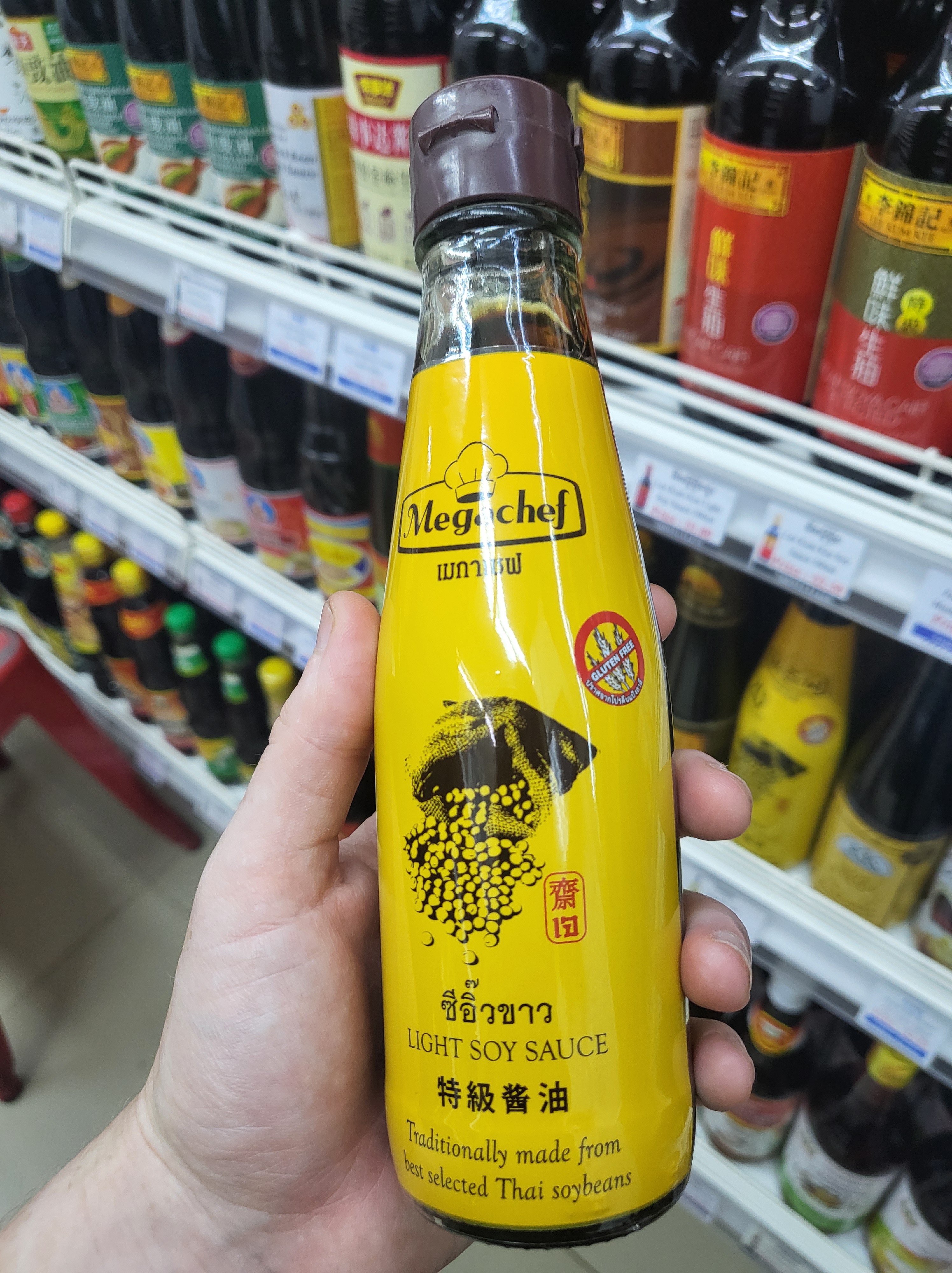
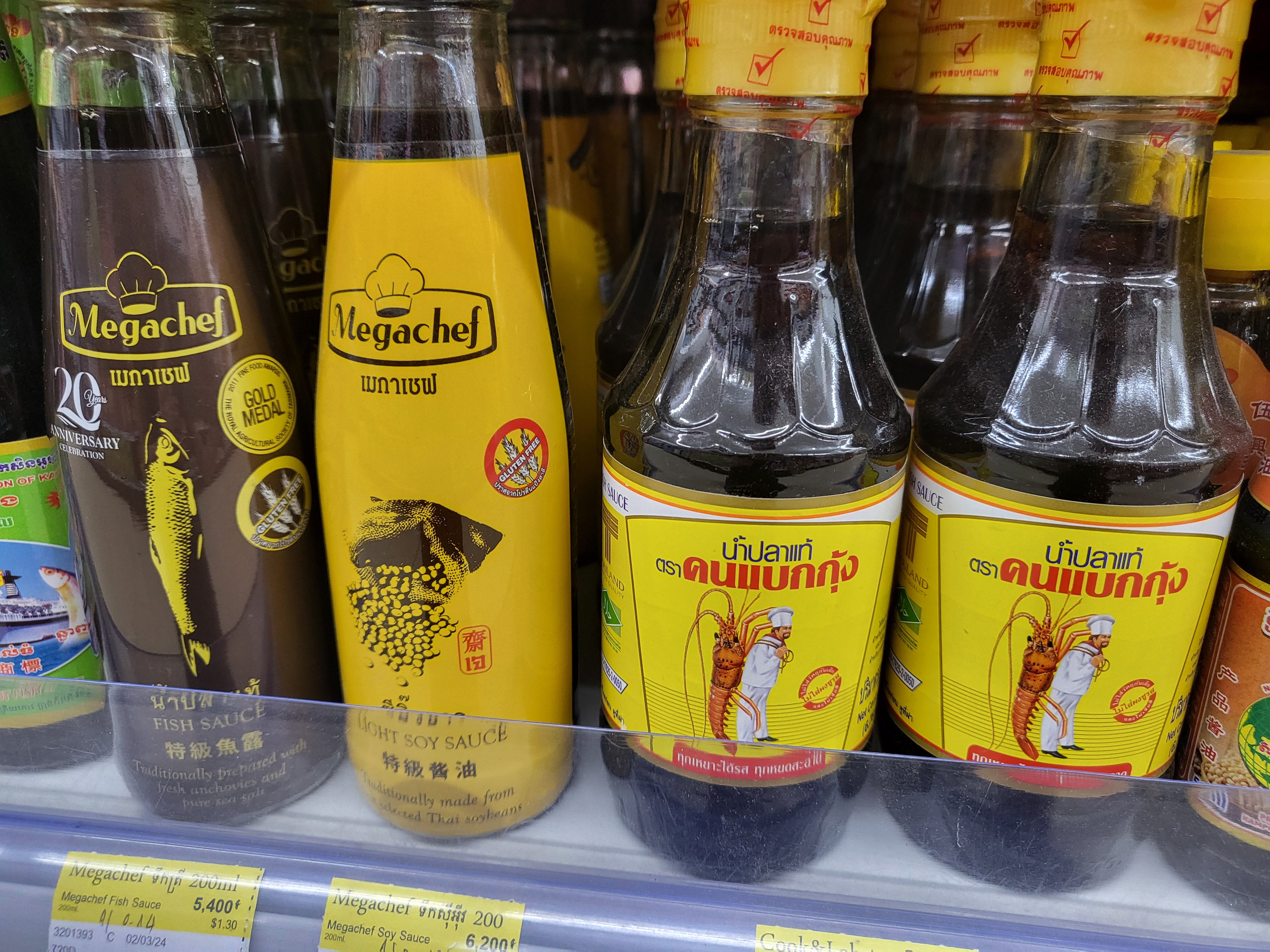
Regarding sauces, I left without any and I didn’t miss them. It’s still possible to find some directly in the country, as shown in the photos below showing a find made in Battambang.
Moving on to practice: where and what to eat?
The paragraph below outlines the dishes available for a gluten-free diet and the precautions to be aware of. At the end of this paragraph, I also share some of the addresses I have tested.
Street stalls vs local restaurants
You have probably understood by now the difference between street stalls and restaurants do not lie in the type of dish you will find there, but rather in the level of service. Below, I summarize the advantages and disadvantages of each. Please note that these are only generalizations and may not always be true.
Street stands / market stands
👍
– Generally, there are few dishes on the menu, which limits the risk of cross-contamination.
– Often, the products they offer, like noodles and rice paper, come from their own production and are not mixed with other flours.
(- Prices are cheaper than in restaurants.)
👎
– Communication is often more complicated: limited knowledge of English, uncomfortable with reading allergy cards.
Restaurants
👍
– More chances of encountering staff who speaks English or who can read your card.
👎
– More risk of cross-contamination as they generally cook more different dishes
(- Higher prices)
Some cambodian dishes detailed
Below, you will find a list of dishes that may potentially be gluten-free; the points of attention should help you understand on which points you should emphasize on. However, this is just a basis to assist and guide you during your stay in Cambodia and does not represent an absolute truth: everyone can add their own twist to their recipes, and not having lived there, my knowledge remains somewhat limited. The intention is to help you see things more clearly, ask the right questions, and clarify the levels of risks involved.
In the list below, the dishes are sorted in alphabetical order so you can find your way around more easily.
It’s also not uncommon to find typical Vietnamese and Thai dishes. Feel free to refer to the guides we have created for these countries to learn more.
Finally, Cambodian cuisine being very rich, I have no doubt that there are many other dishes compatible with a gluten-free diet. Feel free to leave their names in the comments if you know any: it will make the article even more complete.
Amok
អាម៉ុកត្រី
Composition
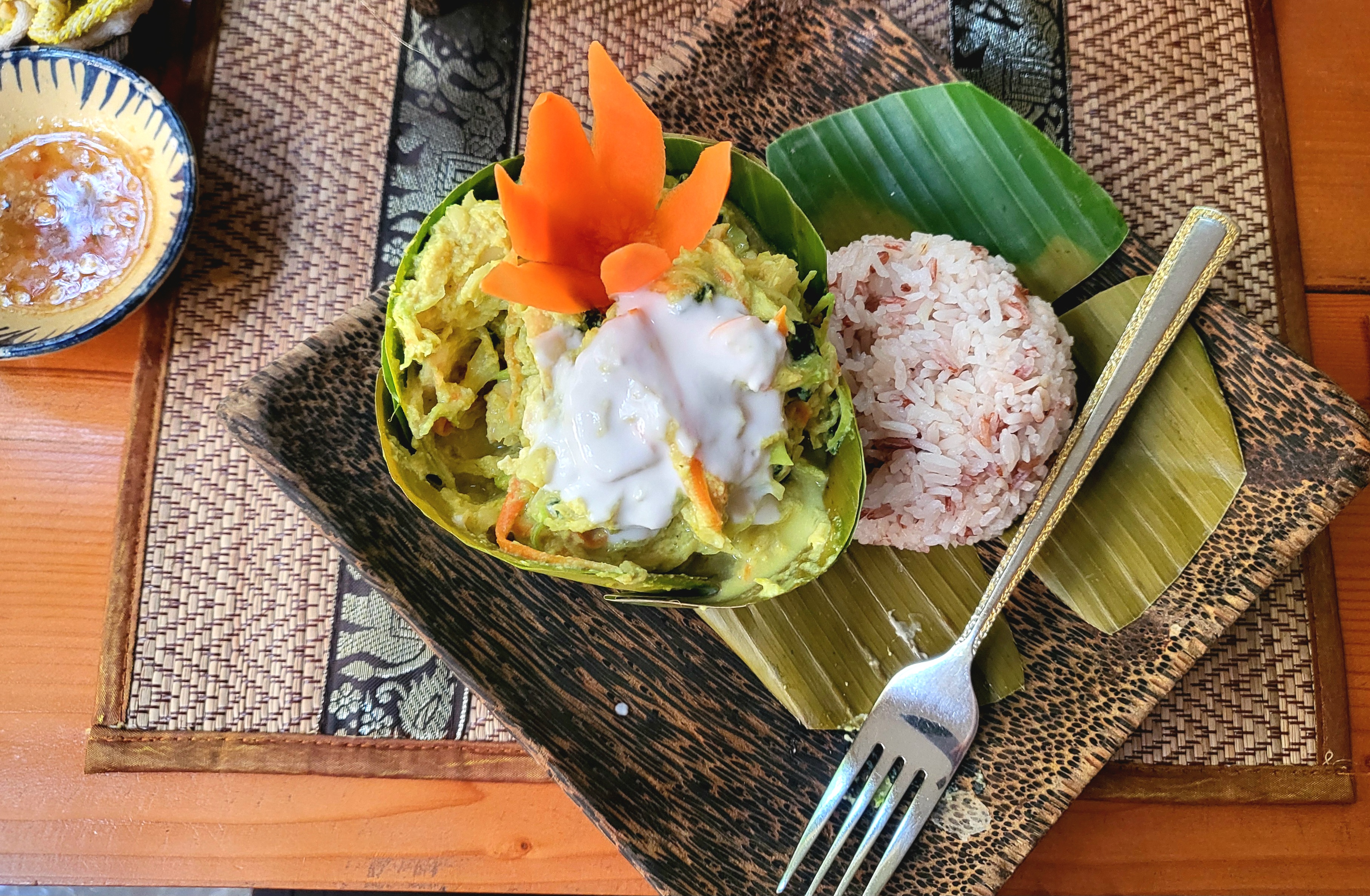
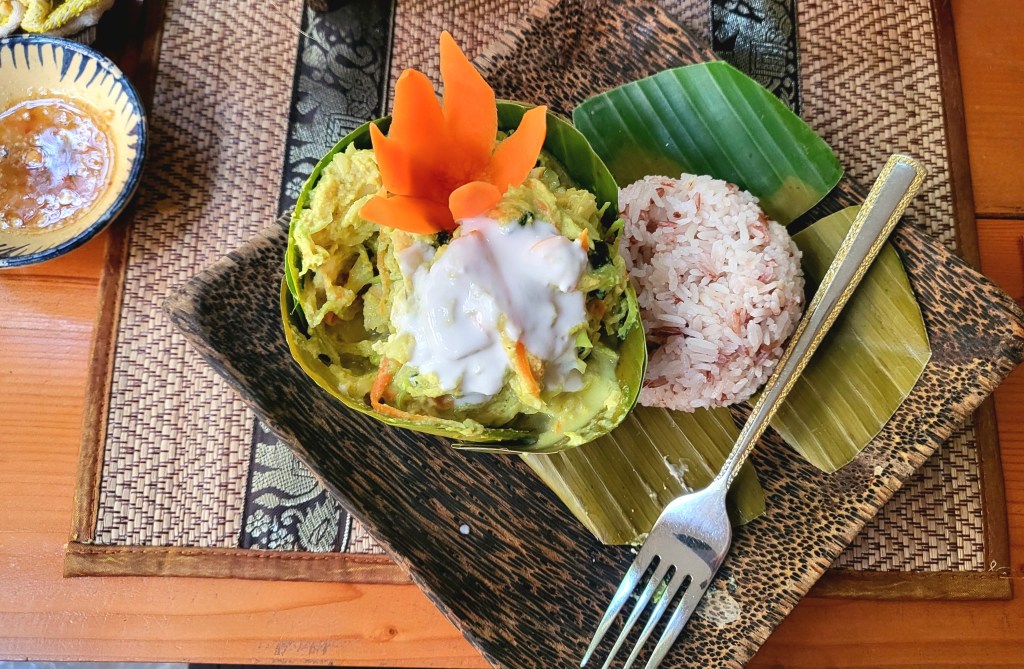
Amok is a type of curry dish that is very popular in Cambodia. It is prepared from a paste called kroeung made with coconut milk and combines various spices and herbs.
Vegetables and meat are cooked in the curry. Typically made with fish, it is now common to find version made with chicken, beef, or tofu for vegetarians.
The dish is traditionally served in a banana leaf and accompanied by rice.
Points of attention
All my internet research led me to find that amok is gluten-free and safe.
Still, I always confirmed with the restaurants the absence of wheat flour (which could be used as a thickener) and soy sauce.
However, when I wanted to buy Kroeung paste at a grocery store, it contained gluten due to a sauce, but I can’t remember which one. I don’t realize how common this is, but I advise you not to hesitate to ask the staff more questions.
Baï chhar
បាយឆា
Composition
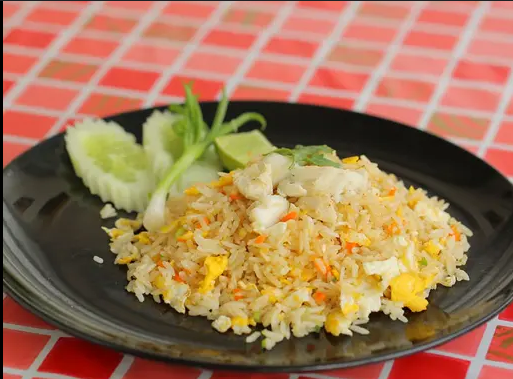
The Baï chhar is none other than the name given to Cambodian fried rice, a dish that you will find absolutely everywhere throughout Southeast Asia with a different name each time.
Whether with meat or vegetarian, it is always garnished with some raw vegetables, vegetables, and onions. The whole is deliciously seasoned with pepper.
Points of attention
Be careful that no soy sauce is added. In Cambodia, the use of soy sauce is less common than in other Southeast Asian countries.
Some travelers have also seen « white powder » added, which they interpreted as flour. I asked each time if flour was used, and it has never been the case. Therefore, I imagine that this white powder was rather MSG, « the secret ingredient » of every Southeast Asian cook.
Most restaurants serving fried rice also offer stir-fried noodles. Try to assess the risk of cross-contamination by checking the menu and don’t hesitate to discuss it with the staff.

Nom banh chew
បាញចីឆវ
Composition
The banh chew name refers to a type of stuffed crepe. Its yellow color comes from the turmeric subtly added by the cook. The ingredients used to fill the crepe vary, but it often includes chicken or seafood.
It can be served with broth underneath and sprinkled with crushed peanuts.
However, it is generally served with greens. If you want to eat like real Cambodians, cut your crepes into pieces and roll them in the greens.
Points of attention
Make sure that no wheat flour has been used in the preparation of the mixture. Feel free to ask additionally if no « flour mix » has been used, as they actually rarely use pure wheat flour.
In the case where the dish is served with a broth, ensure that no sauce has been used and that the broth does not contain wheat noodles.
Price
Between 5000 (1,40€) and 10000 riels (2€)
Krolan
ក្រឡាន
Composition
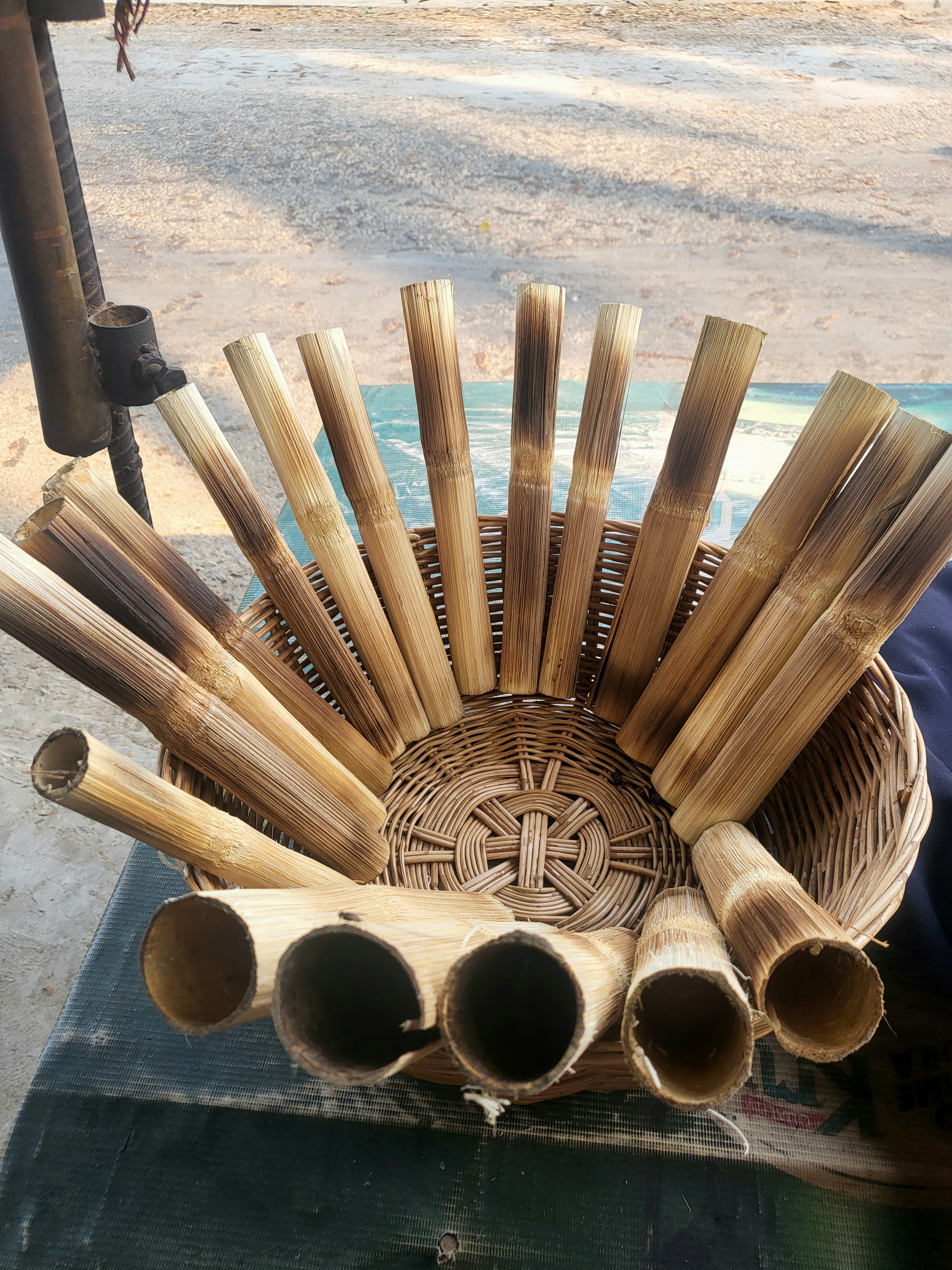
The Krolan is a snack made of rice cooked in bamboo. Each region has its own way of preparing it, but generally, it consists of rice soaked in coconut milk and palm sugar. Red beans can also be added to the preparation.
Points of attention
From my experience, there are no particular points of caution regarding this snack.
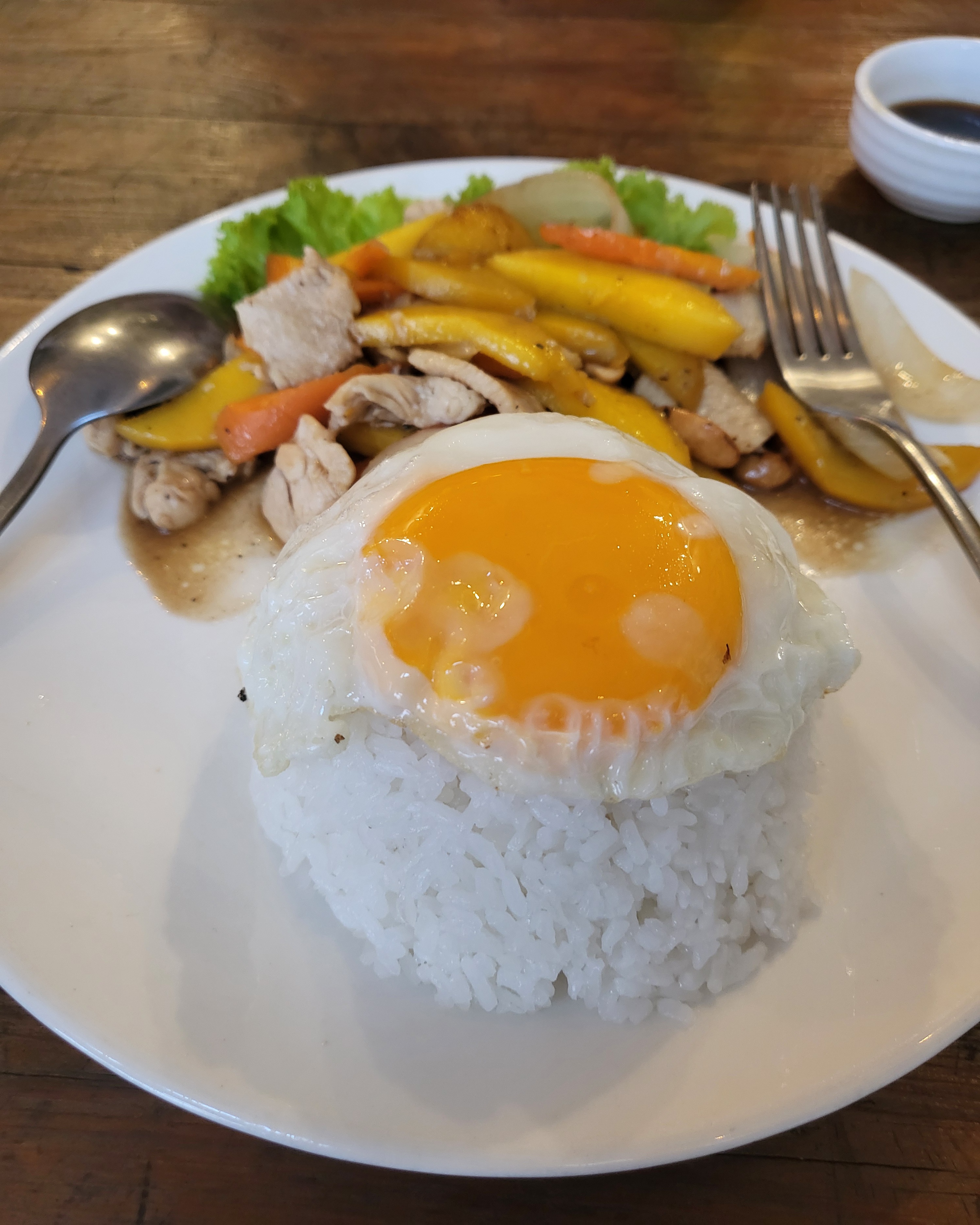
Lok lak
បាយឆាឡុកឡាក់
Composition
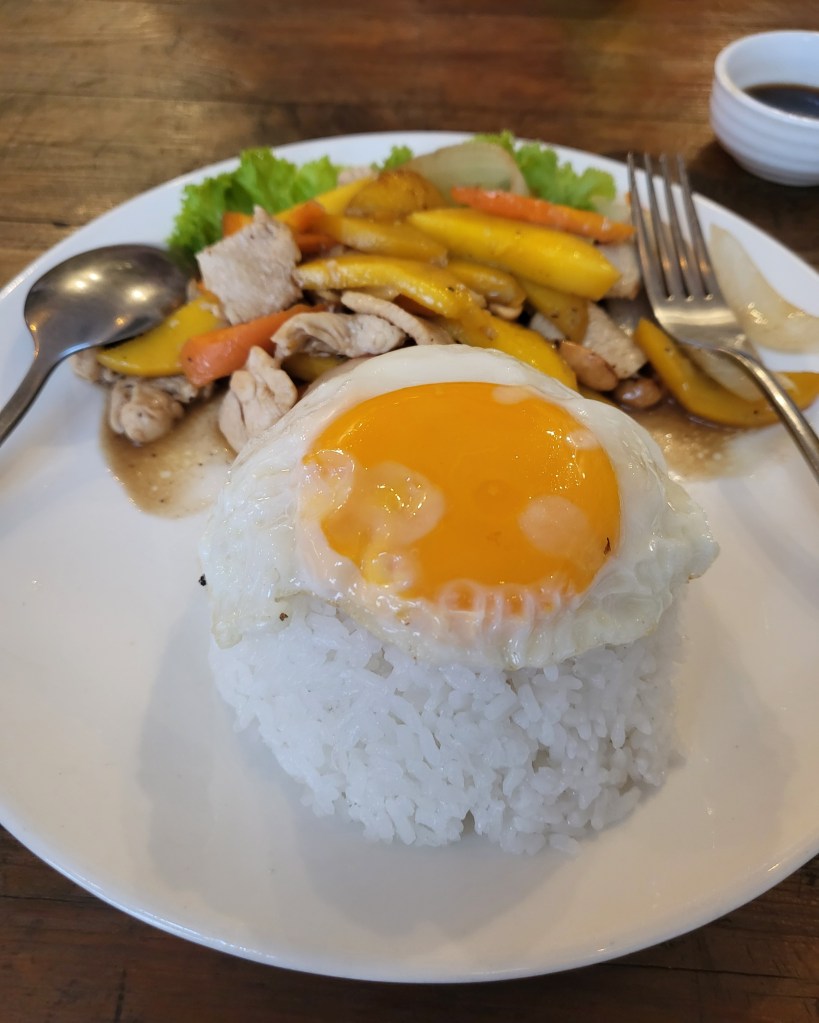
The lok lak consists of stir-fried vegetables and meat served with rice, sometimes topped with an egg.
Vegetarian versions are now common.
This seemingly simple dish is particularly flavorful thanks to the pepper used for seasoning.
Points of attention
Vegetables and meat are simmered in soy sauce or oyster sauce. You can request them to be cooked without the latter, but the risk of cross-contamination remains high (between two dishes, utensils are usually washed little). Alternatively, you can go to establishments that use gluten-free soy sauce.
Lok lak may sometimes be served with bread. Make sure that this is not the case when ordering your plate.
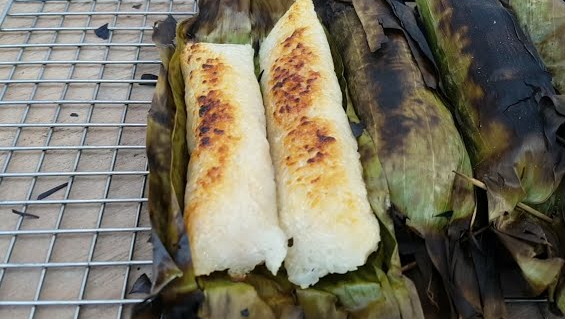
Nom ansom cheik
នំអន្សមចេក
Composition
The nom ansom cheik refers to a banana coated in sweet sticky rice with coconut milk. The whole is wrapped in a banana leaf before being grilled.
Mung beans may sometimes be included in the preparation.
Points of attention
Based on my experience, there is no particular point of caution for this delicious snack other than the fact that many snacks are prepared in banana leaves. This makes it difficult to know what they contain until you have purchased one of these dishes and opened the leaves. Don’t hesitate to take a look when customers are buying at the stand in order to try to understand what they are selling. Honestly, I have never managed to take the plunge in Cambodia. Vietnam was simpler for this as they use the Latin alphabet, which allowed me to know what to expect before making a purchase.
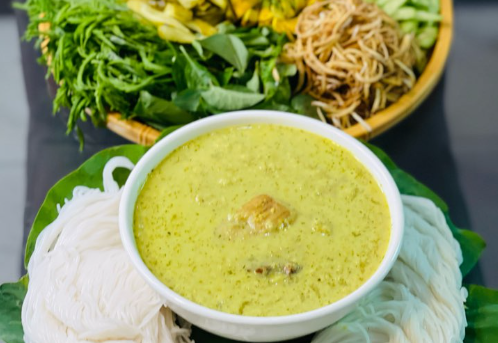
Nom banh chok
នំបញ្ចុក
Composition
The dish nom bành chok is a rice noodle dish served with a sauce made from curry and fresh vegetables. It can be found in all countries, but each region offers different versions.
The dish is typically served with greens and herbs: bean sprouts, coriander leaves, cucumbers… will accompany your meal.
Points of attention
There are no points of concern to my knowledge, but feel free to ask for the usual ones, which are soy sauce and flour.
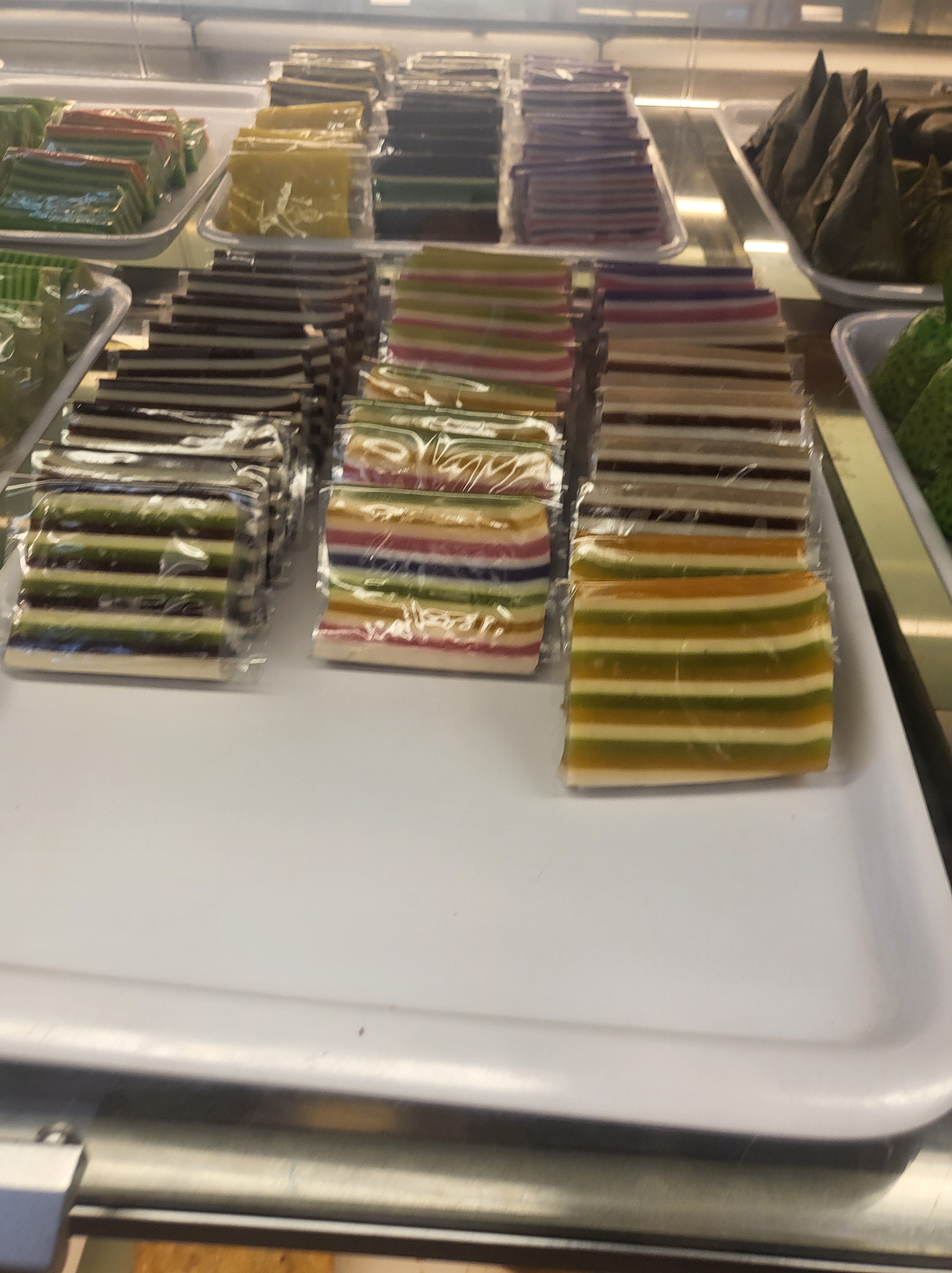
Nhom Chakachan
Composition
The Nhom Chakachan is a delicacy found throughout Southeast Asia under different names.
It is made from rice flour and tapioca flour. Sugar, coconut milk, and coloring agents are added to give the cake its final appearance.
Points of attention
Despite its somewhat frightening appearance due to the fact that the dessert incorporates flour, it seems that the tradition is currently being upheld quite well, and I have never come across versions that include wheat (note that I have only visited a limited number of establishments).
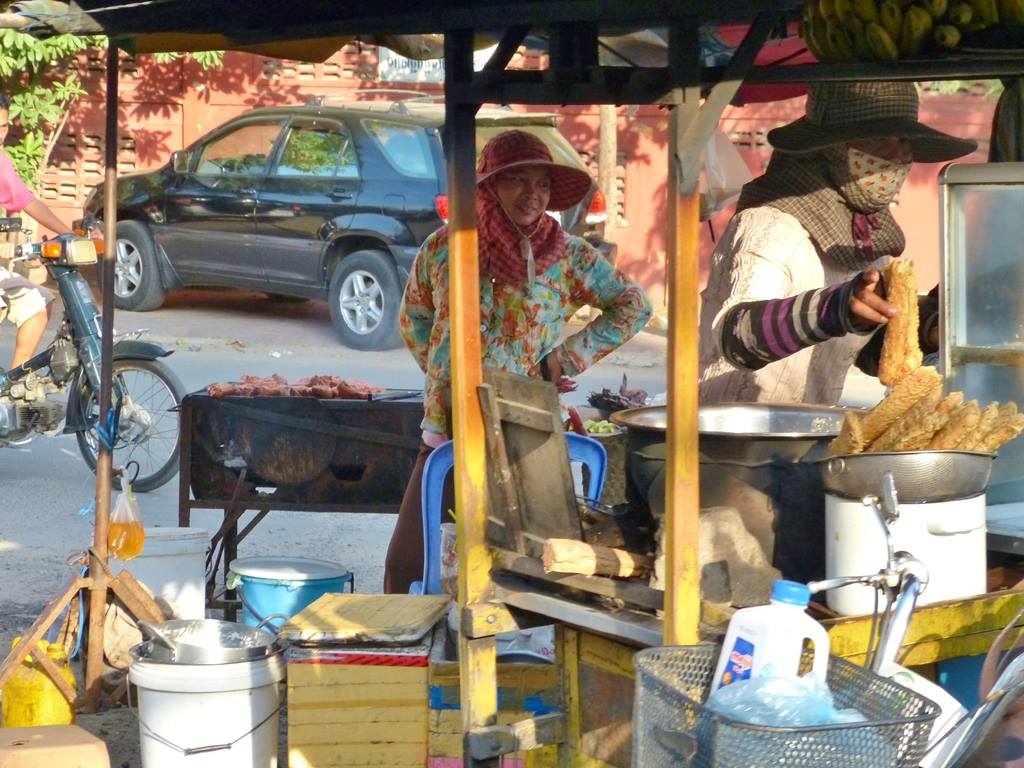
Nom Chek Chean
ចេកចៀន
Composition
Le Nom Chek Chean is a popular snack among Cambodians. It consists of delicious fried bananas with flour. The Cambodian banana fritters were the best I have tasted during my travels in Southeast Asia!
Points of attention
Although the traditional recipe uses rice flour, it is likely that some vendors may use wheat flour. The consequences of consuming this would be so serious that I advise against attempting the adventure alone. For my part, I only dared to venture with the help of a Cambodian who had a very good level of English and was able to confirm with the seller that only rice flour was indeed used.
Price
Between 500 (0,10€) and 1000 riels (0,20€)
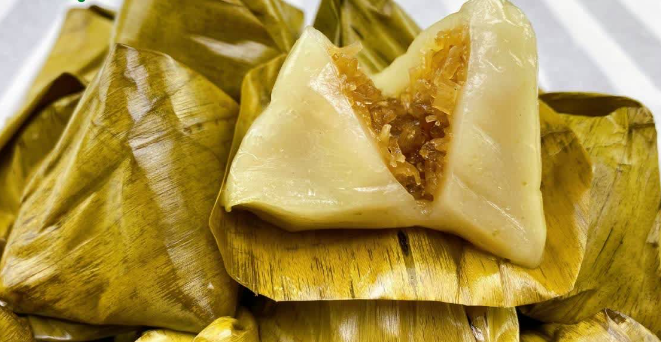
Nom Kom
នំគម
Composition
The Nom kom is a dessert made from glutinous rice flour. It is topped with grated coconut and sugar. Toasted sesame seeds may sometimes be added.
It is wrapped in a pyramidal shape in a banana leaf. IT will be sold to you with this form.
Points of attention
There are no particular points of attention to my knowledge, except that they are sold in banana leaves and it is not easy to know the content before making the purchase.
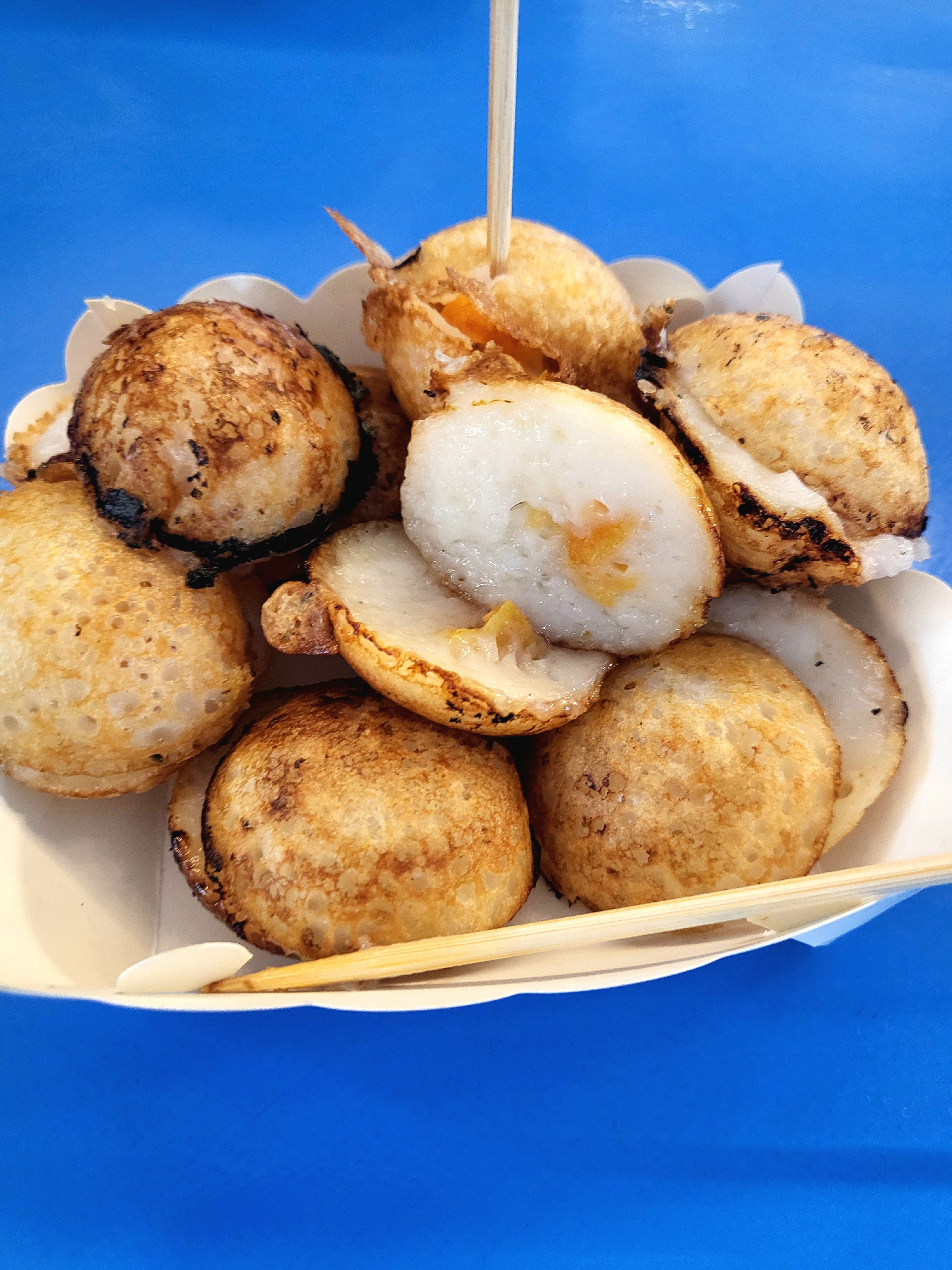
Nom krok
Composition
The Nom krok are a type of small pancakes flavored with coconut milk. They can be found in a savory form, often sold with green onions or dried shrimp. In their sweet version, they are sold with corn kernels or shredded coconut.
Points of attention
These snacks are also very popular in Laos and Thailand. It was in the latter that I tried my luck, but beware of using flour mixes that incorporate wheat flour in addition to traditional rice flour. It is possible that in Cambodia rice flour is more widely used, and I admit I only became aware of the sale of these dishes in Cambodia while preparing this article.
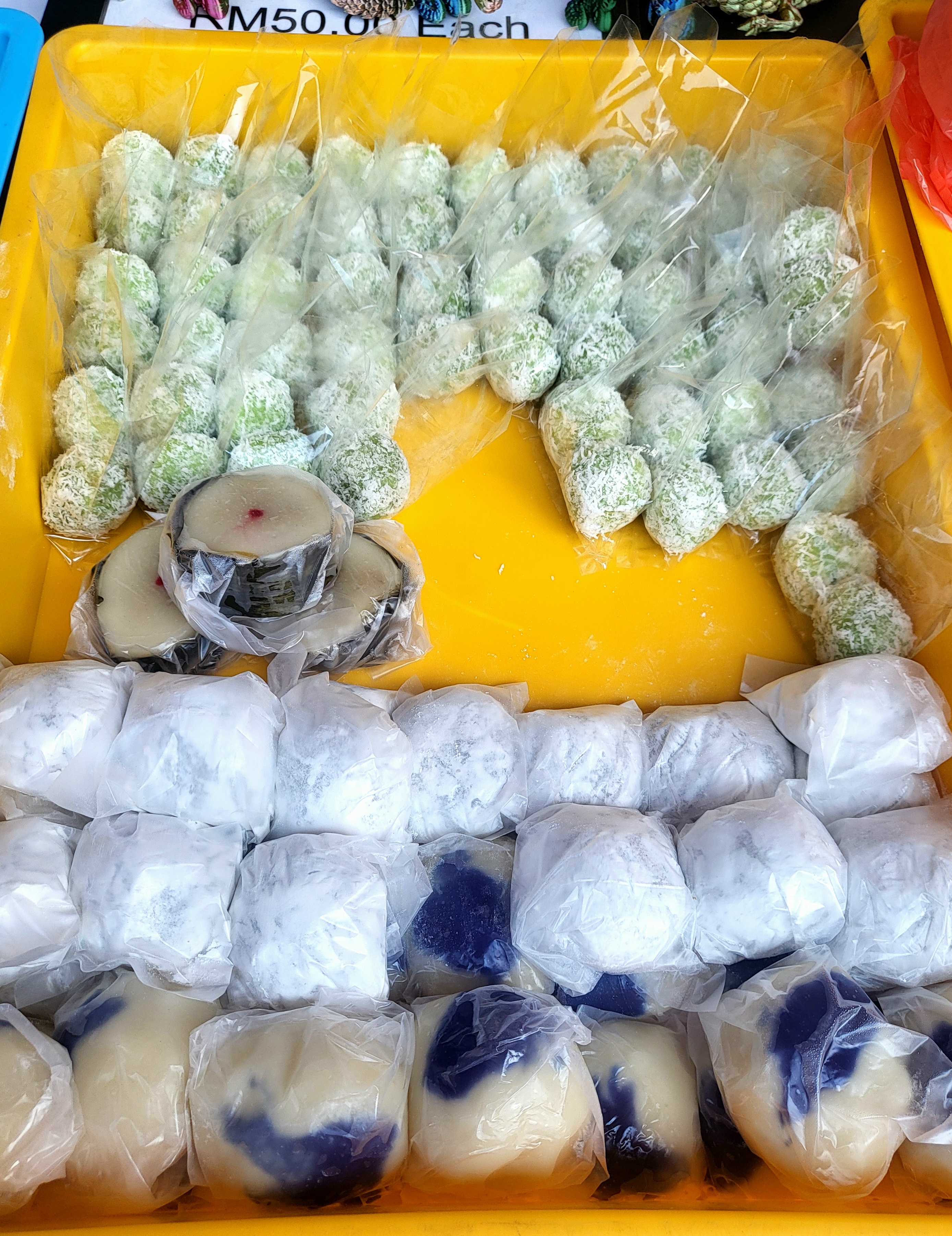
Nom Plae Ai
Composition
The nom plae ai is a popular rice cake that literally means « the dessert that kills the husband. » Legend has it that a newlywed woman wanted to please her husband by preparing this snack. The husband hurried to eat them without realizing they were still hot and therefore sticky. This led to him choking… Ignore this legend and feel free to try your luck with these small balls made from glutinous rice flour and filled with palm sugar, all generously sprinkled with grated coconut.
Points of attention
No points of caution to my knowledge.
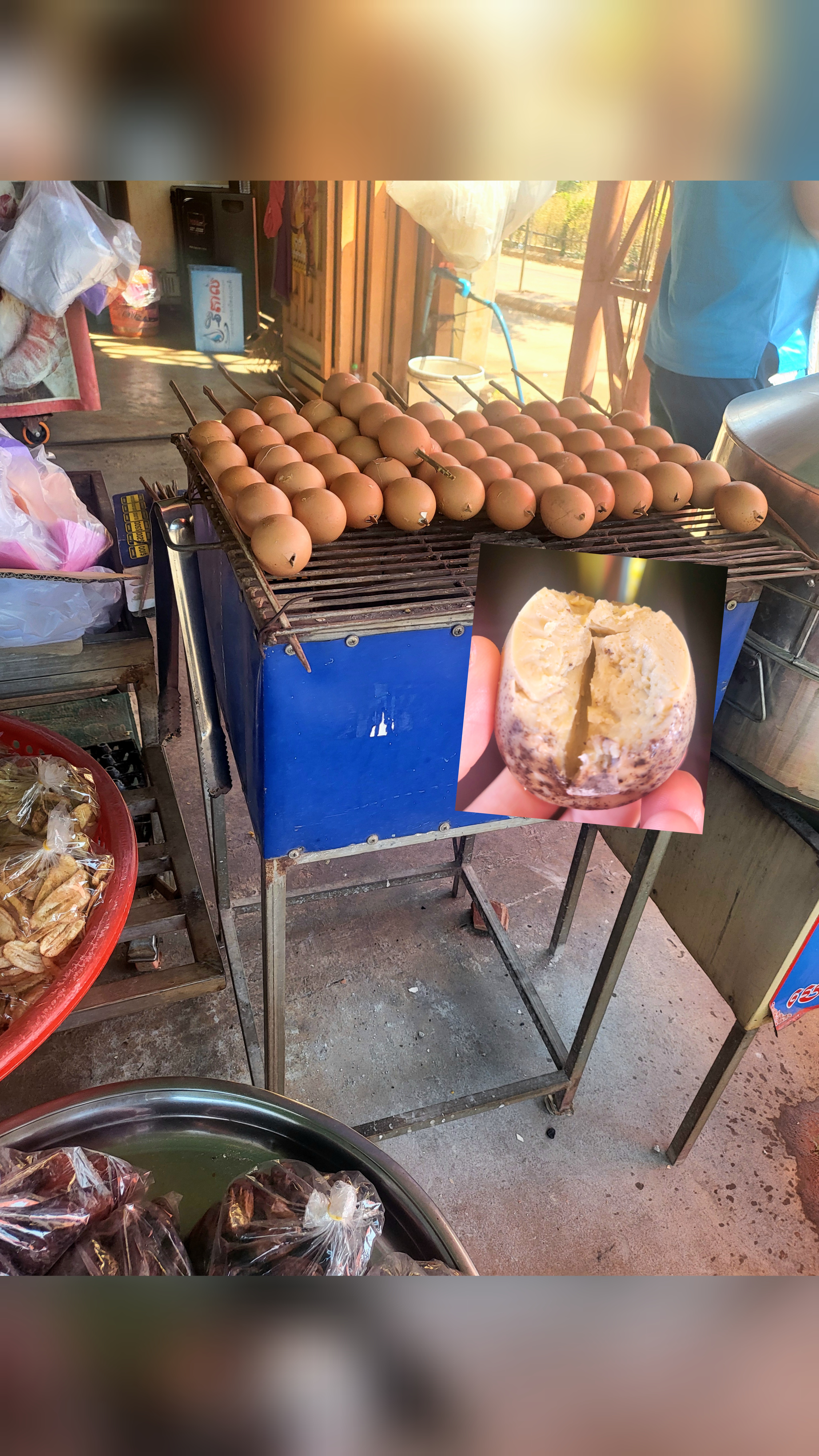
Grilled eggs ?
Composition
I was unable to find the name of these egg skewers that are very popular among the Khmer population.
Easily identifiable, they are threaded on bamboo sticks and placed over a grill. The preparation of these eggs requires a certain level of expertise: their contents are removed, mixed with pepper, sugar, and sometimes nuoc nam sauce. The mixture is then used to fill back the egg shell. The content is then steamed and warmed on the barbecue.
Points of attention
There are no points of concern to my knowledge. However, do check the color to see if soy sauce might have been added to the mixture.
Price
If I remember correctly, I believe the 2 eggs cost us 500 riels (0.10€).
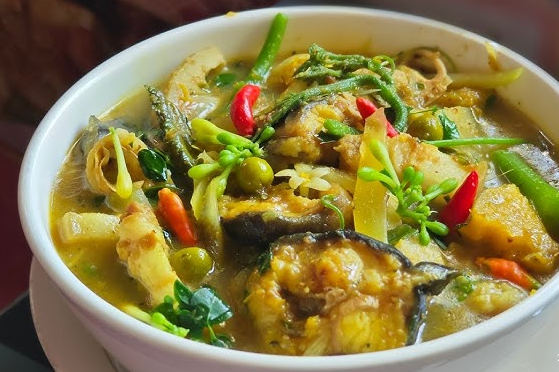
Samlor kako
សម្លកកូរ
Composition
Samlor kako is a dish made from a broth infused with numerous spices and herbs, accompanied by meats and vegetables.
Points of attention
Typically accepted as gluten-free, I now have doubts since I found Kroeung paste containing gluten. Check with the staff for more information.
Groceries and where to find snacks
I admit I haven’t searched much in grocery stores for gluten-free items.
On one hand, I had a sufficient stock of gluten-free snacks and nibbles that I put together during the end of our trip to Vietnam.
On the other hand, the snacks found at markets and street stalls filled in occasional gaps:
– Grilled bananas with or without rice and coconut milk can be found almost everywhere.
– Hard-boiled eggs can easily be purchased at the market. However, be careful of fertilized eggs… I was lucky enough never to come across them!
– Local pastries are generally made with rice and coconut milk and are not yet cut with wheat flour (see the paragraph above for more details about these treats).
– Krolan, those bamboo portions stuffed with rice, coconut milk, and sugar, can be found fairly easily, especially along the Mekong.
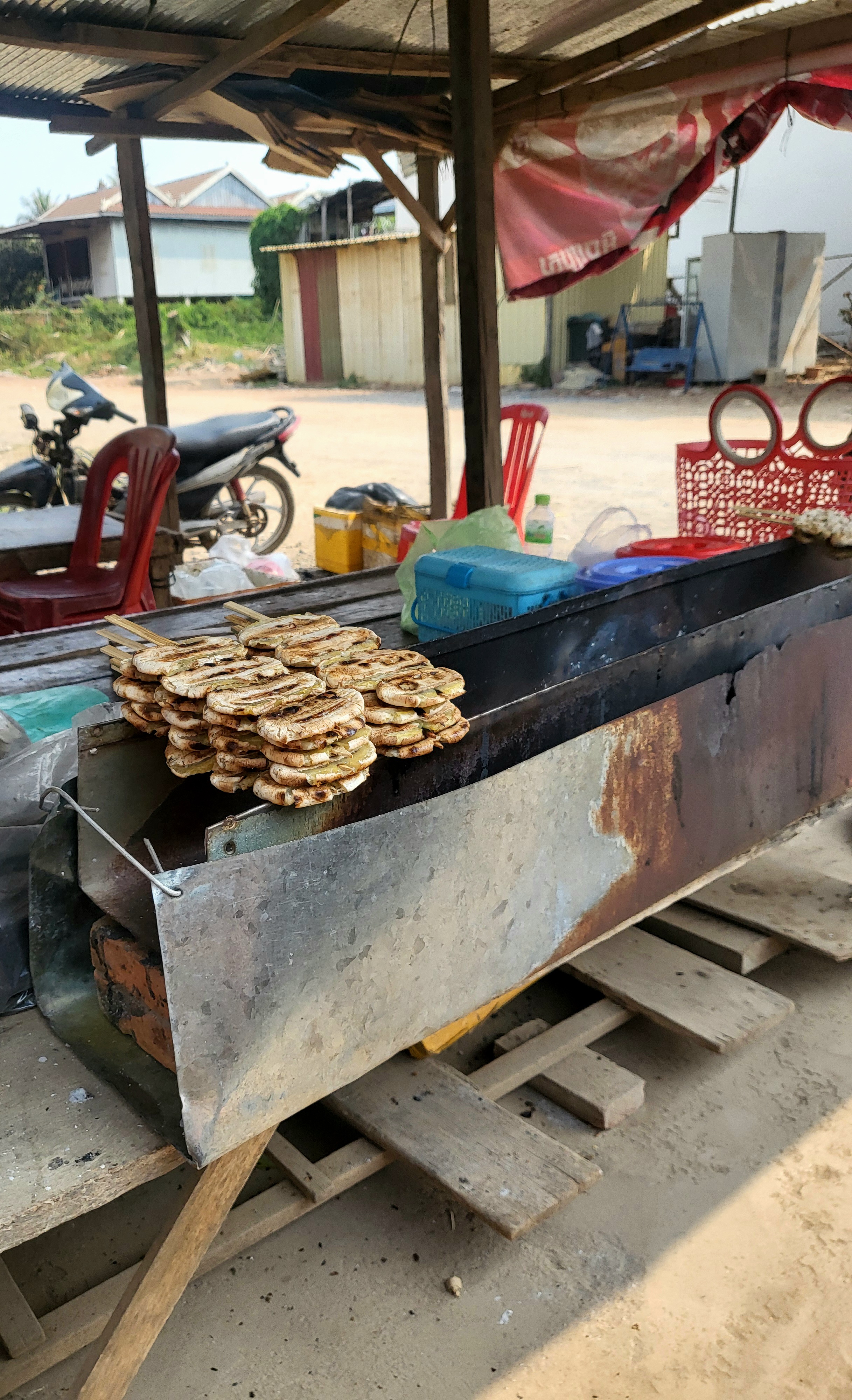
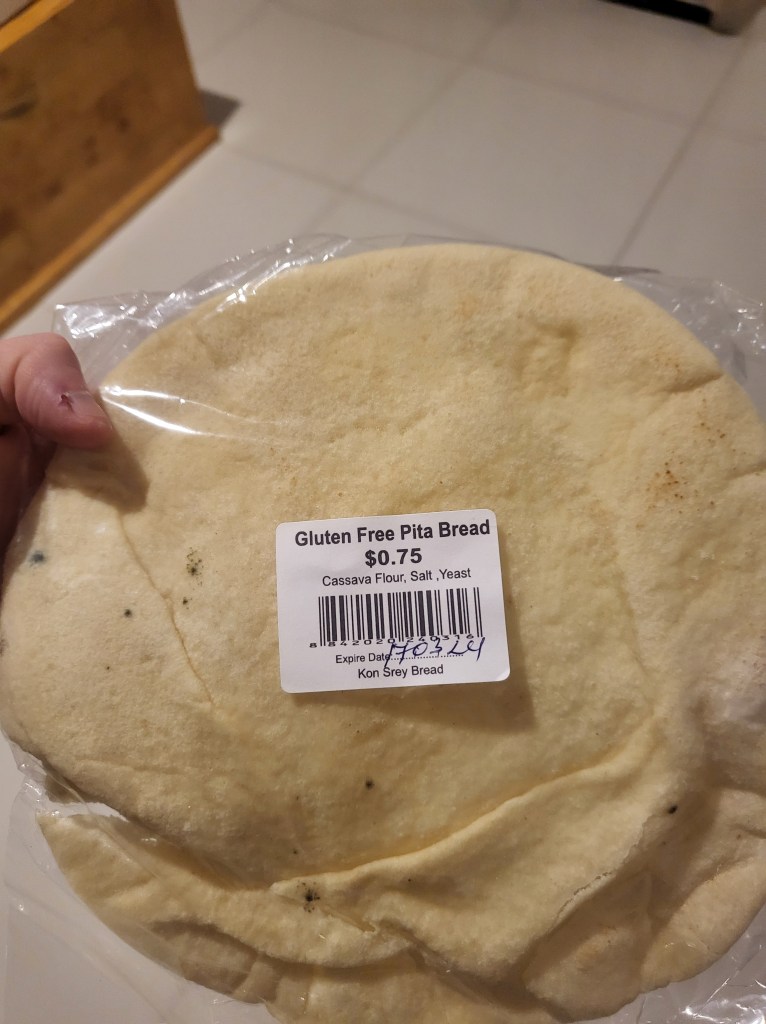
Without too much searching, I still came across the pitas below that do not include wheat flour. The type of yeast used remains, however, more mysterious. It is a good illustration of the differences in labeling that one finds in the country versus what one finds in the Western world.
A shortlist of addresses I have tested
Here are a few of the restaurants that I particularly enjoyed during my trip.
Battambang
La Rose Battambang – GF Friendly – Whole menu available – Bakery/Pastry shop – €€
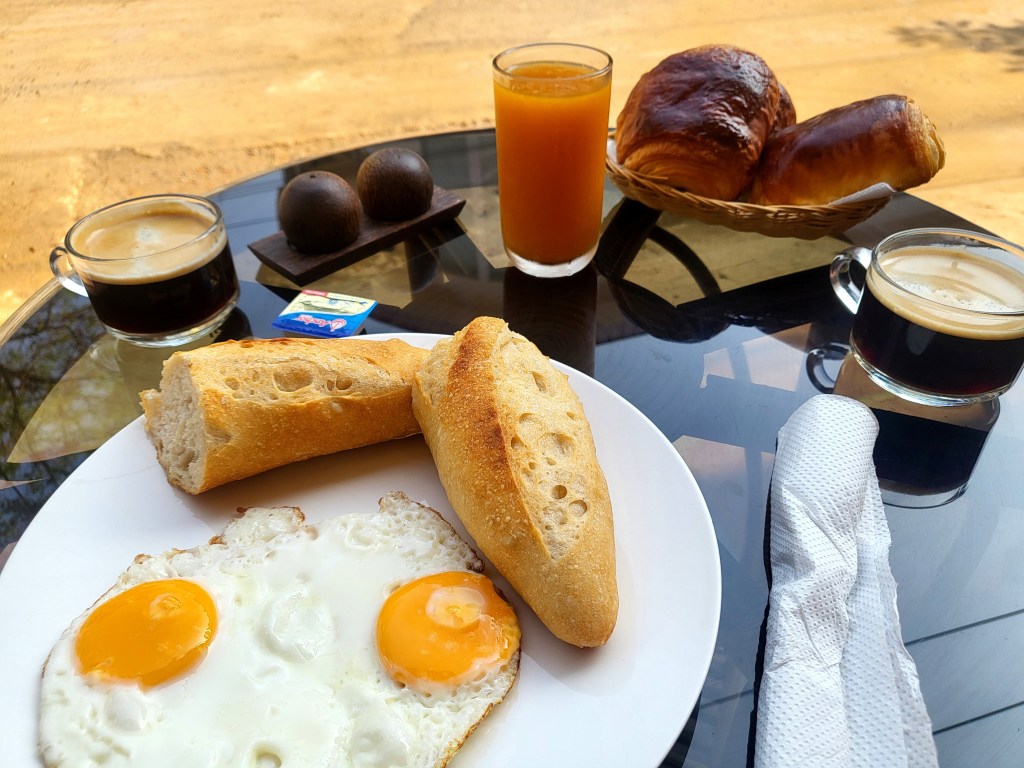
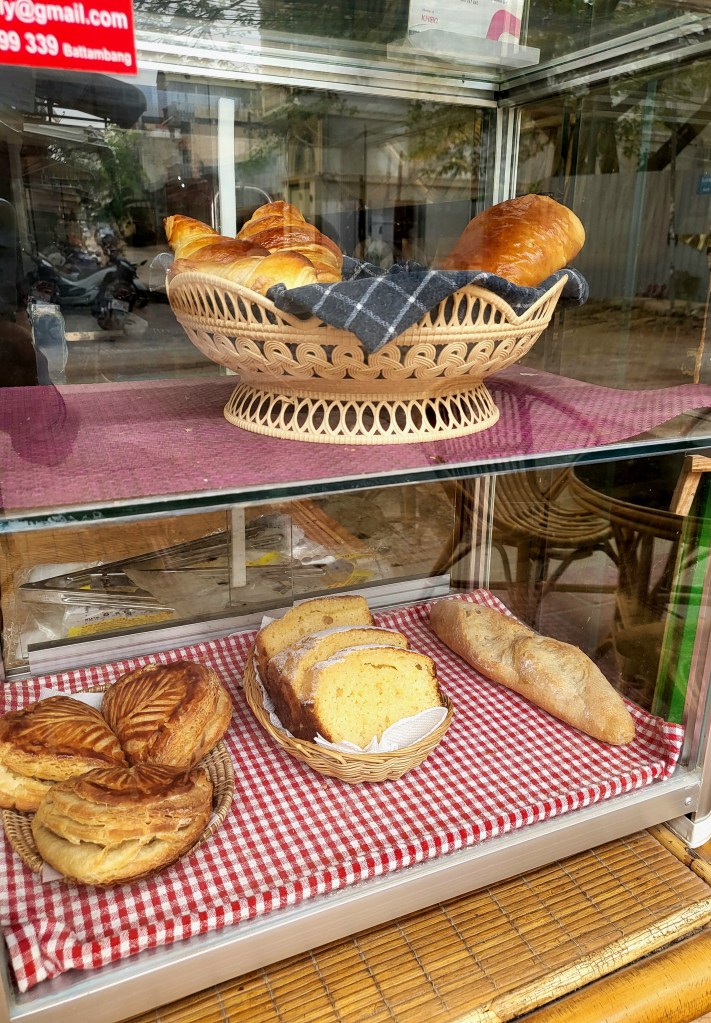
This bakery-patisserie run by French expatriates in Cambodia does not claim to offer 100% gluten-free dishes, but most are consistent with a gluten-free diet.
For all their products, they only use flour sold in the Battambang market, namely cassava flour. This flour is considered « very artisanal, » and nothing is mentioned regarding potential cross-contaminations.
As for the bakery products, the baker’s yeast they use is claimed to be gluten-free by the supplier, although there is no certification.
Regarding the pastry products, during my visit, they were using baking powder that contained gluten. However, they change it regularly, so feel free to ask them to show you.
I ate their bread, their chocolate bread, and their croissant every day during my stay in Battambang meaning during 5 days.
Firstly, I didn’t get sick.
Secondly, their products were just excellent!
Thirdly, the owners are very welcoming and will gladly answer all your questions and even give you advice for your stay in Battambang.
For those less sensitive, I recommend this place 1000%. For those more sensitive, be aware that there is a risk.
The prices are similar to what you would find in Europe for gluten products. Nevertheless, I didn’t hesitate for a single minute: what a pleasure to enjoy good bakery products again!
Google maps link: https://maps.app.goo.gl/HZUauqL22KDZszJw7
La pizza – GF Friendly – GF options – Italian cuisine – €€
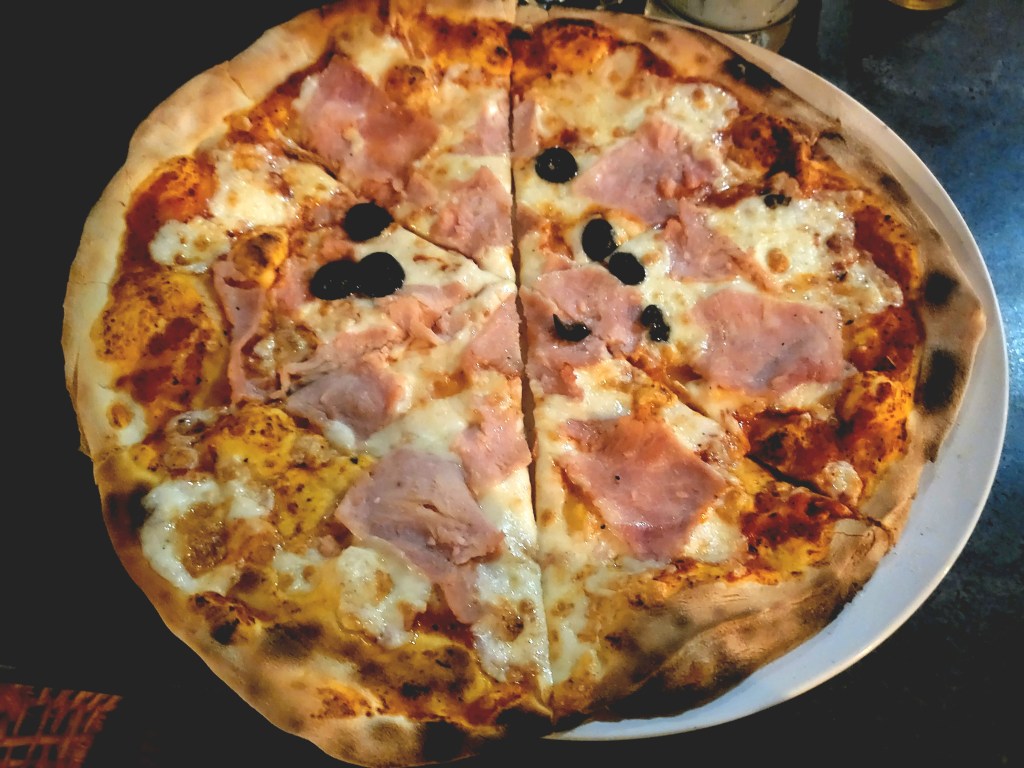
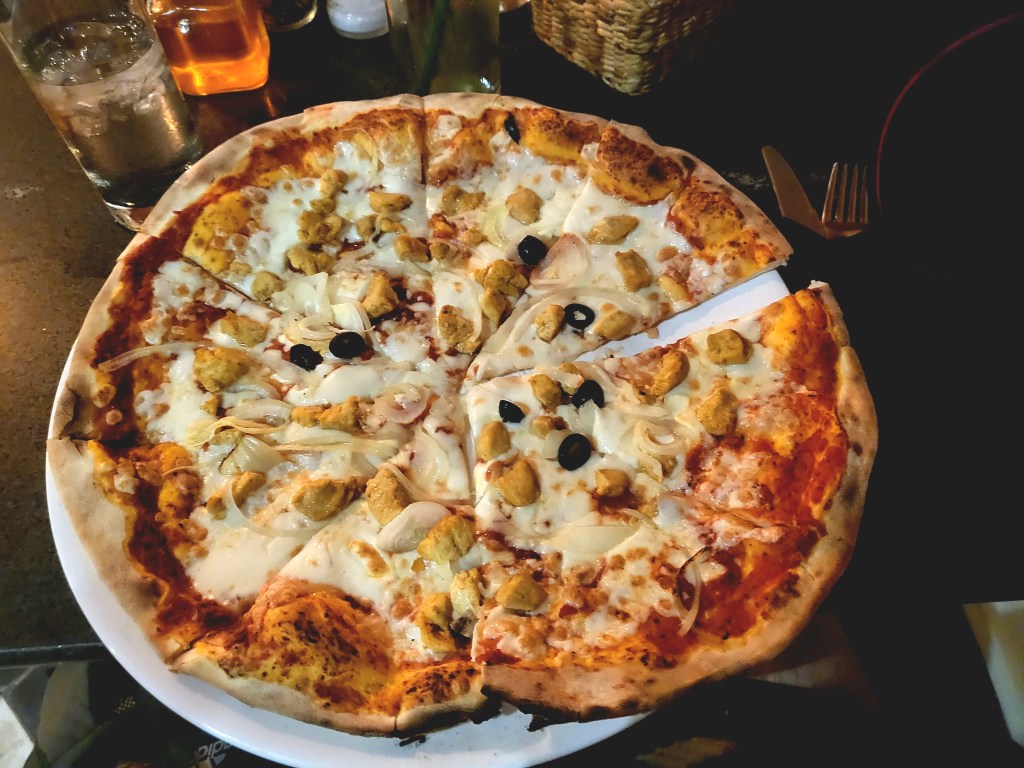
This pizzeria, just like the Rose Battambang, sources its flour from the market. Thus, they use only cassava flour, but no information is provided regarding potential cross-contamination.
They also use the same baker’s yeast that is said to be gluten-free by the supplier but has no certification.
I went there to eat twice during my stay, and I did not get sick. The pizzas were also very tasty.
For those who are more sensitive, be aware that the risk is real.
The only downside is the prices, which are slightly high for the country: the prices are equivalent to those found in Europe (without the usual additional costs for gluten-free).
Google maps link: https://maps.app.goo.gl/yBrSamT1KABeSZScA
The caff – 100% GF – Whole menu available – Western cuisine – €€
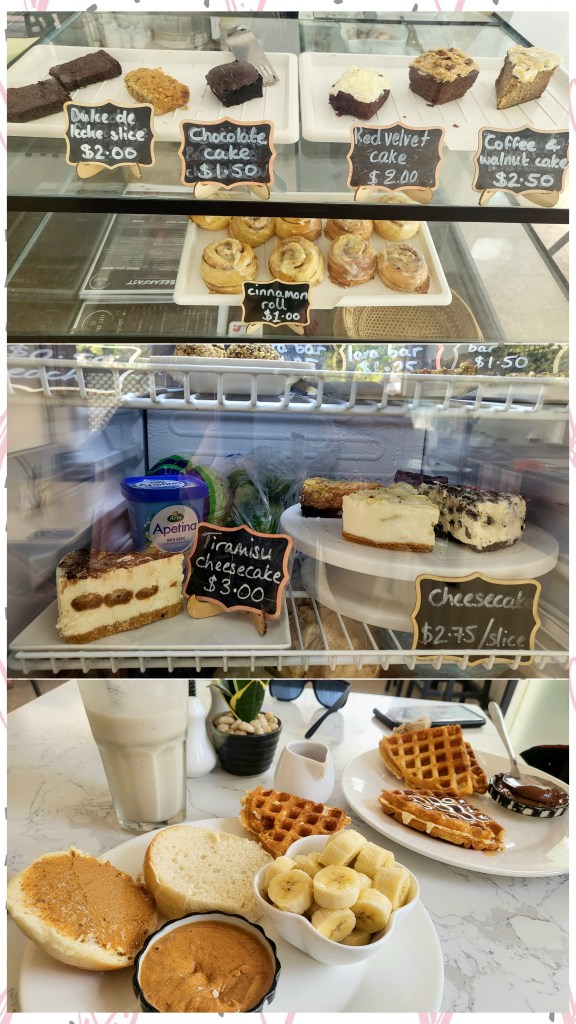
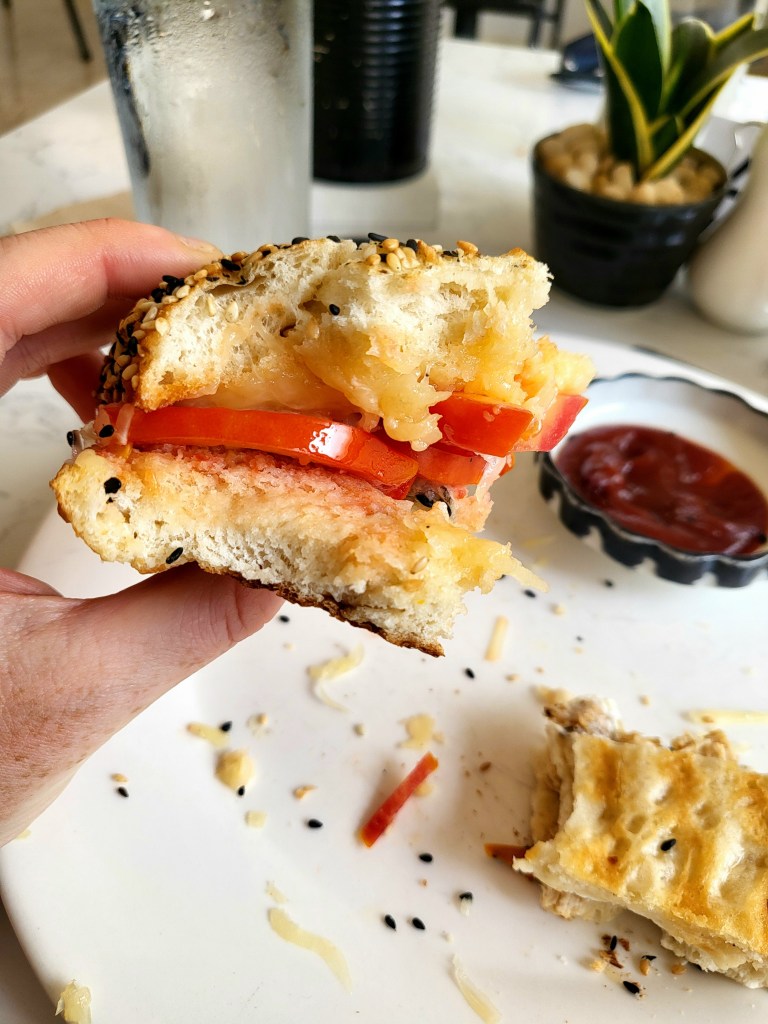
Just like the 2 addresses mentioned below, this café uses only cassava flour for making its pastries and baked goods.
They only use baking powder which is gluten-free according to the ingredient list but without certification.
I enjoyed tasting their treats, but I definitely preferred my breakfasts at Rose Battambang.
The advantage of this café is that they also offer savory dishes like chicken-mozza-tomato sandwiches.
The prices displayed are those you would find in Europe without the usual additional costs for gluten-free options.
Google maps link: https://maps.app.goo.gl/yBrSamT1KABeSZScA
Kratie
Street three eatery – GF friendly – Options available – Cuisine fusion (Cambodian-Western) – €€
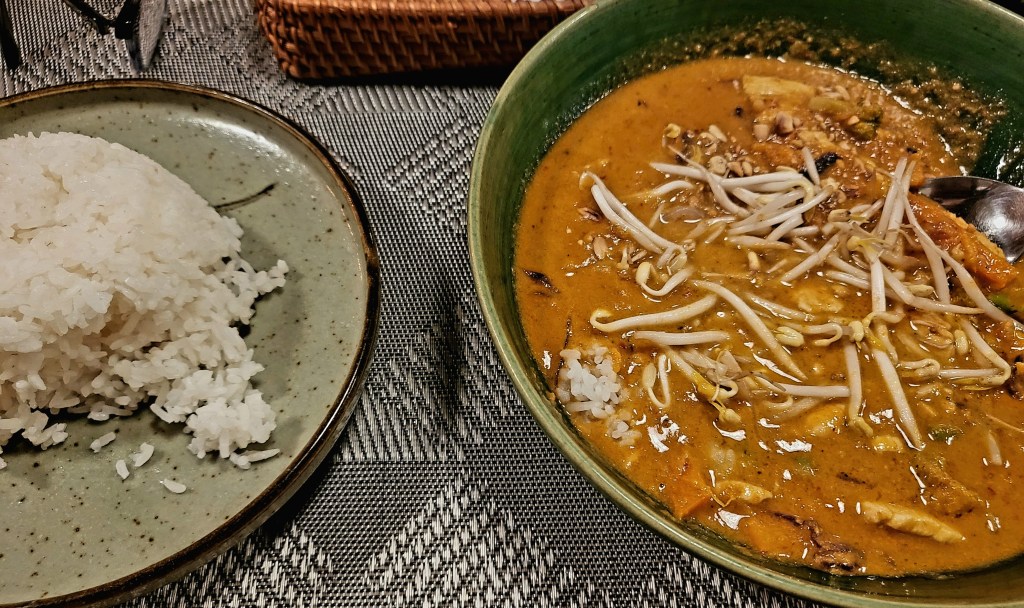
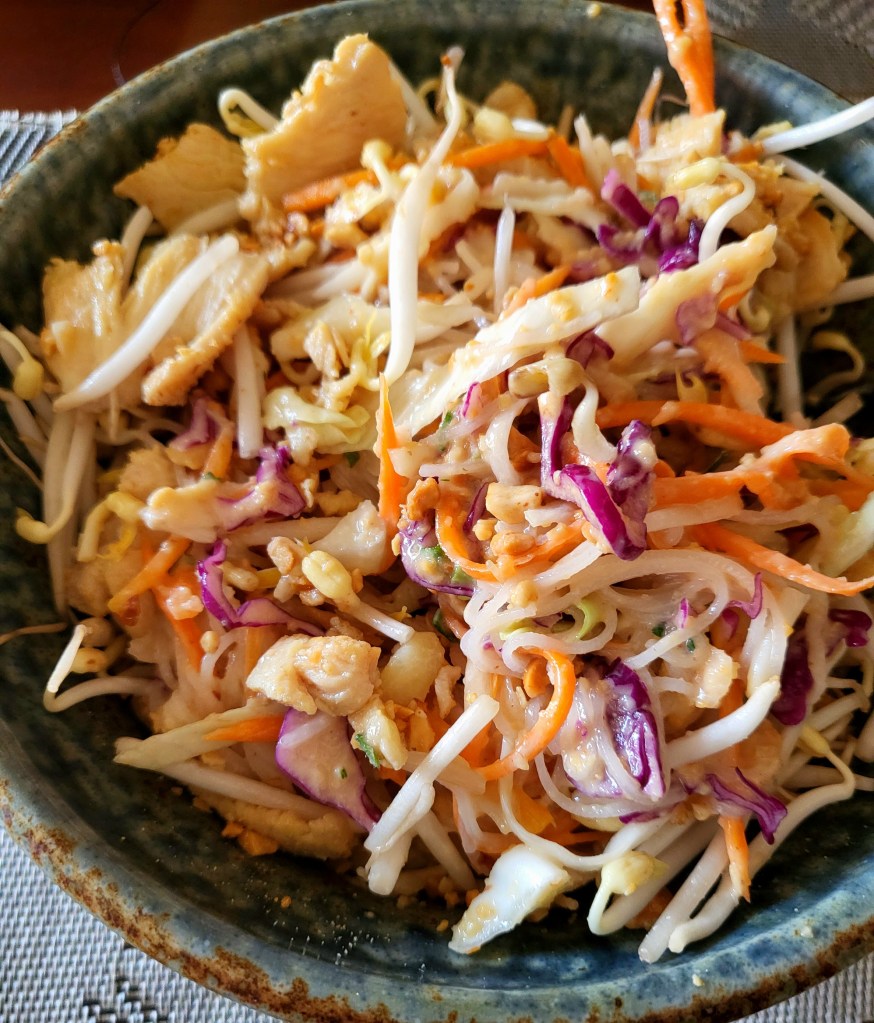
This café-restaurant offers a fusion cuisine between Cambodia and the West. You will find gluten-free options whether for appetizers, main dishes, or desserts.
The staff has a good knowledge of gluten-free options and the adaptation of dishes to gluten-free is mostly done using gluten-free sauce.
They also have a very good understanding of the risks of cross-contamination and when preparing fries, they will change the oil if you specify your dietary restrictions.
All the staff also have a very good level of English which will allow you to easily communicate with them.
They are located in Kratie and Siem Reap. I remembered both addresses and enjoyed each of the dishes I tried.
Google maps link at Kratie: https://maps.app.goo.gl/iLrMWbUhaBpKzCVi9
Google maps link at Siem reap: https://maps.app.goo.gl/wBBFGY5nQ6THA6e67

Mondulkiri
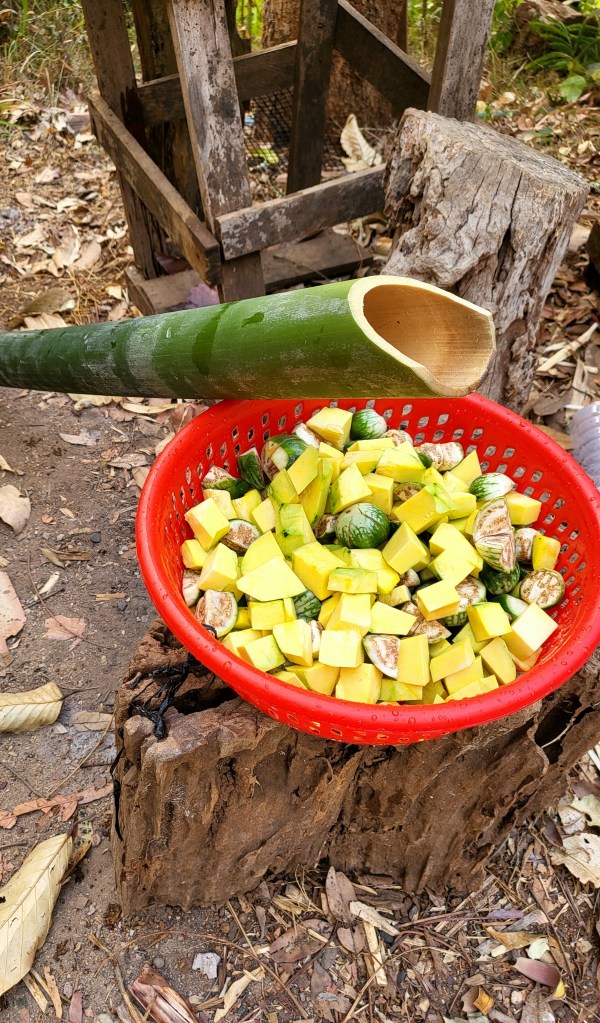
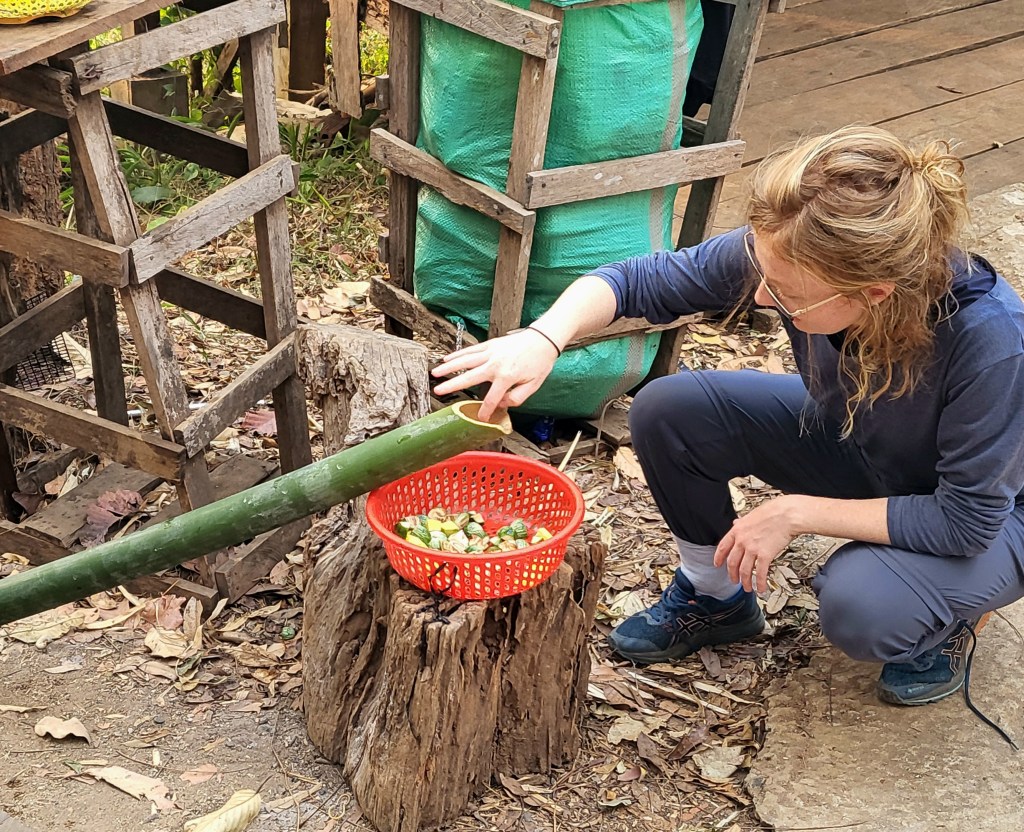
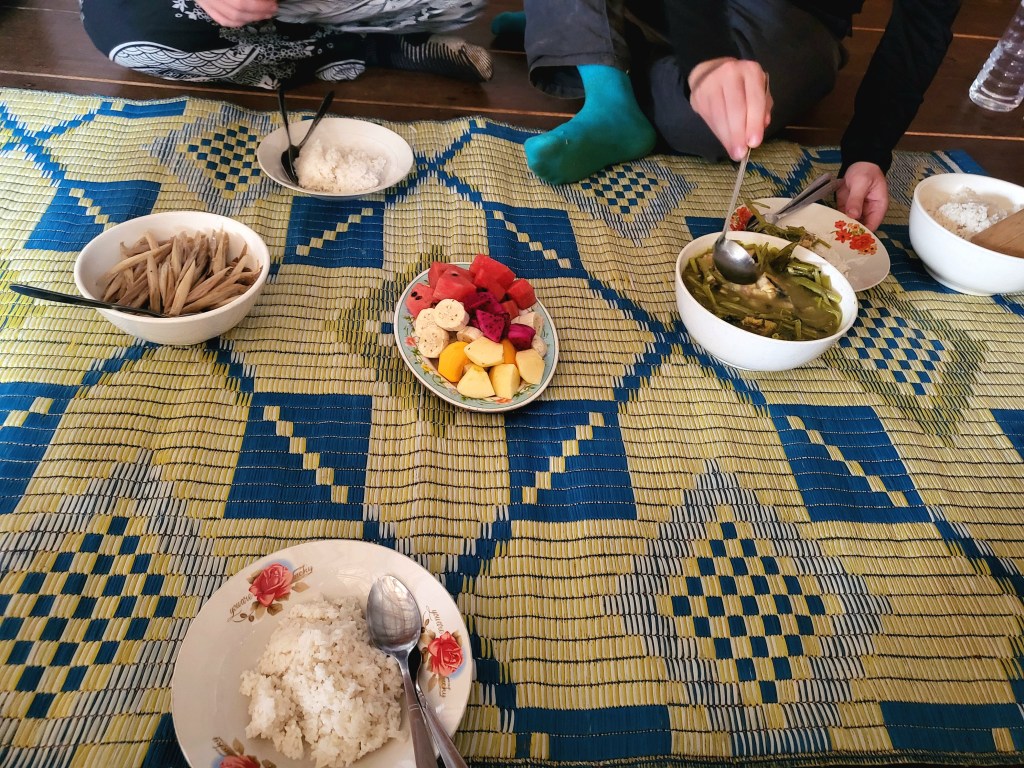
During our stay in Sen monoroum, we completed a 2-day and 1-night trek to meet the elephants of the sanctuary and discover what remains of the surrounding forest.
Each meal is included in the trek price, and they were always very attentive to my dietary restrictions.
During the first dinner, a vegetable soup was made with the locals. This was accompanied by barbecued chicken, or should I rather say cooked over a campfire. IT came accompanied with rice. It was excellent, and no adjustments were required.
The next morning, breakfast consisted of pancakes. They specially prepared a huge plate of fruits for me instead. Other breakfasts can be cooked such as omelet.
At noon, they served us rice, vegetables, and chicken. Again, no adjustments were needed. There was no sauce added, and it was simply excellent. We completed the meal with cashews collected along the way, which we roasted while we ate. It was excellent.
Mondulkiri project was the organism we went through to live this experience.
For more information, please find their website below: https://www.mondulkiriproject.org/
Or you can use the link to the Google Maps reviews: https://maps.app.goo.gl/TFgFt847CAjHb9xn9
Phnom penh
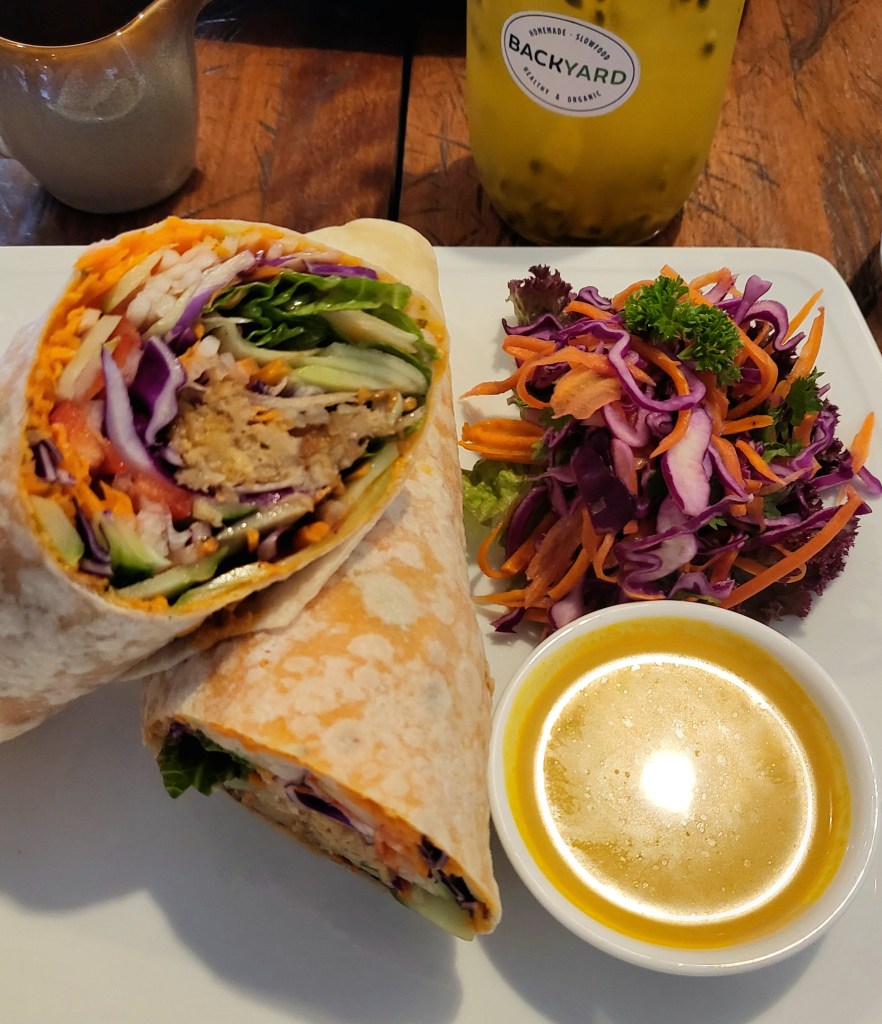
Back yard café – GF friendly – Options available- Cuisine fusion (Western/Cambodian) – €€
Back yard café is a restaurant-café based in Phnom Penh.
They offer various gluten-free dishes: several options for appetizers, main courses, and desserts are available.
Despite some reviews mentioning occasionally disappointing service and sparsely filled plates, that was not my experience during my one visit.
A small note aside: some comments on Google Maps mentioned issues with servers that gave change with faked bank notes. As throughout Cambodia, remain vigilant about this.
Google maps link: https://maps.app.goo.gl/iLrMWbUhaBpKzCVi9
Mama’s restaurant – GF friendly – Options available – Cambodian cuisine – €
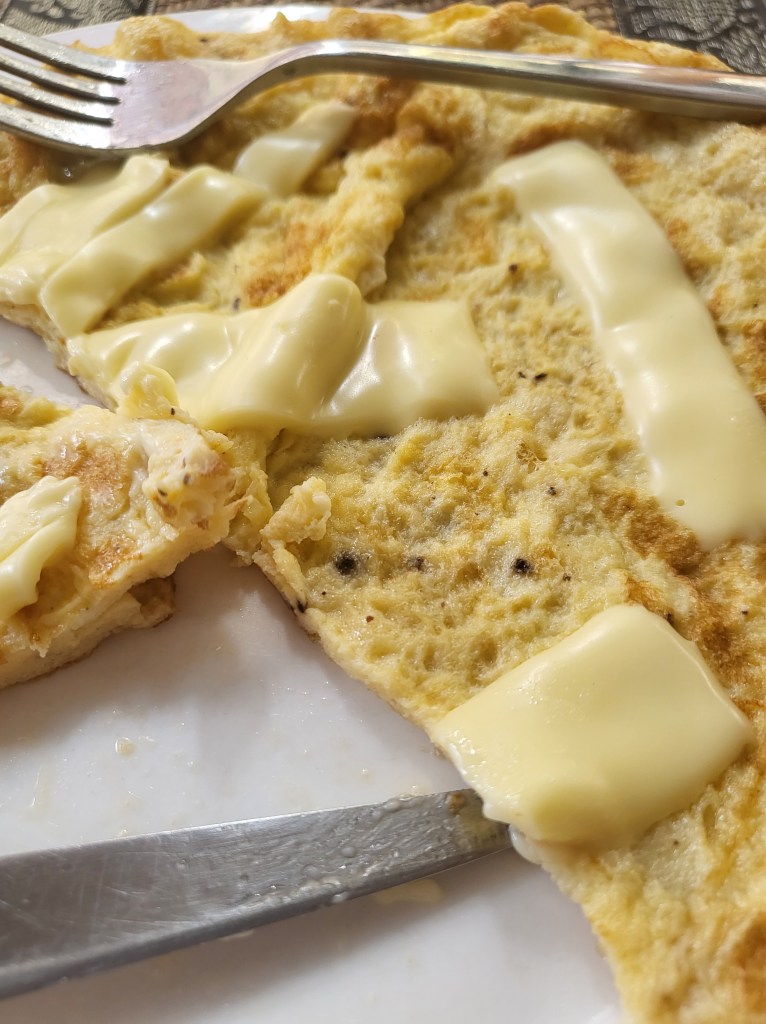
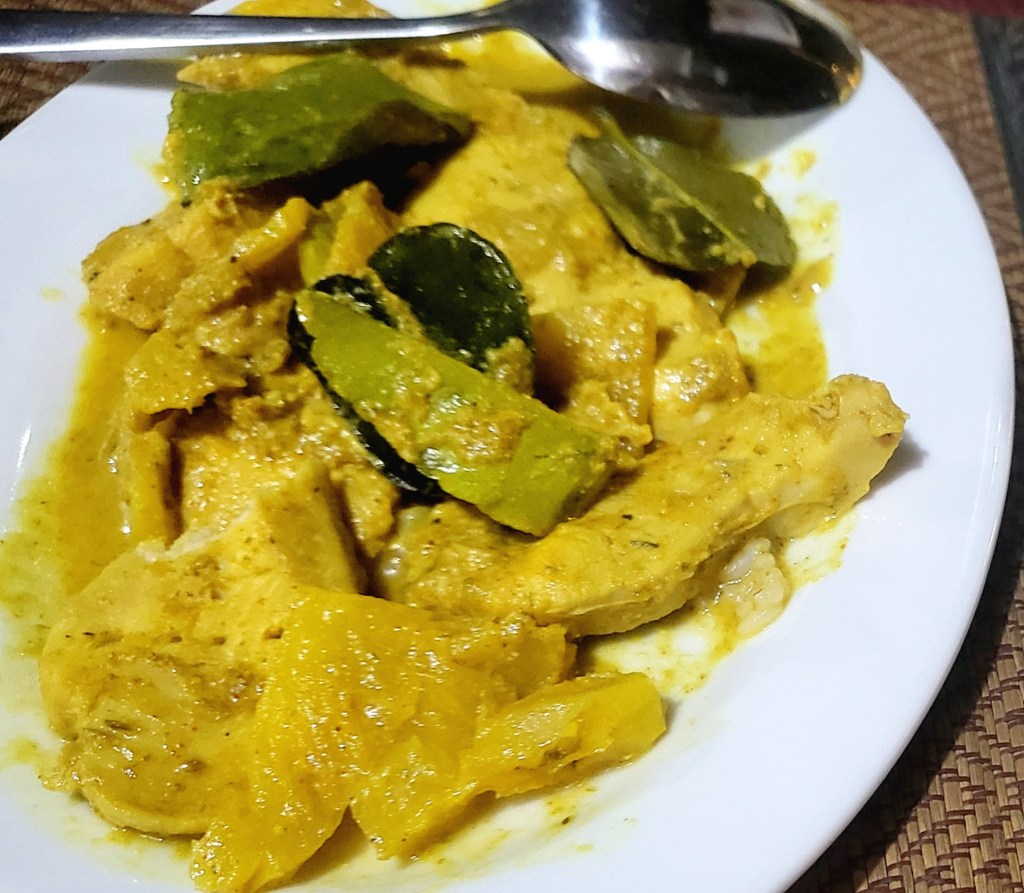
We stayed in the accommodation owned by the owners of this restaurant. We took advantage of the restaurant proximity to eat there some mornings and evenings.
The family running the restaurant speaks a very good English, which allows to confirm and adjust the dishes according to your dietary restrictions.
I was able to enjoy an omelet and amok. I requested the bread to be replaced by rice.
This allowed us to meet Thuy, who taught us a lot about Cambodia, and we really enjoyed exchanging with him. We will actually write an article about this nice meeting..
Google maps link: https://maps.app.goo.gl/iLrMWbUhaBpKzCVi9
Pu rock café- GF friendly – Whole menu available – Cambodian cuisine – €€
Pu rock café is surely the restaurant-café that I enjoyed the most in Phnom Penh.
They offer various gluten-free dishes or dishes that can be adapted to be gluten-free.
They also use gluten-free soy sauce, which is very appreciated.
I have tasted Lok lak twice, and it was excellent.
The manager speaks perfect English and will welcome you very warmly.
Google maps link: https://maps.app.goo.gl/FdWmXwD6Pyve14iq7
Siem reap
Golden pumpkin – GF Friendly – Options available – Cambodian cuisine– €€
Golden pumpkin is a restaurant offering traditional food, located in Siem Reap.
They offer various curries and amoks that are gluten-free.
The food is very good, but the service can be quite slow: don’t go there if you’re in a hurry.
The staff who was there during my visit also didn’t have a very good English level. I mainly relied on the reviews left on Google Maps to choose my dishes.
Finally, during our third visit, they more or less forced us to leave a tip by not giving us our change. Of course, we could have insisted, but we felt embarrassed, and they played on that.
Google maps location: https://maps.app.goo.gl/TXUNcgxMptuyCzfEA
While writing this article, I discovered the existence of a branch in Phnom Penh. The menu seems similar, and it is very likely that their practices are the same as the branch in Siem Reap. Find below Google maps link :
https://maps.app.goo.gl/3T4JBc65vD2PSEUB6
Sister srey café – GF friendly – Options available – Western cuisine – €€
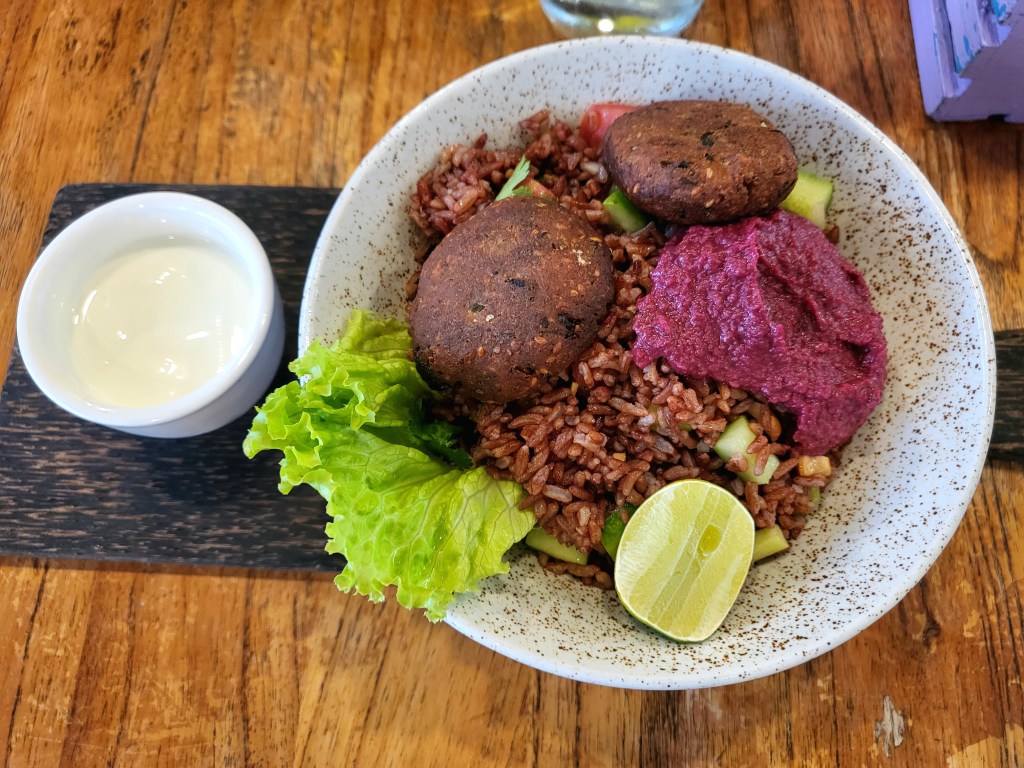
Sister Srey Café is a café-restaurant located in Siem Reap that offers various gluten-free dishes (appetizers, main courses, desserts).
The food was good there, but while preparing this article, I found that the establishment was temporarily closed. To be continued.
Google maps link: https://maps.app.goo.gl/iLrMWbUhaBpKzCVi9
Interactive map: the tool that will ease your travel
Below you will find the interactive map of restaurants offering gluten-free options in Cambodia.
It compiles the addresses that I have tested (the ones mentioned above but many others as well) and some that I found on Google Maps and Find Me Gluten Free. I selected them based on feedback and available options, in the cities I visited.
An empty field for « Ok for most coeliac » means that I hadn’t enough information to fill it. This means you will need to ensure their practices.
The link to access the map can be found here.
And if you are wondering how to use the map or what the different fields mean, feel free to check out this tutorial.

I aim to include addresses in other popular cities in Cambodia, but as I am managing the site and the maps alone, it will take some time. If you have favorite addresses, please feel free to send them directly to me so they can be quickly added and shared with the rest of the community.
Final thought
Finding gluten-free food in Cambodia has not been as difficult compared to what I experienced in other Southeast Asian countries. However, we strayed less from the beaten path than we did in other countries. This allowed us to easily find restaurants with Western influences that offered gluten-free options.
On the contrary, I had a harder time eating at small street stalls or at the market, simply because I was unable to understand what was being sold: sometimes due to the absence of labels, but mainly because I cannot recognize the Khmer alphabet and therefore identify the dish being sold.
Fortunately, most restaurants, even those run by locals, offer English menus that will provide you with some reference points.
Amok has definitely been my go-to dish during this stay. It’s available almost everywhere, and I have never encountered versions containing gluten.
Fried rice has been my second typical go-to dish. This one requires more vigilance: checking for the risk of cross-contamination as well as the absence of soy sauce.
When it comes to snacks, krolan, and grilled bananas (in many different forms), they have been excellent treats that I could find all over the country.
 Le goût du monde sans gluten
Laisser un commentaire