
|
An unforgettable and guenine night in a ryokan
Published
on
Last
modified
on



We spent a night in Hakone. At the foot of Mount Fuji, the city is renowned for its ryokans that offer some of the hottest onsens. But their greatest asset is undoubtedly the incredible views they provide, as well as the countless easy-access walks that lead to the view of Mount Fuji. This experience alone taught us a lot about Japanese culture but especially delighted our taste buds. The chef was able to adapt to gluten-free diet for Eva, and we left with satisfied stomachs, though a bit too ready to burst.
This site contains no affiliate links, allowing us to share our experience with complete transparency.
What is a ryokan?
Do you know the term ryokan? If so, I recommend skipping this paragraph; otherwise, these few lines will surely enlighten you and help you determine if it’s the kind of experience you want to have during your stay.
A ryokan is a typically Japanese type of accommodation that is somewhat unclassifiable. It’s neither an inn nor a hotel, but what is certain is that you will be treated like royalty.
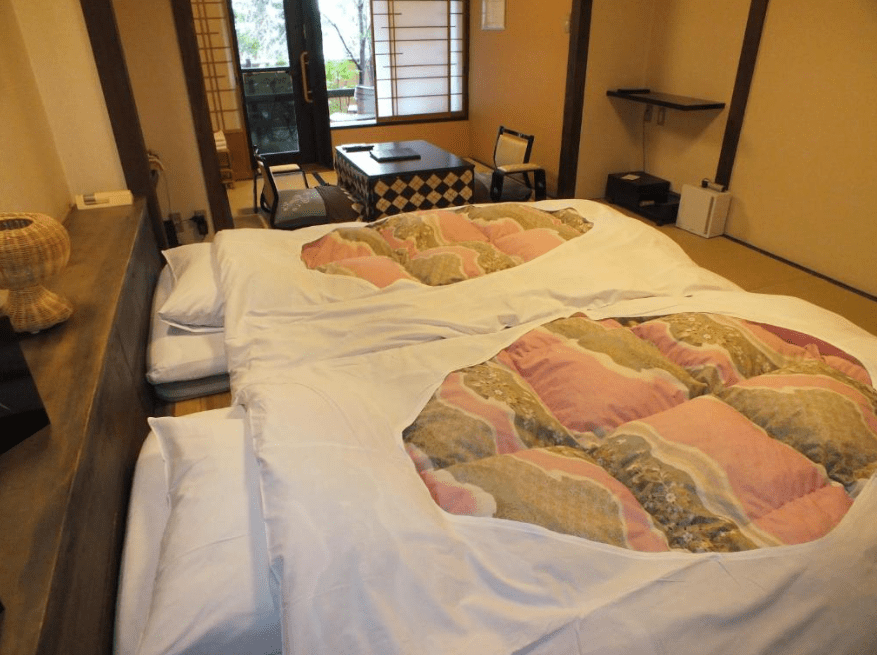
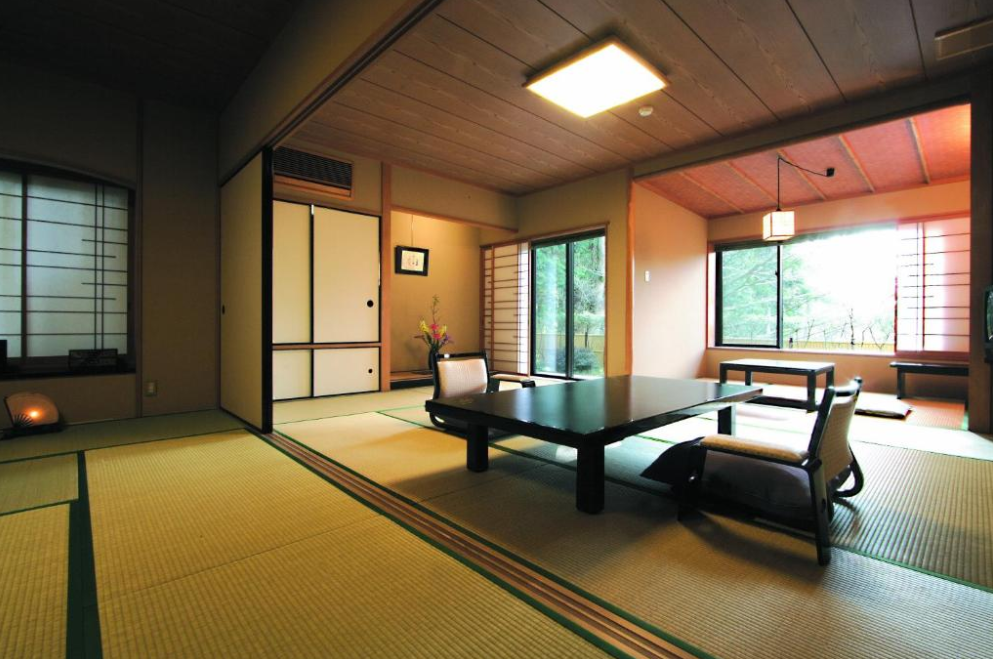
Generally, these accommodations are quite traditional, featuring tatami floors, futons for beds, and private or public onsens, sometimes even outdoors. There are also more modern ryokans with real beds and without tatami floors, but this option is currently quite rare.
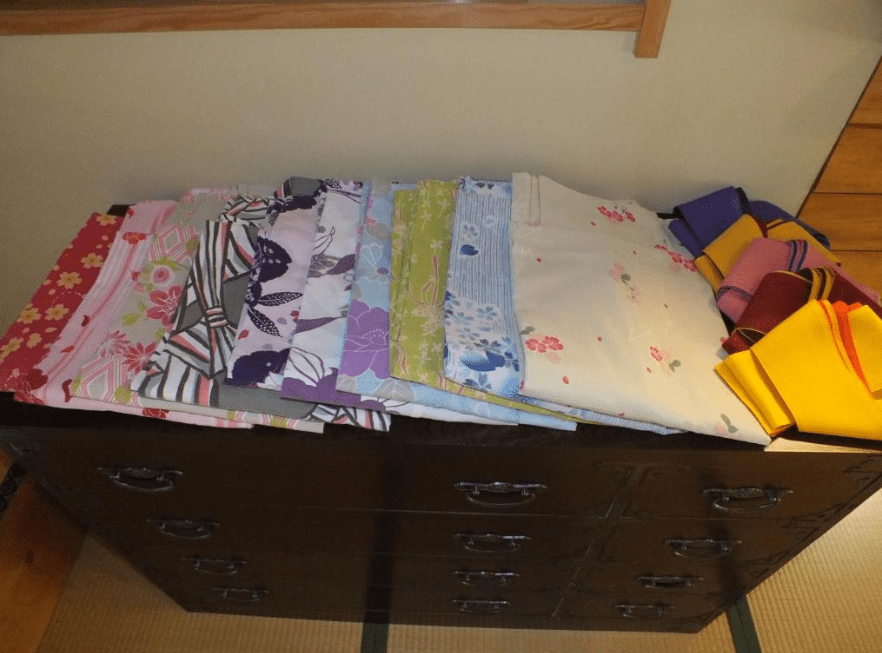
Upon your arrival, you will be provided with traditional clothing: yukata, which are summer kimonos.
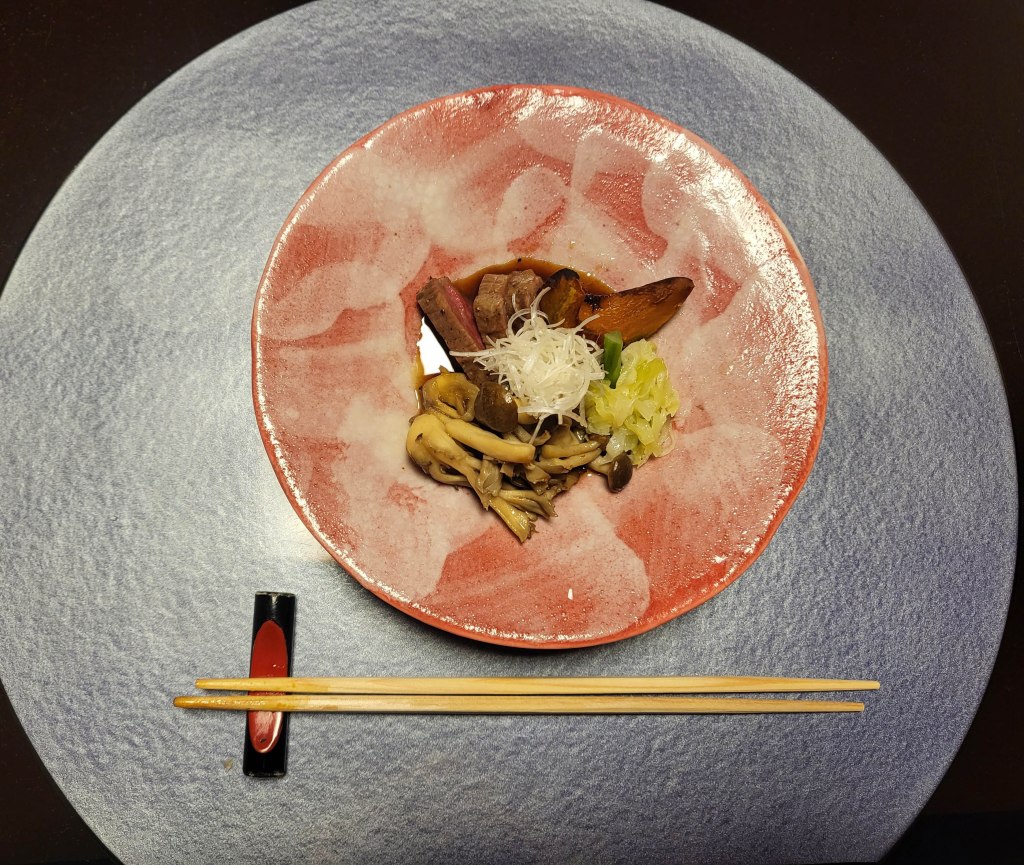
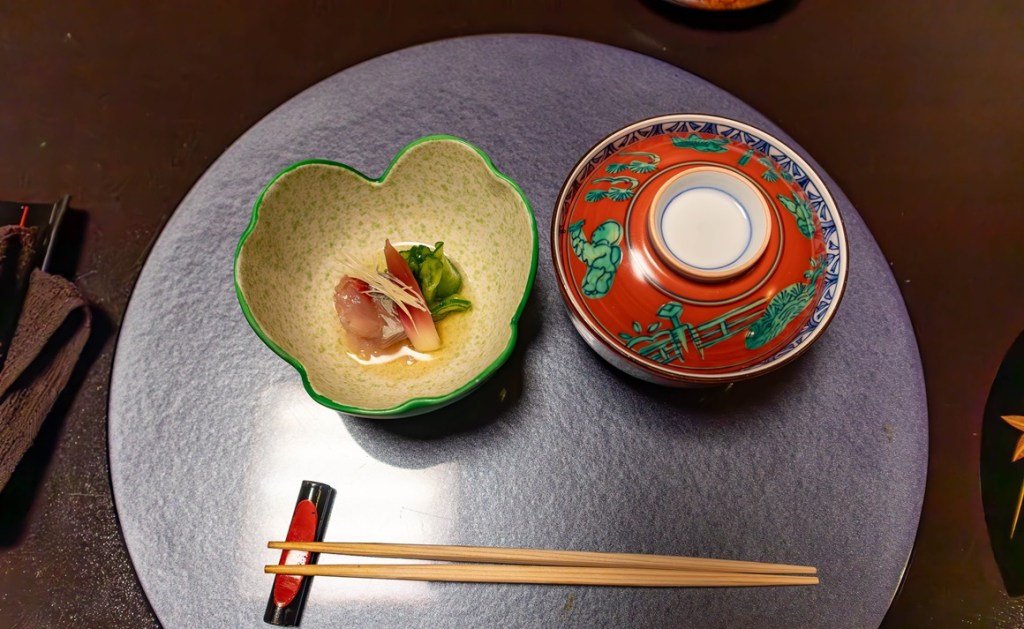
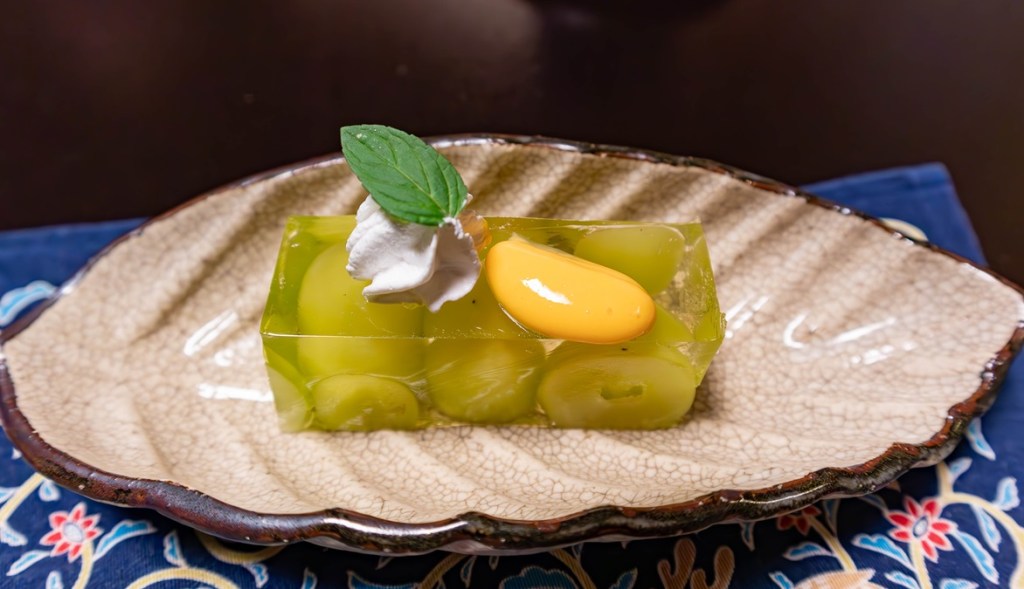
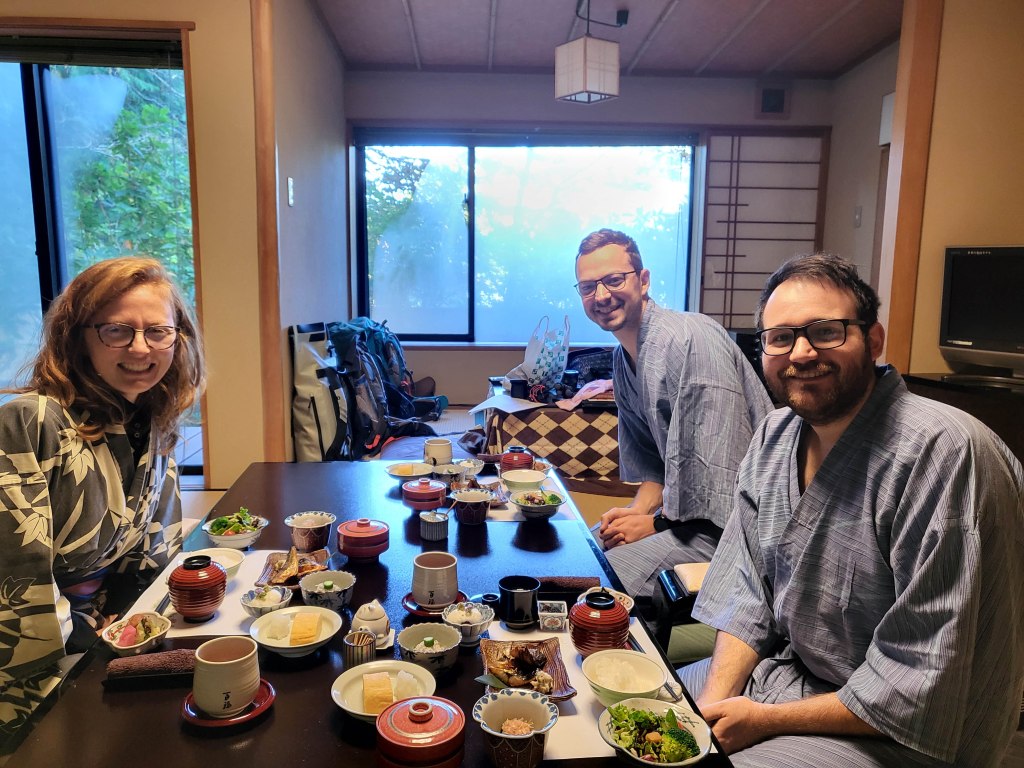
The highlight is undoubtedly the meals prepared by the attentive chef, which are generally served directly in your room. Dinner consists of multiple courses and puts the spotlight on Japanese cuisine, known as kaiseki. To give you an example, during our experience, the meal took place over 10 services. Although the plates may not have been large, our stomachs were a bit too full by the end of the meal. I imagine that in this regard, the experience is comparable to dining in a French Michelin-starred restaurant. As it is often the case in Japan, the cuisine is seasonal, and the menu changes regularly. It’s hard to know it in advance, but the element of surprise adds to making the experience even more exceptional.
Of course, there is a price to pay, and you should generally expect a minimum of €100/night/person for the cheapest options. This also greatly depends on the city where your choice will be made.
So, with such rates, before diving in, we scoured websites to see if the experience was worth the cost. Immersion in Japanese culture, trying outdoor private onsens, and the kaiseki dinner were the three points that made us eager to try the experience. As for the first two points, everyone was unanimous and complimentary, but the kaiseki cuisine did not enjoy the same consensus. Some spoke of food that was bland, overly filling with its multiple services, or too many frills with little added value in terms of taste. As you can understand, despite these mixed reviews, we decided to take the plunge, and we have no regrets. We let you judge with the rest of the articles 😉.
Our trip to the Hananoyado Fukuya at Hakone
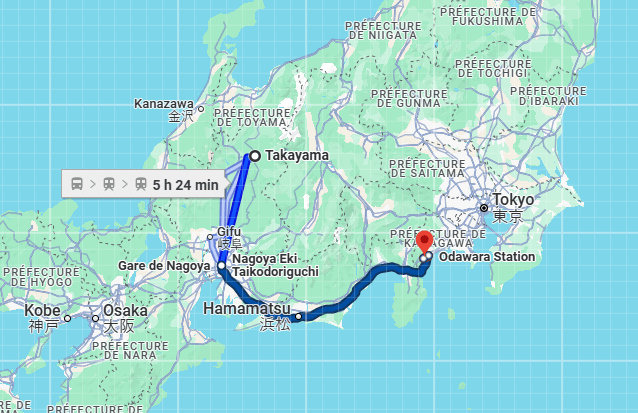
We depart from Takayama to reach Hakone. The journey takes about 5 hours with 2 trains and 1 bus. It may seem like a long time, but the trains are so comfortable and easy to take in Japan that it goes by quickly.
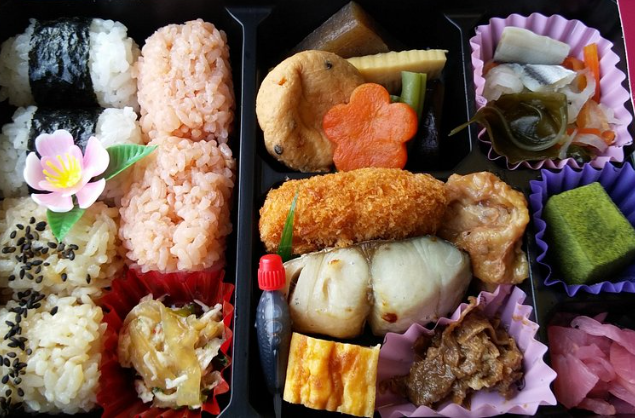
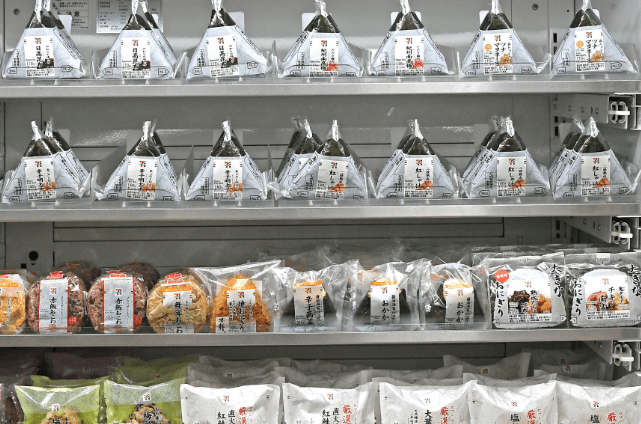
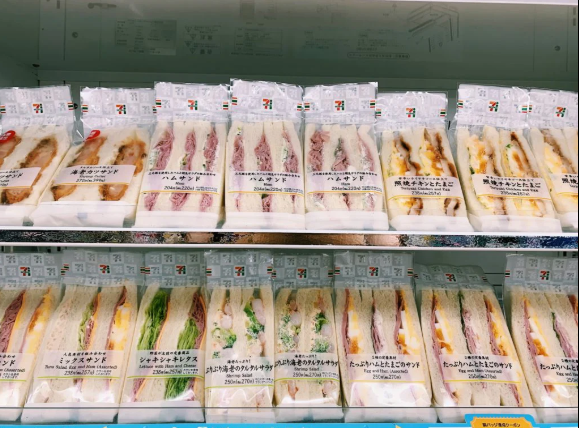
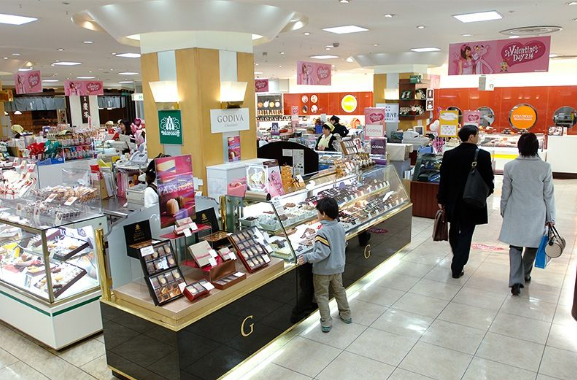
The first train takes us to Nagoya, and we take advantage of this change to buy a snack. And as in all Japanese stations, there is plenty of choice. The stalls and shops offering take-away are numerous. As often in Japan, it’s the underground levels that offer the most variety, with entire floors dedicated to food. Nicolas is tempted by an ekiben, a bento offering a variety of small Japanese dishes. Unfortunately, Eva has never managed to find gluten-free options. She settles for a konbini and their classic onigiri. This is complemented with sweet potato fries. It’s simple but delicious. As for Kévin, who is not too keen on trying new flavors, he takes a sandwich. There really is something for every taste and palate.
Contrary to what one might think, the prices at konbini in the stations are the same as those we could find outside. However, the prices for ekiben and other take-away dishes in the stations tend to be slightly higher, but honestly, it’s worth it to indulge as the food is so good. It’s also extremely convenient: no need to plan ahead, and it gives access to fresh and very typical food.
Once our shopping done, we board our second train which takes us to Odawara.
From there, we take a bus that brings us to Hakone, just a few meters from our ryokan. This last leg of the journey was undoubtedly the least pleasant. We found ourselves among tourists, with huge suitcases that were difficult to fit in. As we ascend, the route is winding and treacherous. We were jostled during the ride while the suitcases bounced from side to side with each turn of the driver’s wheel.
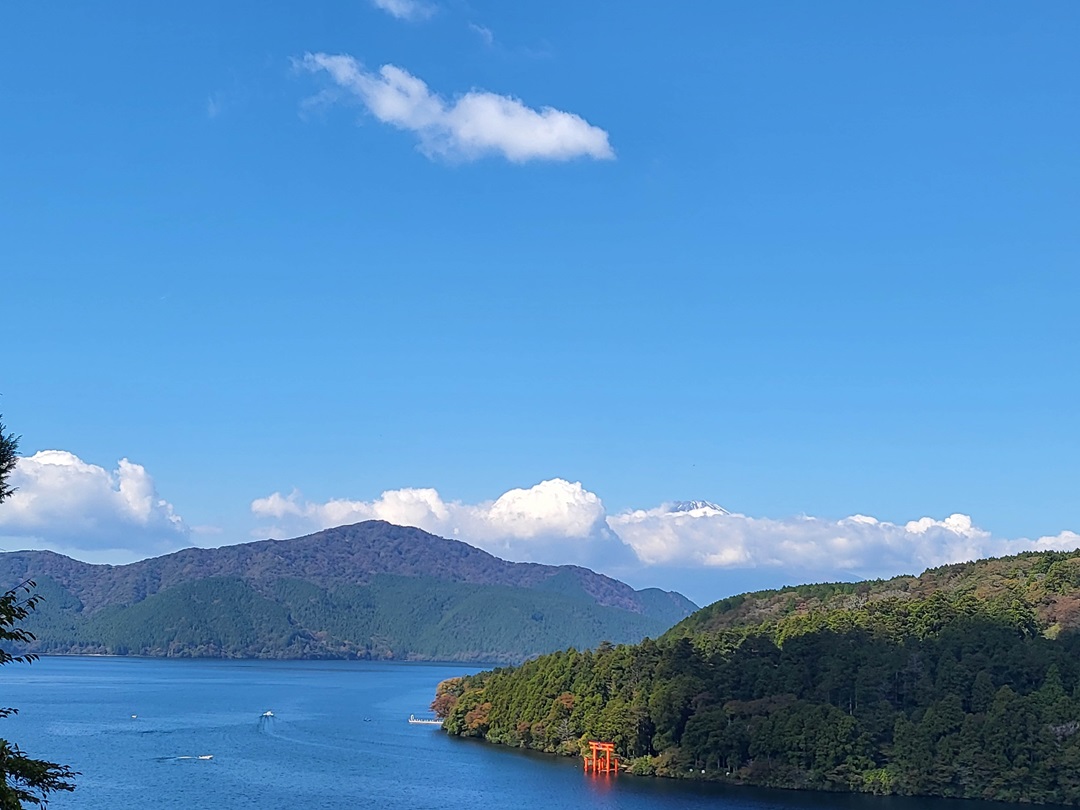
As soon as we get off the bus, we are greeted with the stunning view of Lake Ashi and its famous torii! We finish the walk to the ryokan on foot. There isn’t much, and thankfully so because it’s uphill!

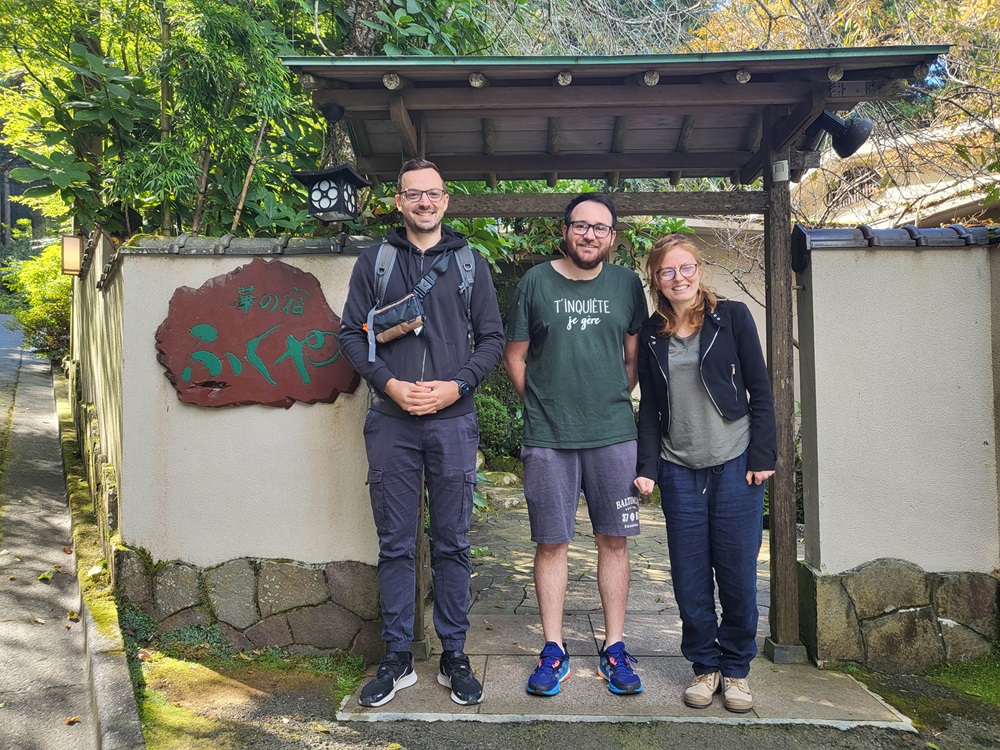
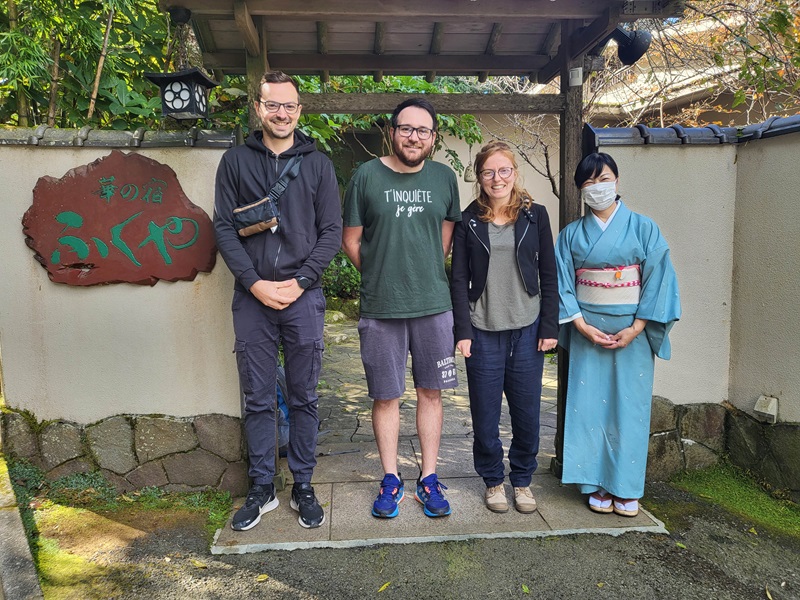
Here we are in front of the entrance of Hananoyado Fukuya, the ryokan we chose. The entrance is charming, and the perfectly maintained Japanese garden immediately immerses us.
Our unforgettable experience at Hananoyado Fukuya
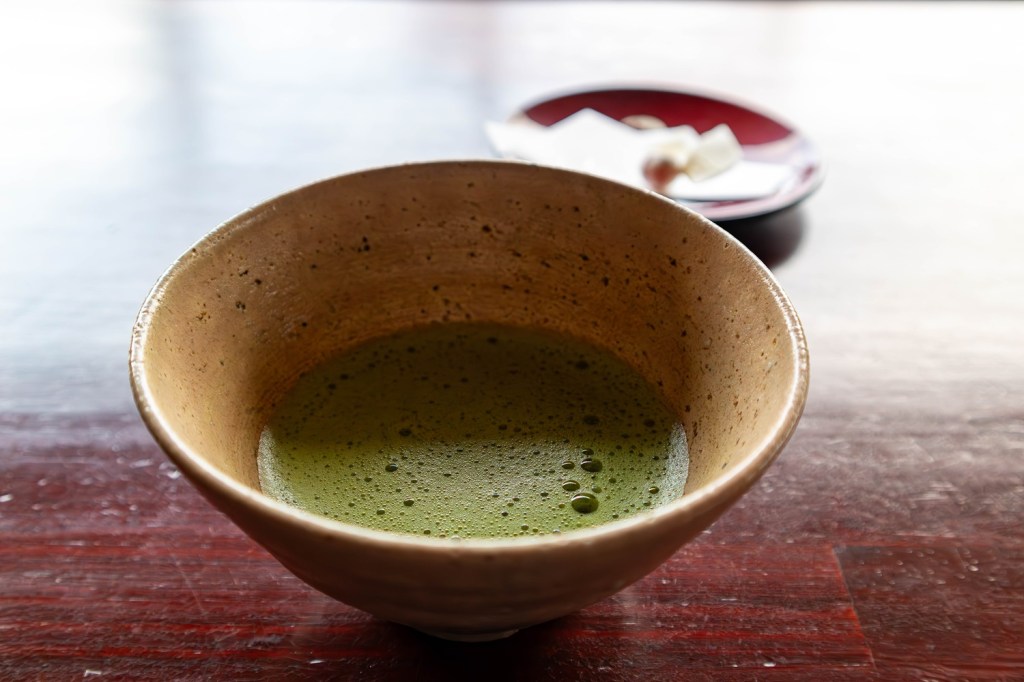
We arrive before check-in time, so we are somewhat hesitant. However, we take our chances and are immediately welcomed by a butler who is attentive to us, as it is the custom in Japan. Despite his advanced age, he insists on carrying our rather heavy luggages. This makes us feel almost uncomfortable, but we refrain from insisting too much, knowing it might be disrespectful. Once our luggage is set aside, he takes Eva to choose her yukata and a beauty mask included in the price of the stay. He then leads us to a small patio furnished with the most comfortable chairs. Kévin, who made the reservation, receives all the honors and is called Sir Kévin by the butler. He almost seems to swell with pride. The butler then asks Sir Kévin what drinks we would like. We all opt for a matcha tea that we have definitely come to appreciate since our arrival in Japan.
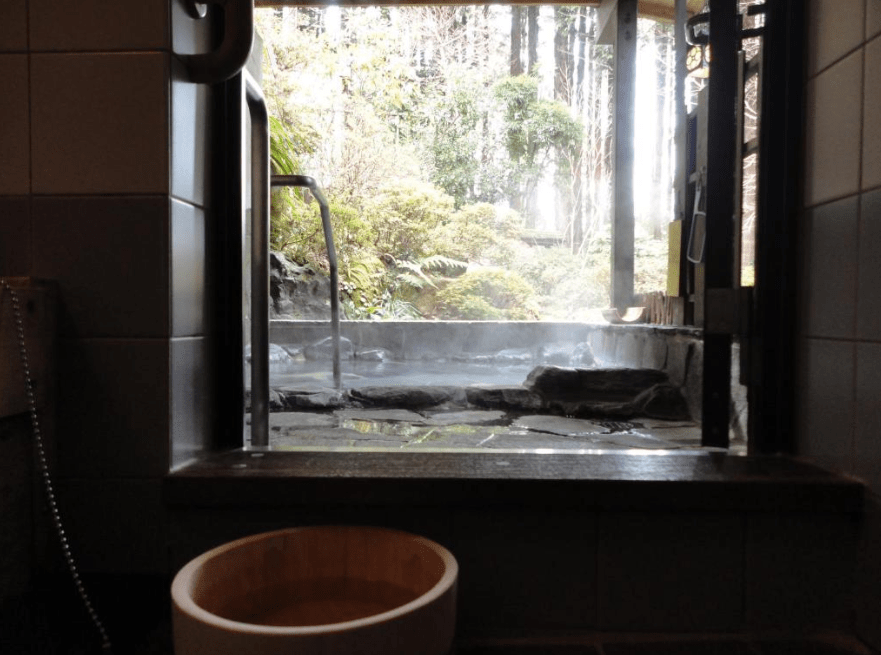
We then discover our room. It is completely in Japanese style and is exactly what we came looking for. After a quick shower, we plunge into the private outdoor bath that awaits us! It’s pleasant, especially outside, but let’s be honest, it’s very hot, and we don’t stay in there for hours either.
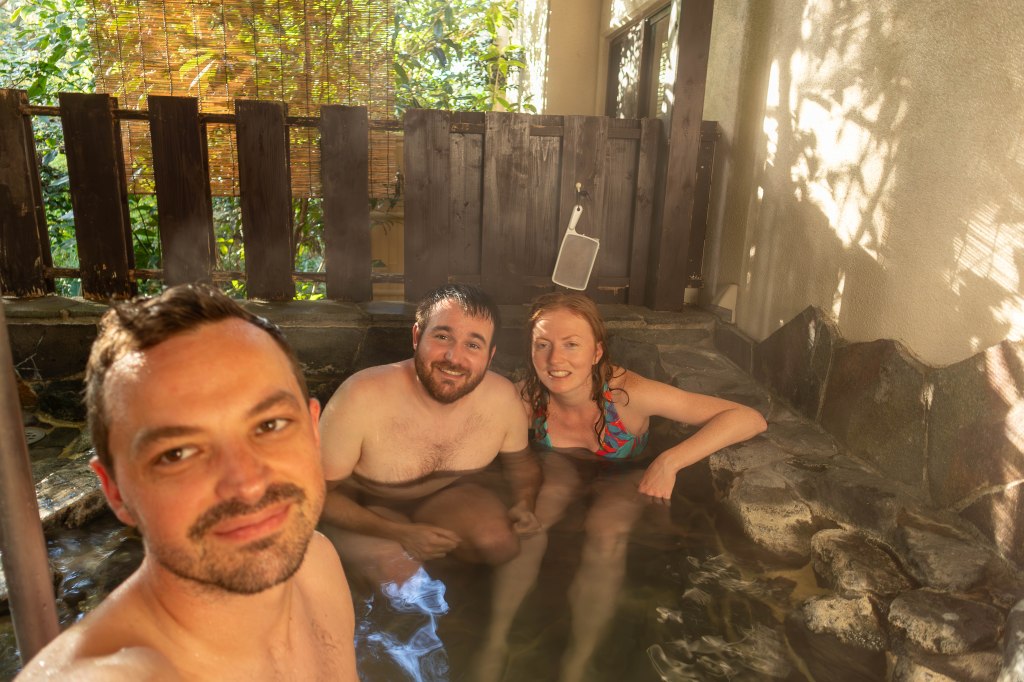
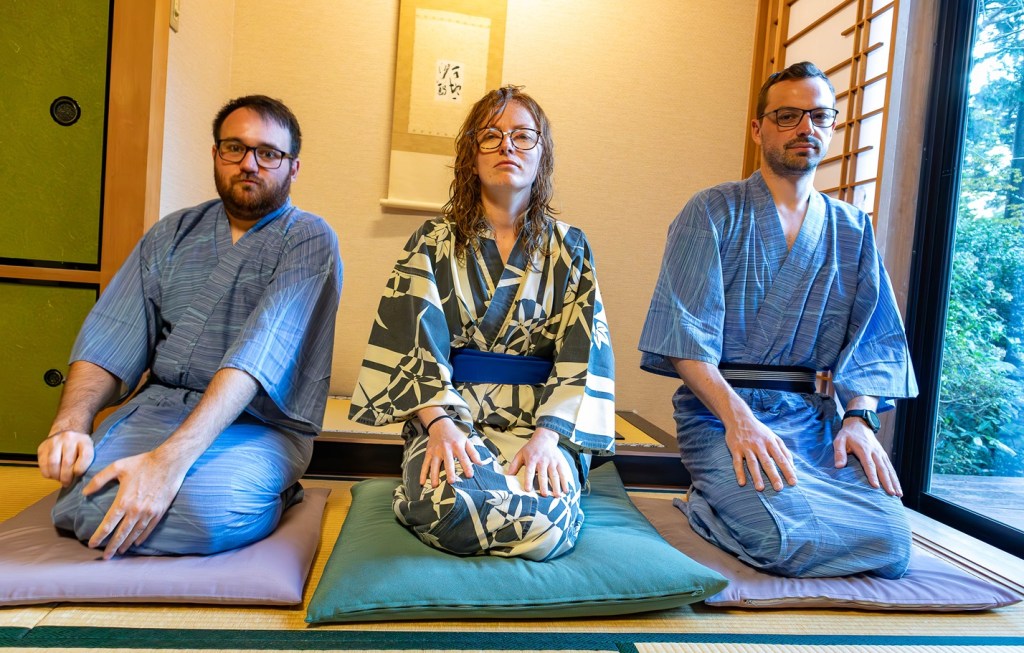
Once this little swim is finished, we put on our yukata and get ready for the meal.
A few minutes later, we hear a small hand knocking at our door. It’s Elie, beautifully dressed in a kimono, that will serve us our dinner as well as our breakfast. She is also very welcoming: always with a smile on her face, she does everything possible to meet our needs, even though her English is basic, so she doesn’t hesitate to use her phone to translate from Japanese to English. Let’s be honest: we feel tense every time she comes in… We don’t want to make a mistake, but we don’t know how we should behave. It creates a bit of discomfort, and as soon as she enters, we stop talking and sit quietly on our shins, as that seems to be the proper way. We can feel that she wouldn’t mind a bit more commotion, but out of embarrassment, we remain stoic… well, whenever we manage to. Yes, yes, we do have a little anecdote about this, be patient, it’s coming.
Our first dish is served, and we begin to taste. It is simply exquisite. We discover new products and new flavors that are very harmonious and in line with umami. As expected, the ingredients are fresh and in season, no joke! The service unfolds over 10 services, and Elie keeps going back and forth in our room. We probably spent 1.5 to 2 hours eating everything.
The chef did his best to adapt the dishes to be gluten-free. Gluten-free soy sauce was even specifically purchased for the occasion. But sometimes, elements of the dish had to be removed to accommodate the gluten-free request. To be very honest, this didn’t bother Eva because the balance of flavors and the culinary discovery were still there.
It’s probably Kévin who struggled the most to finish his dishes. Between the rice and the fish, two foods he doesn’t like, he was served. He still managed to recognize the quality and freshness of the ingredients that were offered to us.
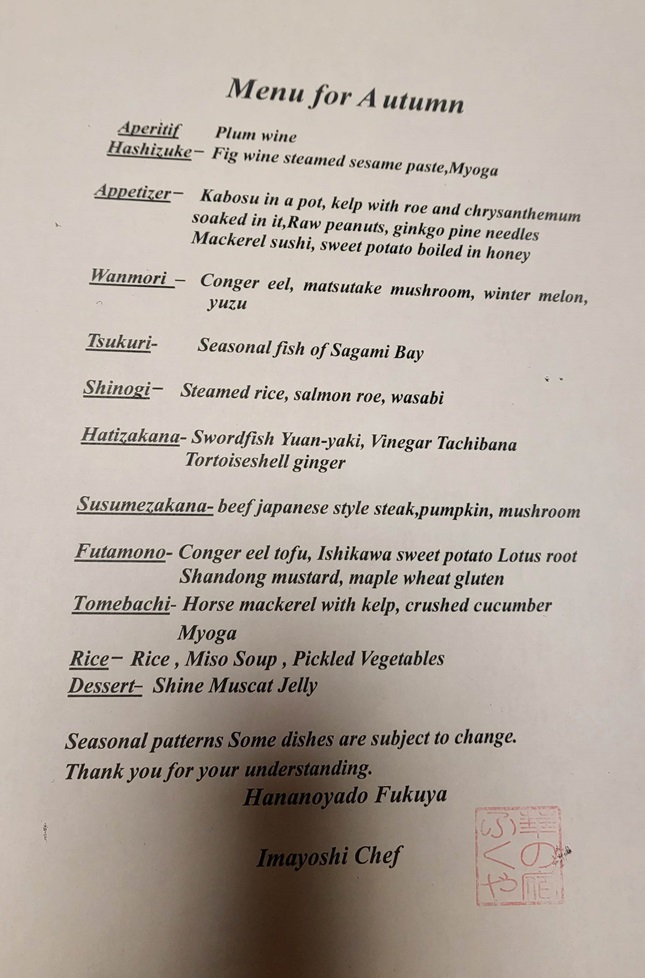
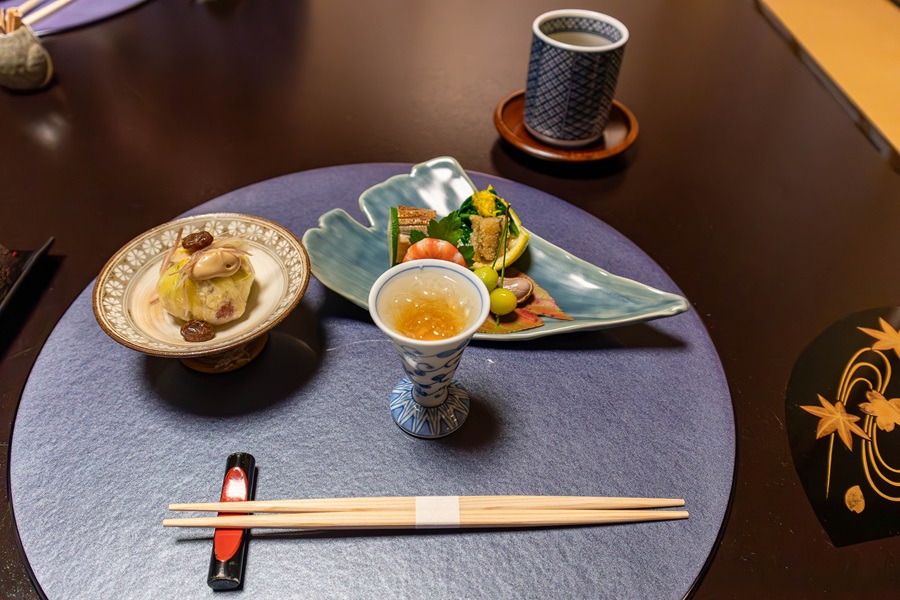
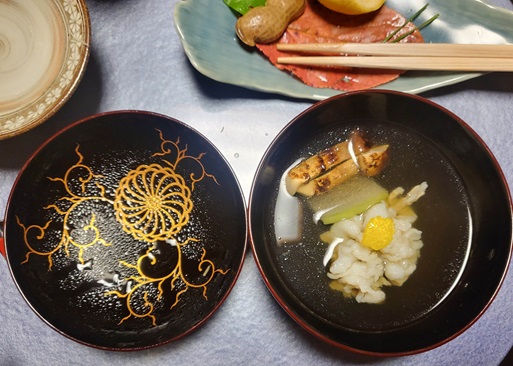
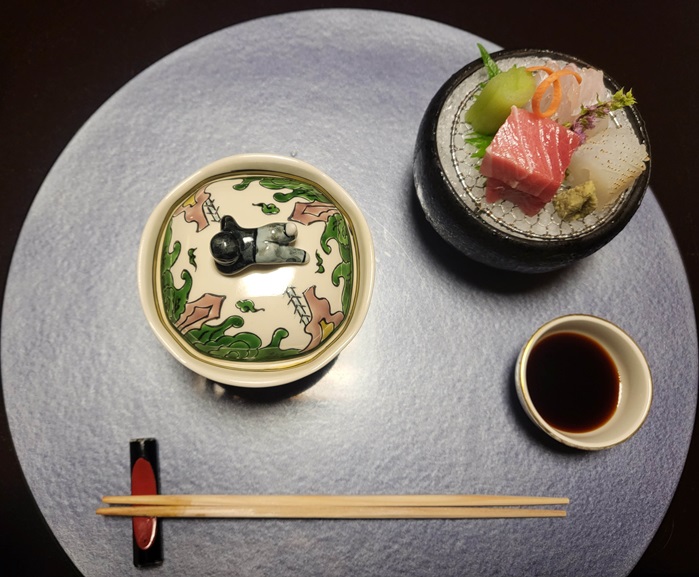
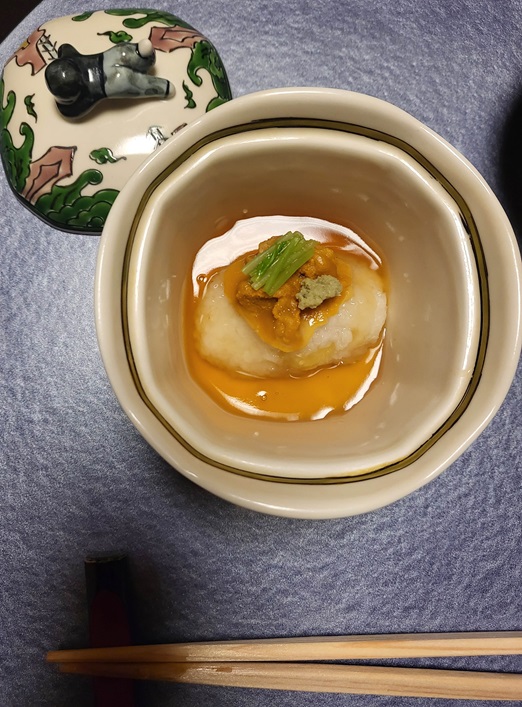
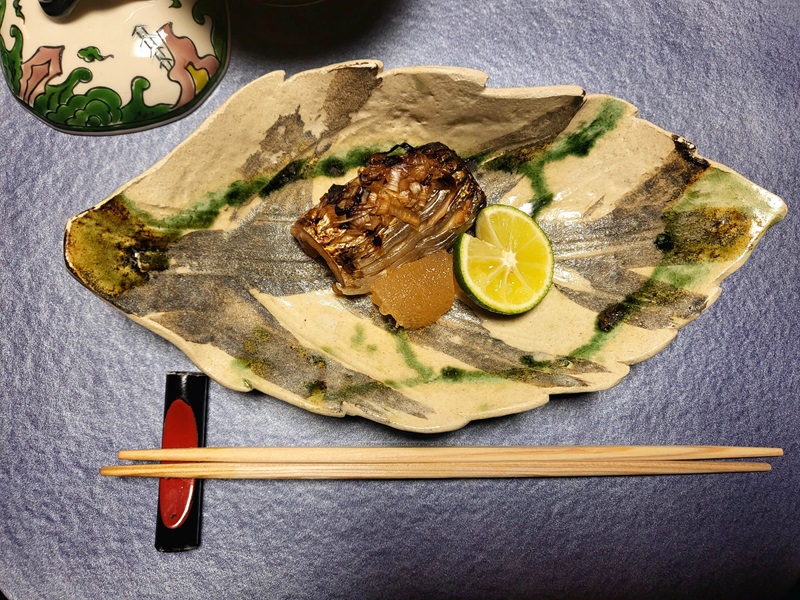
We are going to bed feeling completely full. The futons are arranged in the same room, but that doesn’t bother us. It mainly allows us to test real Japanese futons for the first time, and honestly, we sleep quite well on them even though they are not the most suitable for tall people.
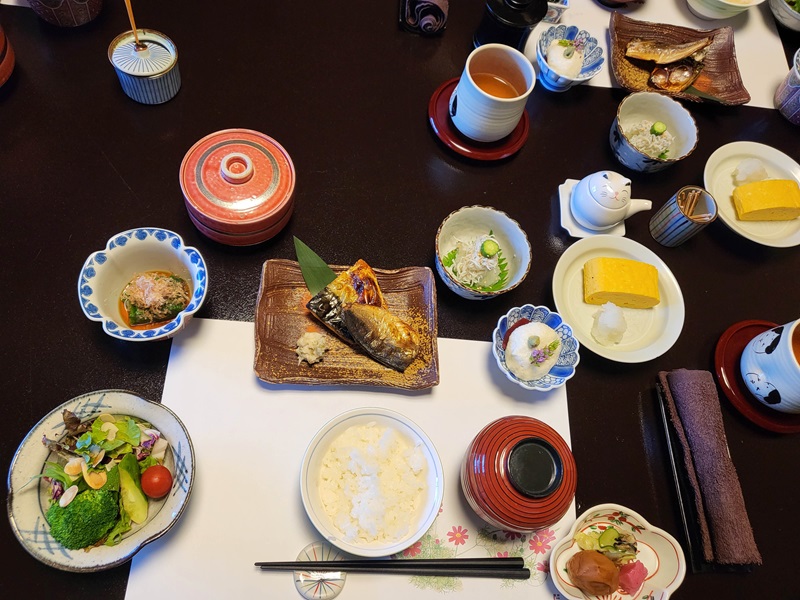
The next morning, Kévin wakes up with beads of sweat on his forehead. Breakfast should arrive in a few minutes, and he dreads another episode of rice and fish. We try to reassure him as best aswe can, but it’s no use: rice and fish are back in the menu. This time, the small array of dishes that make up our breakfast is all brought out at once. When Kévin realizes what awaits him, he looks at us totally depressed. We can’t help but erupt into nervous laughter with Nicolas while Elie is still there. We are embarrassed, but we can’t contain ourselves… Elie wonders why we are laughing, and luckily for us, she dares to ask us; most Japanese people probably wouldn’t have. We explain, but she doesn’t seem really convinced: she must be thinking it’s not credible. Who would dare to come to a ryokan for a meal without liking rice or fish, especially without specifying it? We wonder the same… Nevertheless, this little anecdote ruined all our efforts from the day before to try to adopt the best attitude possible. Despite all our efforts, we remain deeply European and are not used to controlling all our emotions.
The service continues, and breakfast comes with a drink: tea or coffee.
We start eating. The taste is still there, but our stomachs are still quite full from the previous day: we have a bit more difficulty swallowing our dishes. Also, we are not used to eating fish in the morning, and we enjoy the experience less than the evening before, even though it must be just as good. Nicolas, who had helped Kévin finish his meal the night before, is no longer really in a position to assist him. The rice is reluctantly eaten, but the fish is partly consumed. He gives his all to finish his plates to not be disrespectful to the chef. He comes out of the meal relieved that it’s the last one!
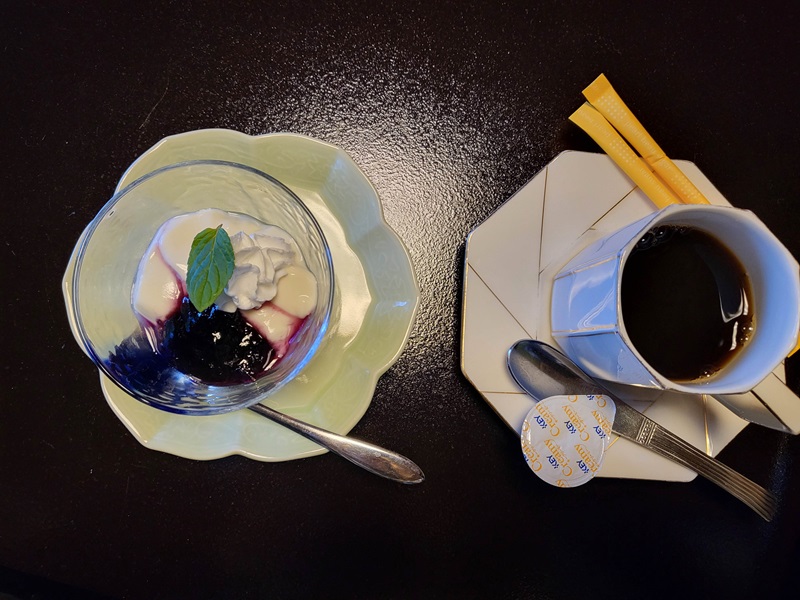
It’s not yet check-out time, and we would like to take a little walk in Hakone, around the lake and in the heights, hoping to catch a glimpse of Mount Fuji. It will be a bit tight to return before check-out time, so we ask if we can leave our bags. They confirm that there is no problem, and we set off for a light stroll.
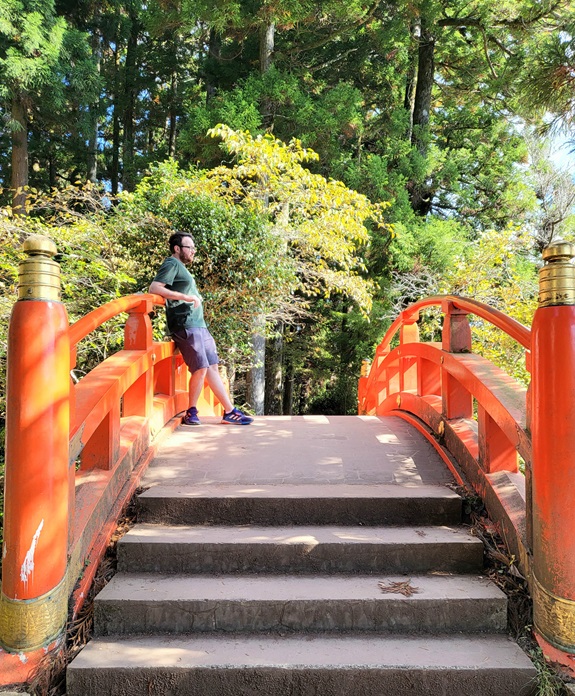
We first continue to climb a hundred meters above the ryokan. This place usually offers a viewpoint of Mount Fuji, and we are lucky: Mount Fuji is almost completely covered in clouds, but its summit remains visible, and we can see the snow that has already returned there.
We then descend to the level of Lake Ashi, hoping to take the photo that everyone wants to capture at the torii, but the queue is monstrous. There’s at least a 30-40 minutes wait, and we prefer to pass on that. We return to the ryokan to pick up our bags. We ask Elie if we can take a photo with her and her beautiful kimono. She happily agrees.

In a nutshell
Our opinion
It’s truly a unique experience in the country that we enjoyed undertaking, but we probably wouldn’t do it a second time as this first experience met all our expectations.
The welcome is true to the reputation of the Japanese, and you will be treated like royalty. It can even be a bit disconcerting at times, but it provides a very good insight into tatemae.
Kaiseki cuisine is, in my opinion, an experience worth having even if it is expensive. You do not necessarily have to go through a ryokan for this type of experience, but restaurants offering this experience will also be pricey.
The baths were enjoyable, but ultimately we didn’t spend much time there. For those who have been to hot springs in the mountains, the experience is quite similar, minus the smell of sulfur. It’s so hot that you don’t stay in for too long, but in winter, the experience must be different.
Practical side
What is the name of the ryokan we tested?
The ryokan is called Hananoyado Fukuya in Hakone. It is very well located by Lake Ashi and for viewing Mount Fuji. What attracted us was its private outdoor bath as well as the excellent ratings given by previous travelers.
Below, you will find the Google Maps link: https://maps.app.goo.gl/3QuGDXVc9jgKFe8n8
How does it work for gluten-free meals?
We notified them at the time of booking. Although we had already specified what this entailed, they asked us for clarifications which reassured us from the start and confirmed their seriousness. We sent them an email a few days before our arrival. When we arrived, we were a bit worried that the message hadn’t been properly passed along, but it was just due to a communication issue. At each service, they specified that certain dishes had been specially prepared for Eva using gluten-free soy sauce or removing certain ingredients. This was never done at the expense of flavor.
According to feedback from other travelers, they can also accommodate vegetarian diets.
What is the price?
We went there at the end of October 2023 and it cost us €275/night/person. We made the reservation several months in advance. Knowing that an « authentic » kaiseki meal costs around €100, this totally explains the cost of such a night. After that, it’s worth considering and it adds to the price of the plane ticket, which is not negligible. And of course, it depends on what you want to do.
We made the reservation via booking: booking link.
How to get there?
This will largely depend on where you are coming from, of course.
We were coming from Takayama, and it took us about 5 hours, with the train tickets covered by the JR pass we had.
We only had to pay for the bus ticket from Odawara station to Hakone. This is the Hakonetozan line, and it cost us about 890¥, which is approximately $5.50.
Our other articles about Japan

COMMENTAIRES
 Le goût du monde sans gluten
Laisser un commentaire